



Investor Profile: Discover your investor type and strategy


At a glance:
• Determining the investor profile is mandatory when providing investment advisory and portfolio management services, in accordance with the MiFID II Directive (Markets in Financial Instruments Directive II).
• The risk profile is determined by a combination of financial capacity, time horizon, and psychological tolerance to volatility.
• There are three main categories: conservative, moderate, and dynamic, each with distinct allocation strategies.
• Completing the questionnaire ensures that the Bank’s recommendations are aligned with your real objectives.
Everyone has different investment objectives, whether it’s enjoying a more secure retirement or protecting wealth for the next generation. Knowing your investor profile, including your risk tolerance and capital growth goals, is essential for making informed financial decisions.
Discover your investor profile, your risk profile, and which products are most suitable for your financial situation and goals.
What are the different types of investor profile?
The term investor type refers to the different profiles or categories that investors may fall into, according to their risk tolerance, past experience, financial goals, and life stage. Understanding your investor type helps make investment decisions more strategic and better aligned with your needs and preferences.
More than a simple categorisation, the investor type identifies individual goals and the motivations behind financial choices. It opens a new path to building more resilient portfolios.
Why is it important to know your investor profile?
Understanding and applying investor typology allows you to manage your financial wealth in a more conscious and strategic way. Knowing your investor profile enables you to create personalised investment strategies adapted to your risk profile and objectives, which will differ from investor to investor.
Investor typology acts as a guide for decision-making by allowing the choice of assets to be adjusted according to each person’s circumstances. It also helps to avoid impulsive and emotional decisions and provides an objective framework for investment choices. This way, investors can manage their portfolios in a more balanced and conscious manner.
The Importance in the Regulatory Framework
Knowing your investor profile goes beyond mere strategic curiosity. According to the guidelines of the CMVM and Banco de Portugal, financial institutions have a duty to ensure that financial products are suitable for the client.
This process, governed by the European MiFID II standard, requires the application of an investor profile questionnaire. This document assesses not only your investment objectives, but also your knowledge and previous experience, ensuring that the risk of the proposed assets never exceeds your capacity to absorb losses.
What types of investor profiles exist?
These typologies are illustrative and may vary according to the classification methodology adopted by each financial institution. At Banco Carregosa, we follow three investor typologies:
1. Conservative Profile: Preservation and Security
The conservative investor prioritises capital protection above all other objectives. Their tolerance for volatility is minimal and their time horizon tends to be short to medium term. This profile prefers the predictability of cash flows to the uncertainty of rapid gains.
Strategy: The focus is on liquidity management and mitigating the risk of nominal loss. Although fixed-term deposits are the classic instrument, guaranteeing nominal capital up to the limits of the Deposit Guarantee Fund, we always highlight the risk of erosion of purchasing power in the face of inflation rates higher than the net return.
Key points:
• Objective: Stable income with zero or residual volatility.
• Approach: Delegation of management to ensure institutional security and technical rigour.
• Benchmark assets: Fixed-term deposits, short-term government bonds and money market funds.
Recommended reading
Read the article "How to Choose the Best Fixed-Term Deposits in 2026" and find out how fixed-term deposits work in Portugal, compare the latest TANB rates and discover which deposit is best for your profile.
2. Moderate Profile: Balance Between Risk and Growth
The moderate investor seeks a balance between capital preservation and capital growth. They accept some volatility in the short term in exchange for returns that consistently outperform inflation. Their investment horizon is typically medium term (3 to 5 years).
Strategy: Through a diversified allocation, this profile combines fixed income assets with instruments that capture the equity market risk premium. In certain contexts, and after a suitability assessment, solutions such as Notes and Structured Deposits become particularly attractive, as they allow exposure to equity or commodity indices, often with partial or full capital protection.
Key points:
• Objective: Gradual capital appreciation with controlled risk.
• Approach: Co-management or specialist guidance to optimise the risk-return ratio.
• Benchmark assets: Corporate bonds, Structured Notes and Mixed Funds.
3. Dynamic Profile: Focus on Maximising Returns
This profile is characterised by a high capacity to absorb risk and a long-term investment horizon. The dynamic investor understands that volatility is the price to pay for superior compound returns. They are generally an informed investor who follows macroeconomic and technological cycles.
Strategy: The allocation is predominantly focused on Equity (Shares) and assets with strong growth potential. Whether the client prefers the autonomy of direct trading on our platforms or opts for Discretionary Portfolio Management, the goal is to capture high-impact market movements. Here, price fluctuations are seen as rebalancing opportunities and not as sources of financial stress.
Key points:
• Objective: Long-term capital growth.
• Approach: Autonomy in decisions or delegation in active management mandates focused on shares.
• Benchmark assets: Shares (Developed and Emerging Markets), Sectoral ETFs and Private Equity.
Recommended reading
Read the article "Private Equity: What it is and why it is important" and discover what this concept is, how it works and why it is relevant to investment strategy.
Comparison between the three investor profiles
Below is a detailed comparative analysis of the characteristics and typical allocations for each profile.
| Profile | Main Objective | Risk Tolerance | Time Horizon | Predominant Assets | Expected Return |
|---|---|---|---|---|---|
| Conservative | Capital Preservation | Low (avoids fluctuations) | Short term (< 2 years) | Deposits, Government Bonds, Short-term Funds | Low (focused on beating inflation) |
| Moderate | Balanced Growth | Medium (accepts controlled volatility) | Medium term (3 to 5 years) | Mix of Bonds, Blue Chip Shares, Property | Moderate (above market average) |
| Dynamic | Maximising Returns | High (long-term focus) | Long term (> 5 years) | Shares, Derivatives, Emerging Markets, Private Equity | High (search for alpha) |
Case Study: The Evolution of a Real Portfolio
To illustrate the importance of typology, consider the hypothetical case of "Investor A":
Scenario: A 45-year-old investor with €200,000 in capital.
1. Initially, he identified himself as Dynamic, allocating 80% to technology shares.
2. Faced with a 15% market correction, anxiety led him to try to sell at the "bottom".
3. Bank Intervention: After a new assessment and reapplication of his investor profile questionnaire, it was realised that although he had the financial capacity for the risk, his psychological tolerance was that of a Moderate profile.
4. Result: The portfolio was rebalanced to 50% shares and 50% fixed-income assets. The investor remained faithful to the strategy during the next cycle, achieving more consistent and less stressful potential returns.
How do I know my investor type?
Determining your investor profile is not an intuitive process. It requires rigorous analysis of financial and behavioural metrics. In the European Union, this process is formalised by DMIF II (Markets in Financial Instruments Directive II – MiFID II), through a mandatory questionnaire applied by banks and financial intermediaries.
However, the correct definition of the profile should not depend solely on the bank. It is a structured process that combines self-analysis, institutional assessment and continuous review over time.
1. Investor Self-Assessment
The first step consists of an honest personal analysis of some fundamental dimensions:
Financial Knowledge
Primarily, the level of financial literacy should be assessed, as this determines the ability to understand the available products and the associated risks. An investor who does not know or understand financial instruments should adopt a more cautious stance, classifying themselves, initially, as a conservative investor, avoiding exposure to overly risky and complex products. We can distinguish three levels:
• Basic: Limited knowledge of deposits and capital-guaranteed products. Investors at this level may not fully understand the risks associated with more complex instruments and should therefore adopt a conservative approach;
• Intermediate: Familiarity with investment funds, ETFs and shares, understanding concepts such as diversification and volatility;
• Advanced: Experience with derivatives and other complex financial instruments, including understanding risks such as leverage and potential capital loss.
The second step in self-assessment is to distinguish two concepts that are often confused:
Risk Capacity
This refers to your objective financial situation (assets, income and liquidity) and the real capacity of your financial resources to absorb a loss without compromising your standard of living.
Income, savings, assets and emergency fund are assessed. For example:
• Less than 3 months of reserves - more conservative profile;
• 3 to 6 months - moderate profile;
• More than 6 months - greater risk tolerance, dynamic profile.
Note: A larger financial reserve may increase the capacity to absorb risk, but it does not determine the investor profile on its own.
Risk Tolerance
This is the psychological component. How do you react emotionally to a 20% market drop? If your priority is absolute stability, your profile will tend towards the Conservative. If you are looking for long-term compound growth and accept volatility as part of the process, you fit into a Dynamic profile.
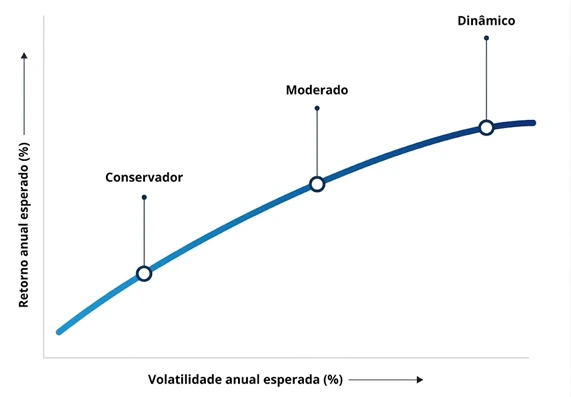
Strategic Asset Allocation: The Influence of Time Horizon on Risk
The longer the investment period, the greater the portfolio’s resilience to equity market volatility.
Source: Banco Carregosa
Time Horizon and Life Cycle Analysis
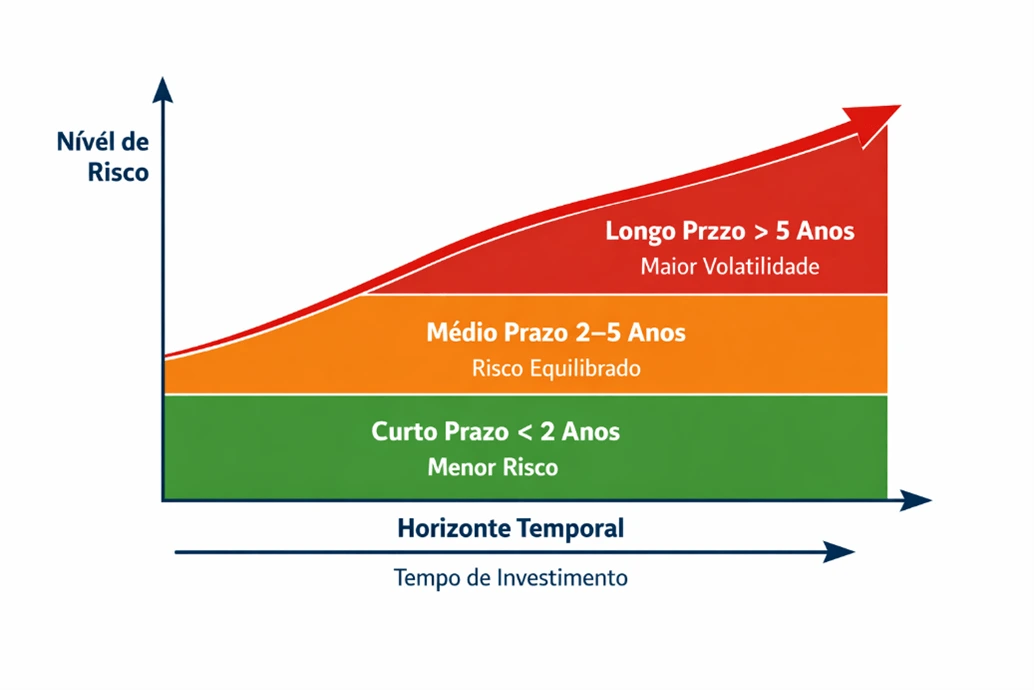
Time is the factor that most influences the risk you can take. An investor with a 20-year horizon can afford exposure to more volatile assets, as they have time to recover from downturns. On the other hand, if the goal is to buy a property in two years, capital preservation becomes imperative. According to financial planning guidelines, your profile should be adjusted as you approach your goals (e.g. transitioning to a more moderate profile as retirement approaches).
The time available to invest directly influences the risk assumed:
Source: Banco Carregosa
2. Completing the MiFID II Questionnaire (at the bank)
After the self-assessment of the investment profile, you should complete the MiFID II Questionnaire with your bank or financial intermediary. It is important to avoid common mistakes, such as filling out the questionnaire only to gain access to certain products or, conversely, omitting answers out of fear of risk exposure. The questionnaire should be completed honestly and rigorously, as this is the only way for the institution to truly understand your profile and present solutions appropriate to your objectives. Failing to complete it or doing so incorrectly may leave you unprotected and limit access to appropriate recommendations.
At Banco Carregosa, there is a team of specialists ready to help you complete the questionnaire and clearly identify your investor profile, as well as the financial products most suitable for your profile.
The second step is therefore formal and mandatory. Banks apply the MiFID II Questionnaire, which assesses:
• Financial and professional situation;
• Investment objectives;
• Experience and knowledge in financial markets;
• Risk tolerance through loss scenarios;
• Preferences for ESG Investment.
Based on the answers, the institution classifies the investor and determines which products are suitable for their profile.
3. Comparison between the two results
After self-assessment and completion of the bank’s questionnaire, a comparison should be made between the two results:
• If the profiles match, there is alignment and consistency;
• If there is a discrepancy, the more conservative profile should prevail;
• Significant differences may indicate excessive optimism or unrealistic perceptions of risk.
This step is essential to avoid investment decisions that are misaligned with your true capacity and risk tolerance.
4. Monitoring and Review of the Investor Profile
A point that is often ignored is that the investor profile is not static over time. It evolves with:
• Changes in financial situation;
• Changes in personal objectives;
• Accumulated experience in investments;
• Market cycles and economic context.
Therefore, there should be periodic review of the profile, ideally annually or whenever there are relevant changes in the investor’s financial life.
The Value of Professional Guidance
Subjectivity and emotional burden are often the biggest challenges in defining an investment strategy. The specialist support of a Private Banker from Banco Carregosa offers a technical and external view, essential to ensure consistency between your perception of risk and your real capacity for loss.
Through advanced simulation tools and scenario analysis, the consultant helps to:
• Validate the Self-Assessment: Ensure that your profile reflects the objective financial reality and not just a moment of market optimism or pessimism;
• Holistic Optimisation: Integrate your risk profile into a strategy that considers not only profitability, but also tax efficiency and succession planning;
• Evolution Management: Support the periodic review of the profile (point 4), adjusting asset allocation as your life goals change.
Partnering with a Private Banker transforms the investor profile from a mere regulatory form (MiFID II) into a dynamic strategic tool for the preservation and growth of your wealth.
Recommended reading
Read the article "What does a Private Banker do?" and discover how we can support you in strategic decisions about your wealth.
The Next Step in Your Strategy with Banco Carregosa
Knowing your investor profile is essential for the way you manage your wealth and to achieve your financial goals. Each profile brings with it unique complexities and challenges.
With Banco Carregosa’s services, you can benefit from the advice of professionals who know the market in depth and find solutions such as portfolio management and advisory services from Banco Carregosa.
Contact us and implement investment strategies designed for you.
Investor Profile: Frequently Asked Questions
Can my investor profile change over time?
Yes. The profile is not for life. Life events (marriage, retirement, inheritances) or changes in market experience may require an update of your risk profile.
What happens if I want to buy a product above my risk level?
The Bank will issue an unsuitability warning. At Banco Carregosa, we prioritise client safety, always alerting when a financial instrument does not match the registered typology.
How is the investor profile questionnaire assessed?
The assessment combines data on income, net worth, age, return objectives and the level of comfort in the face of the possibility of temporary losses.
Disclaimer: This article has been prepared by Banco Carregosa for informational and educational purposes only. It does not constitute, under any circumstances, an investment proposal, purchase recommendation or personalised financial advice. Investing in financial instruments involves risks, including the possibility of losing the invested capital. Past performance is not a guarantee of future performance. We recommend that you consult an account manager or financial advisor before making any investment decision, to ensure that it is suitable for your risk profile and financial objectives. This content does not replace the pre-contractual information or the Key Information Document for each product.