



Active ETFs: What they are, how they work and how to invest in them

Active (or actively managed) ETFs are attracting increasing interest among investors. In 2024, they reached global flows of $41 billion — up 185% year-on-year. Since 2019, this type of fund has maintained annual growth of more than 20%.
But what are active ETFs, how do they differ from traditional ETFs, and how can you tell if they make sense for your investment strategy? In this article, we explain the main benefits and how you can use them to diversify and strengthen your portfolio.
What are active ETFs?
Traditionally, ETFs (Exchange-Traded Funds) were passive management vehicles designed to replicate the performance of a market index without the active intervention of a manager. Investors invested in these products to diversify their exposure to market movements.
However, as investor needs evolved, active ETFs began to emerge. The main difference is that instead of passively tracking an index, ETF managers make strategic decisions about the composition of the fund’s portfolio. Depending on the economic or market scenario, they can adjust positions, buy or sell assets as they see fit.
This approach allows greater flexibility: the manager can, for example, focus the fund on specific sectors, select companies with high growth potential or even respond to structural changes such as an economic crisis or new regulations.
What are the benefits of active ETFs?
he main benefit of active ETFs is their flexibility. Unlike passive ETFs, which simply replicate the market, active ETFs allow for real-time adjustments, boosting gains or minimising losses depending on the context.
For example, during periods of volatility, an active ETF can reduce exposure to riskier assets or identify new opportunities. Similarly, it can back booming sectors – such as technology – to capitalise on the momentum, something a passive fund cannot do.
Another added value is the ability to explore niches and themes that would be virtually inaccessible with passive management. Managers can identify opportunities in emerging markets, specific sectors or even early-stage companies with the potential for significant upside.
Seeking to outperform is also important. While passive ETFs simply replicate the market, active ETFs seek to outperform it by making strategic moves based on analysing and anticipating trends.
Active ETFs vs ETFs passivos
Choosing between passive and active ETFs depends on your investor profile and objectives. Both have advantages, but also different challenges.
Passive ETFs
These are the best known and most traditional and follow a simple logic: they automatically replicate a market index without any human intervention.
Advantages:
• Simplicity: Their structure is easy to understand and decisions are virtually automatic as they simply replicate a market index;
• Transparency: As the fund follows a fixed index, there is greater transparency, making it easier to understand where the money is invested;
• Consistency: Because they replicate an index, they offer more consistent performance over time.
Disadvantages:
• Limited profitability: The fund’s return is linked to the performance of the replicated index, with no potential to outperform the market;
• Low flexibility: There is no ability to adapt in times of crisis or to take advantage of specific market opportunities. In other words, if the index falls, so does the ETF, with no ability to react;
• Lack of differentiation: For investors looking for something more unique or different from the market, a passive ETF may not be of much interest.
Active ETFs
The dynamic management of these ETFs can be an advantage, but it also implies a greater degree of complexity.
Advantages:
• Flexibility: The manager can make adjustments to the asset portfolio based on analysis or market trends to improve returns;
• Higher potential for returns: With active management, there is the potential to outperform the market by identifying opportunities not present in traditional indices;
• Adapting to trends: Active ETFs can quickly take advantage of market trends or economic changes;
• More precise diversification: The manager can select the assets they consider most appropriate, resulting in a more diversified and focused portfolio.
Disadvantages:
• Greater risk: Performance is closely linked to management decisions. This is why it is crucial to have the support of specialised and experienced professionals such as the team at Banco Carregosa;
• More difficult to monitor: Dynamic management can make the process more difficult for the inexperienced investor to monitor and understand.
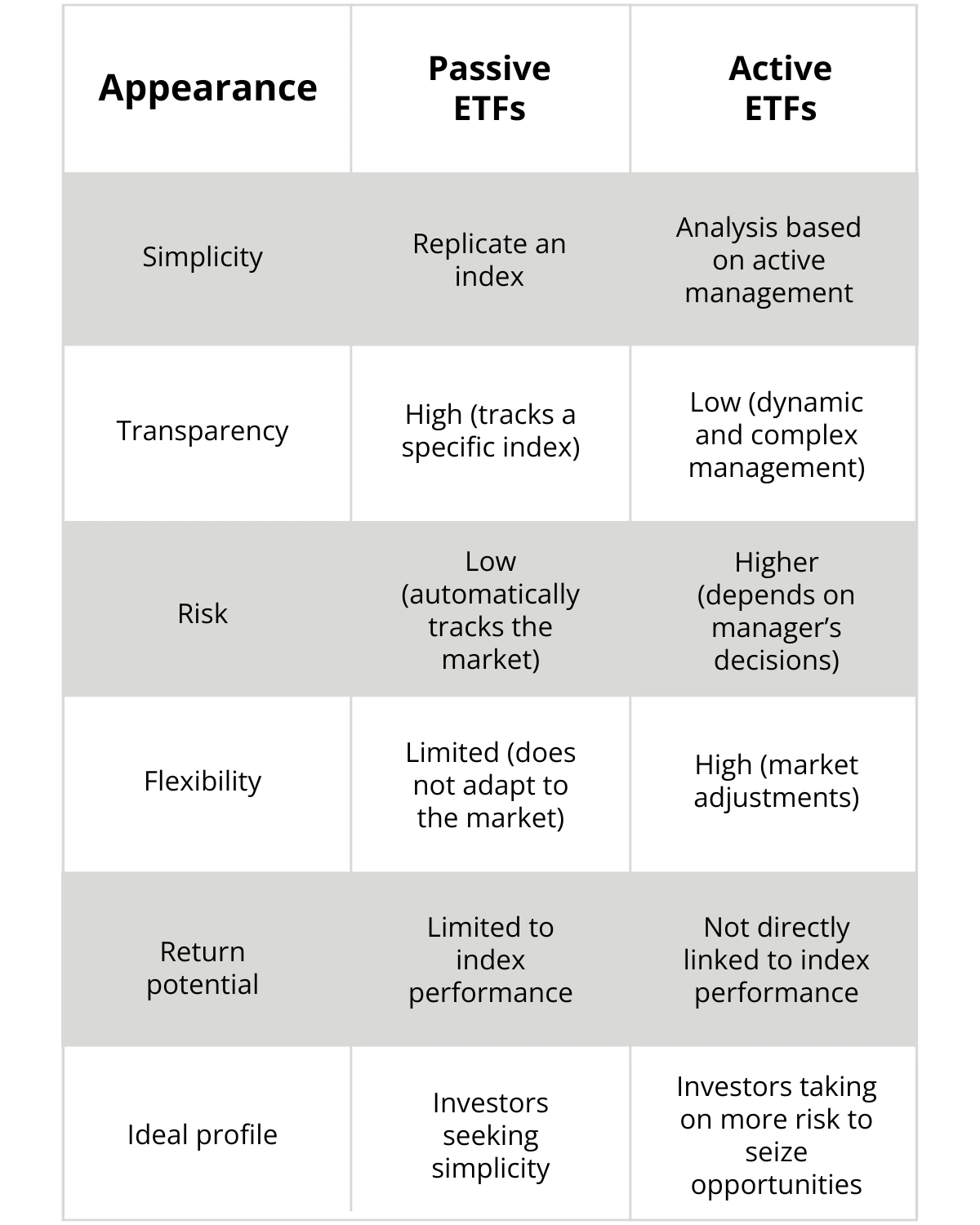
Active ETFs, on the other hand, can be an option for those who want something more complex, with the potential for above-average returns, but are aware that this comes with greater risk. The table below helps to categorise the differences:
Cautions on investing in active ETFs
Despite their potential, active ETFs may require more attention from investors. Here are the key points to consider:
1. Assess the quality of management
The quality of active management is crucial, as success depends on the ability of managers to identify good opportunities and respond to market changes. Therefore, research the management team and their strategy before making an investment. Banco Carregosa, with its vast experience, is an excellent option to guide you through this process and help you select funds from managers with a solid track record.
2. Check transparency
Transparency may not be as evident in active ETFs, as managers make decisions based on internal analysis that may not be as directly correlated to the benchmark index. This can make it difficult to assess the risk and performance of the fund, particularly for investors who prefer to know more about how they invest. The Banco Carregosa team offers transparent management and constant monitoring, so that investors can feel more confident in their choices.
3. Monitor regularly
Active management calls for more frequent monitoring. Managers can change the composition of the fund as market conditions change, so you need to be aware of changes in the portfolio and check that the strategy is still in line with your objectives.
4. Look out for diversification
The diversification of active ETFs can be more personalised as managers can select specific assets according to their analysis and forecasts. However, care must be taken to avoid excessive concentration in certain assets, which can increase risk.
Banco Carregosa: the right choice if you want to invest in active ETFs
Whether you’re ready to take the next step in your investments or feel you need specialised advice, the Banco Carregosa team is here to help you explore the world of active ETFs so that your choices are in line with your objectives and risk profile.
Contact us today to find out how we can help you build a portfolio of ETFs that meets your needs and expectations.