



What is Equity Value, and why is it important?


At a glance
• Equity Value represents the value attributed to a company's equity;
• It is a key metric for company valuation, facilitating the analysis of investments, the comparison of companies, and the informed decision-making process relating to mergers and acquisitions;
• For a complete and well-founded assessment, it should be analysed in conjunction with other financial metrics, such as enterprise value and cash flows.
How much is a company worth? Is it the amount reflected on the balance sheet or the "price” that the market is willing to pay? These questions lie at the heart of the concept of Equity Value, one of the most widely used indicators in financial analysis and company valuation. Find out what it consists of, how to calculate and interpret it, and how you can use it to inform your next investment decision.
What is Equity Value?
Put simply, equity value is the value attributed to a company’s equity, rather than just its book value. In theory, it represents what belongs to the shareholders once all their debts have been paid off.
In practice, it provides an answer to the question of how much your stake in the company is worth to its shareholders. This value reflects market expectations regarding the company’s ability to generate future results, taking into account the company’s assets, financial structure, and the associated business risks.
For example, consider a listed company with 10 million shares in circulation, each priced at €5. In this case, the company’s equity value is €50 million, which is the total amount that investors are willing to pay for its equity at that time. This value may differ from the recorded equity on the balance sheet because it incorporates future expectations, not just past accounting data.
Market value of the world’s most valuable companies
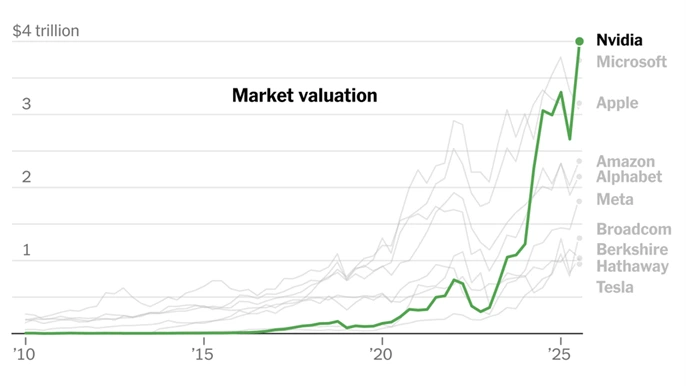
Source: Nvidia
For companies listed on stock exchanges, this value can be seen directly in the market, since the share price shows how investors value the company’s equity at a given time. For non-listed companies, equity value is determined by financial evaluation methods. However, the concept remains the same: measuring the value attributed to equity rather than the book value recorded on the balance sheet.
How is Equity Value calculated?
Although the calculation of Equity Value can vary depending on the context, the basic formula is relatively simple:
Equity Value = Enterprise value – Net debt
In this formula, Enterprise value (EV) represents the total value of a company, including both its equity and its debt. Net debt is the total financial debt of a company minus cash and cash equivalents.
For listed companies, Equity Value can be calculated directly via the market:
Equity Value = Number of shares × Price per share
This figure shows how much the market currently values the company’s equity.
Why measure Equity Value
Equity Value is a key metric in financial analysis, directly influencing how investors evaluate companies and investment opportunities.
It evaluates the true value for shareholders
Equity Value shows how much of a company’s total value belongs to its shareholders once all financial obligations have been taken into account. This indicator is therefore essential for investors.
It compares companies at different levels of debt
Two companies may operate in the same sector but have very different financing structures. Equity Value enables companies in the same sector to be compared, highlighting the impact of debt on the value remaining for investors.
It forms the basis of financial ratios
Many of the ratios used by investors, such as price-to-earnings (P/E) and price-to-book (P/B), are based on Equity Value. To ensure a consistent interpretation of these indicators, it is essential to understand their true meaning.
Limitations of Equity Value
Although Equity Value is a widely used metric in financial analysis, it has some limitations that should be considered when interpreting its results.
For example, the Equity Value of listed companies is influenced by variations in share price and earnings projections, which may be the result of cyclical factors, investor expectations or market movements that are not necessarily linked to business fundamentals.
Equity Value, on the other hand, indicates the value of equity, but does not assess the associated risks of the company or investment. To achieve a balanced analysis, it should be supplemented with indicators that consider volatility, indebtedness, and the stability of results.
If analysed in isolation, Equity Value can lead to incomplete conclusions. Its interpretation becomes more consistent when it is considered alongside other financial indicators, such as enterprise value, profitability and cash flows.
Other relevant indicators besides Equity Value in investment analysis
Equity Value is an important component of a broader financial analysis. When analysed alongside other indicators, it offers a fuller and more balanced picture of an investment's value and potential.
Enterprise Value
It represents the total value of the business, taking into account equity, financial debt and minority interests, while excluding available cash. This indicator is particularly useful for comparing companies with different financing structures, as it shows the cost of acquiring the entire company.
Operating cash flow
This corresponds to the amount of money that the company generates through its activities, once all receipts and payments have been taken into account. More than accounting profit, cash flow indicates a company’s actual ability to finance operations, invest in growth, repay debt and distribute income to investors.
Profitability
It measures the return that an investment can generate relative to the amount of capital invested. This indicator enables you to assess whether the potential gain outweighs the investment made, and to compare different opportunities by taking into account the required capital and time horizon.
Risk
This is linked to the uncertainty surrounding future results. It reflects the possibility that expected cash flows or profitability may not materialise due to factors such as market conditions, competition, debt, or the wider economic context. The greater the risk, the higher the return demanded by investors.
Equity Value: Invest with the support of Banco Carregosa
Understanding Equity Value is a fundamental step towards evaluating companies and making more informed investment decisions. However, this metric’s true meaning is only revealed when it is integrated into a structured financial analysis tailored to your objectives.
At Banco Carregosa, we help investors to read and interpret indicators such as Equity Value. We then incorporate these into a robust investment strategy that aligns with their risk profile. Talk to us to find out how to turn financial analysis into solid, sustainable investment choices.
Equity Value: Frequently Asked Questions
Below are the answers to the most frequently asked questions about Equity Value.
1. What does Equity Value mean?
The term "Equity Value” refers to the value assigned to a company’s equity.
2. Is Equity Value the same as market capitalisation?
For listed companies, Equity Value corresponds to market capitalisation. In non-listed companies, however, Equity Value is determined using financial valuation models.
3. What is the difference between Equity Value and Book Value?
Book Value is based on balance sheet data, whereas Equity Value reflects an economic assessment that takes into account future expectations and market conditions.
4. Why do companies with high levels of debt have lower Equity Values?
This is because debt reduces shareholder value and increases risk, thereby reducing the company’s market appeal. Even if a business is financially stable, the higher the net debt, the lower the equity value tends to be.
5. Is equity value the only factor that should influence your decision to invest in a company?
No. Although Equity Value is an important indicator, it must be analysed alongside other factors, such as profitability, risk, the sector in which the company operates, and the macroeconomic context.