



Investing for Beginners: 12 tips you need to know before you start investing


You don't need to be a financial expert to start making your money grow. By following the right advice, anyone can make an informed start, avoid common mistakes and build a more secure financial future.
In this article, we'll explain how the world of investments works in simple terms, free from jargon, complicated formulas and "get rich quick” promises. It’s just the basics, but they’ll give you the confidence you need to get started.
1. Understand your current financial situation
Before investing, take a look at your finances. Consider how much you earn, how much you spend, and how much you save each month. You can use either financial management apps (linkar artigo) or a simple spreadsheet. The important thing is to establish whether you have the financial capacity to invest. If not, the first step is to create it.
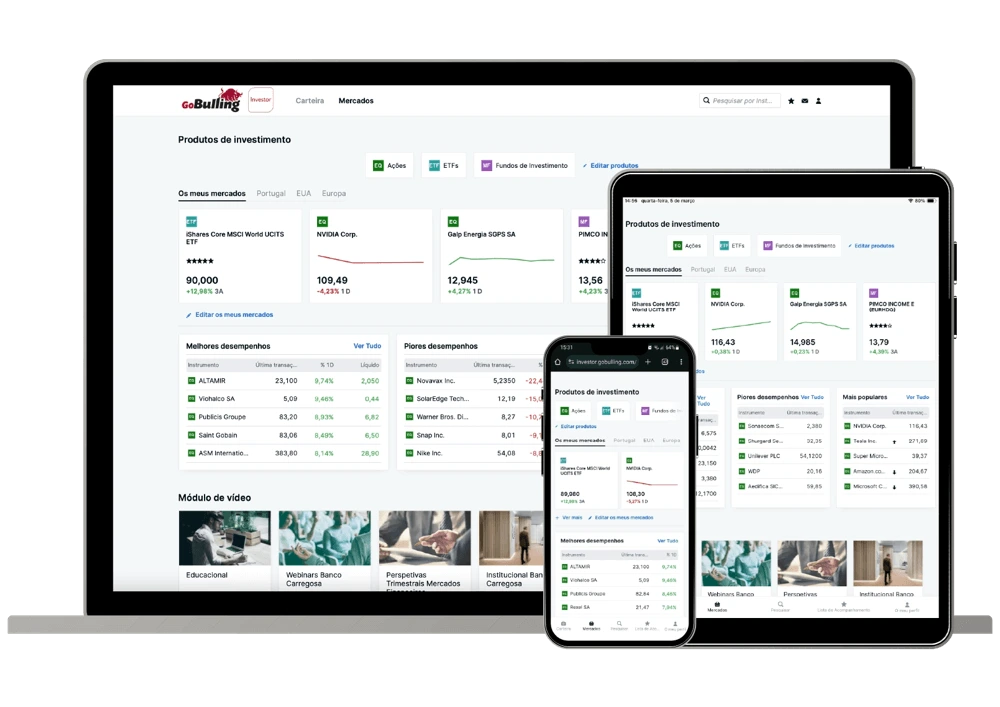
The GoBulling Investor platform was developed for individuals seeking an intuitive and reliable investment experience. Executing transactions is easy and movements are well organised.
2. Set up an emergency fund
This is your "financial cushion”. Ideally, you should save up enough money to cover three to six months’ worth of expenses in an accessible, risk-free account. This means that, if unforeseen circumstances arise, you won’t need to touch your investments.
3. Pay off your debts first
Before you start investing, make sure you don’t have any high-interest debts, such as credit cards or personal loans. Consider shedding this "weight” before you start investing.
4. Define your (realistic) objectives
What would you like to invest in? Buy a house? Or achieve financial freedom? Your objective will determine the most suitable timeframe and type of investment for you.
• Short-term objectives: require liquidity and low risk, such as term deposits or savings certificates;
• Long-term objectives: allow for a little more risk, and therefore the potential for higher returns.
5. Start small, but often
Don’t wait until you’ve saved up a large sum of money before you start. It’s more important to make it a habit than to worry about the amount you save. Set aside a monthly amount, however small, and arrange for it to be invested automatically. You’ll see the results over time.
6. Keep an eye on inflation
Making money from an investment isn’t just about seeing the numbers go up. If the return on your investment is lower than the inflation rate, the value of your money is actually decreasing.
For example, if you receive an annual return of 2%, but inflation is at 2.6%, you’re losing purchasing power.
Therefore, when planning your investments, always bear in mind the goal of outperforming inflation. Inflation-linked funds are also an option worth considering.
7. Learn the basics
You should know what some of the terms in the investment world mean. Fortunately, there are plenty of simple resources, such as books, podcasts, videos, webinars and blogs that explain everything in an accessible way.
Here are some of the terms you’ll come across most often:
• Share: a small portion of a company. When you buy shares, you become "part-owner” of that company;
• ETF (Exchange Traded Funds): a fund that tracks an index, such as the S&P 500, and comprises several shares. It is traded on the stock exchange in the same way as a share;
• Bonds: debt securities issued by companies or governments. These tend to be lower risk and pay periodic interest;
• Return: the amount earned on an investment, expressed as an annual percentage;
• Volatility: this indicates how unstable the value of an asset is. The greater the volatility, the greater the risk (and potential return);
• Liquidity: it assesses how easy it is to convert an asset into cash;
• Inflation: it represents generalised price increases. An investment is only "profitable” if it outperforms inflation;
• Term: how long you intend to keep the investment: short-, medium- or long-term;
• Compound interest: "interest on interest”. Over time, this accelerates the growth of your capital.
8. Start by choosing the type of investment
Here are some of the most popular options among beginner investors:
• ETFs: they're cheap, diversified and easy to manage. They’re ideal for the long term;
• Investment funds: managed by professionals and involves different levels of risk;
• Shares: buying portions of companies. This requires more knowledge, but also has a higher return potential;
• Bonds: These are public or corporate debts. They tend to carry a lower risk and offer a lower return. In Portugal, savings certificates and treasury certificates are common;
• Cryptocurrencies: although currently popular, they're highly unpredictable.
Do you need help? The Banco Carregosa can help you build a portfolio that aligns with your objectives.
9. Diversify your risk
Don’t put all your eggs in one basket. Instead, invest in a variety of sectors, geographical areas and asset types, such as shares, bonds, funds and deposits. This way, if one sector performs poorly, another can offset this.
One practical way to achieve diversification from the outset is to invest in ETFs or index funds, which spread risk across hundreds of companies and geographies.
10. Don’t invest in things you don’t understand
It’s best not to invest in a company or financial product if you don’t understand how it makes money and how it works. You won’t be able to assess risk, identify opportunities or react to an adverse market event unless you have the relevant knowledge.
11. Don’t believe everything you read
If an investment starts appearing everywhere, it probably means that its price has already skyrocketed. Don’t just blindly follow "hot tips” – take the time to analyse them first. If you invest based on hype, you may end up buying at a high price and selling at a loss.
Beware of promises of easy gains, which are often unfounded and can mask high risks that could compromise your finances.
When it comes to making decisions, look for reliable information, ask questions, compare options, and base your choice on your objectives, rather than getting caught up in excitement in the moment.
At first, the world of investments can seem confusing. But rest assured, you're not alone. The
NextGen project by Banco Carregosa is designed for those just starting out:
• Clear, beginner-friendly information;
• Simple, intuitive digital solutions;
• Professional support whenever you need it.
Start today. You have the power to transform your financial future. All you need to do is take small steps, be consistent and use good resources.