



NPV: What is Net Present Value and why is it important for your investments


As a general rule, a euro received today is worth more than the same euro received two years from now, particularly in an environment of positive inflation. This seemingly simple principle raises a key question for many investors: how do you determine the effective value of future income? How would you account for the impact of factors such as inflation and the expected returns on other investments? What is the current value of a dividend of "x” euros to be received in 2030 or 2050?
The Net Present Value (NPV) is a financial indicator that can answer these questions. While it is not perfect and should be supplemented by other metrics, it is one of the most effective tools for evaluating the real profitability of an investment. Find out what it means, why it’s important, and how to calculate it.
What is NPV?
The Net Present Value (NPV) is a financial tool that provides the answer to a fundamental question: is it worth investing in a particular project?
Just as you shouldn’t compare apples and oranges, you shouldn’t add or subtract financial flows from different periods in finance. This is because €1 today is worth more than €1 in 20 years’ time. Therefore, if you want to add up financial flows over several years, you must first adjust these values using the mathematical procedure of "discounting”, which is described below.
In practice, the NPV is the difference between the present value of an investment’s future cash flows (cash flows) and the amount required to make the investment today. In other words, it converts the future value of money into its present value, enabling you to assess whether the investment will generate additional wealth.
A positive NPV indicates that the investment should generate more value than it costs, which is good news. Conversely, a negative NPV indicates a potential loss of value, prompting many investors to rethink their decision.
The NPV is a widely used tool for evaluating expansion projects, acquisitions and personal investments, used by fund managers, analysts and companies alike. This objective approach turns future expectations into concrete values, which is essential for reducing uncertainty when making financial decisions.
Advantages of the NPV
NPV is an indispensable tool for evaluating projects and making objective comparisons between investments thanks to the following advantages:
• It takes into account the time value of money: it converts future cash flows into their present value, allowing for fair comparisons;
• It focuses on absolute value creation: it indicates the additional value generated by the project and assesses its feasibility;
• It makes it easier to compare projects: this is particularly useful when investment amounts and timescales vary;
• It facilitates scenario testing: it makes it easier to adjust the discount rate and cash flows in order to assess their impact on the result;
• It aligns with the investor's objectives: it helps to maximise the economic value of the portfolio or project.
Limitations of the NPV
It is essential to understand the limitations of NPV in order to interpret it realistically and complement the analysis with other financial metrics:
• Sensitivity to flow estimates: overly optimistic or conservative forecasts can distort the result;
• It does not assess risk: it must be complemented with analyses of risk, volatility and the probability of different scenarios;
• The scale can be misleading in contexts where capital is limited: a high NPV may require a significant initial investment. In this case, it is recommended that it is used in conjunction with the internal rate of return (IRR) and the payback period;
• It does not take strategic factors into account: aspects such as synergies, market positioning, operational flexibility and qualitative impacts are not considered.
How to calculate the NPV
The formula for calculating the Net Present Value (NPV) is as follows:
NPV = ? FC? / (1+ i)? - I0
• FC? = Cash flow in period t (expected cash inflows);
• i = discount rate (opportunity cost or minimum required rate of return);
• t = period of time (years or months, depending on the investment);
• I0 = initial investment.
This formula converts the value of future cash flows into their present equivalent, enabling you to determine the viability of the investment.
Consider, for example, a project requiring an initial investment of €10,000, which promises to generate €3,000 per year for five years, assuming a discount rate of 5%. The NPV calculation will show whether or not the investment is profitable.
Example calculation:
NPV = (Sum of discounted cash flows) – Initial investment
Discounted on a yearly basis:
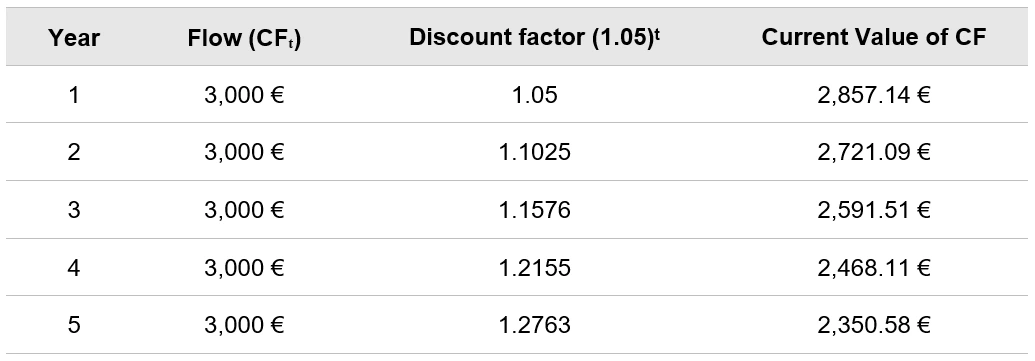
• Sum of the current flow values: €12,988.43
• NPV: €12,988.43 - €10,000.00 = €+2,988.43
• Interpreting the results: a positive NPV indicates that the project generates value in excess of the cost of the considered capital. In other words, the investment is profitable.
Scenario analyses are useful for assessing the robustness of the investment and the sensitivity of the NPV to changes in assumptions. For example:
• With a discount rate of 8%, the NPV falls to around €1,978;
• With a discount rate of 10%, the NPV is around €1,372;
• If the annual flows are €2,500, the NPV will be around €824;
• With flows of €2,000, the NPV becomes negative at around -€1,341.
Another relevant metric is the Internal Rate of Return (IRR). In this example, an IRR of 15.2% corresponds to annual flows of €3,000. This means that with a discount rate of 15.2%, the NPV is zero, and investors are indifferent as to whether or not to carry out the project. The project is no longer feasible if the discount rate is higher than 15.2% or the annual cash flows are lower than expected, resulting in a negative NPV.
NPV: Frequently Asked Questions
Below are the answers to the most frequently asked questions about the Net Present Value (NPV):
1. Does NPV method apply only to business projects, or can it also be used for personal investments?
The NPV is a versatile tool that can be used in any context involving future cash flows. Examples include business projects and personal decisions, such as purchasing a property to rent out or assessing long-term financial investments. In financial markets, the NPV is essential for establishing the fair value of a share, estimating the cash flows generated by a bond, and comparing different investment options based on objective criteria.
2. Can NPV be calculated when dealing with irregular cash flows?
Yes, the NPV can be calculated even when cash flows vary over time. To do this, you just need to apply the formula to each individual flow, discounting it by the appropriate rate of return for the relevant period.
3. Can the NPV be negative despite the project showing positive returns?
Yes. While a project may generate positive cash flows, if these are insufficient to cover the initial investment and the chosen discount rate, the NPV will be negative. The result indicates the profitability of the investment in absolute terms.
4. How do you choose the appropriate discount rate to calculate the NPV?
The discount rate should reflect either the opportunity cost of capital or the minimum required rate of return for investors. It can be based on market benchmarks, financing costs, or the expected returns of similar investments.
5. Is the NPV a substitute for the risk analysis of a project?
No, NPV assesses whether a project will generate the expected value; however, it does not measure risk directly. To provide a full analysis, it should be supplemented with sensitivity analyses, alternative scenarios, the Internal Rate of Return (IRR), the probability of success, and other indicators that take volatility and uncertainty into account.
6. Is the NPV useful for short-term investments?
The NPV is generally more relevant to medium- and long-term projects and investments, where the impact of future cash flows is significant. For short-term operations, it may be more practical to use metrics such as absolute return or payback period.
Maximise the NPV with the support of Banco Carregosa
NPV is a valuable tool for evaluating investments and making informed decisions. However, you can maximise its potential when you combine it with expert advice and in-depth market knowledge.
At Banco Carregosa, we support investors by helping them to interpret indicators such as NPV, evaluate opportunities, and build portfolios that strike the right balance between growth and security. Drawing on our experience in wealth and investment management, we analyse, plan and monitor every decision to ensure optimal results.
Contact us to learn how you can leverage NPV and other financial metrics strategically, with personalised support and bespoke solutions designed to help you achieve your goals.