



Computing reaches the limits of the physical world

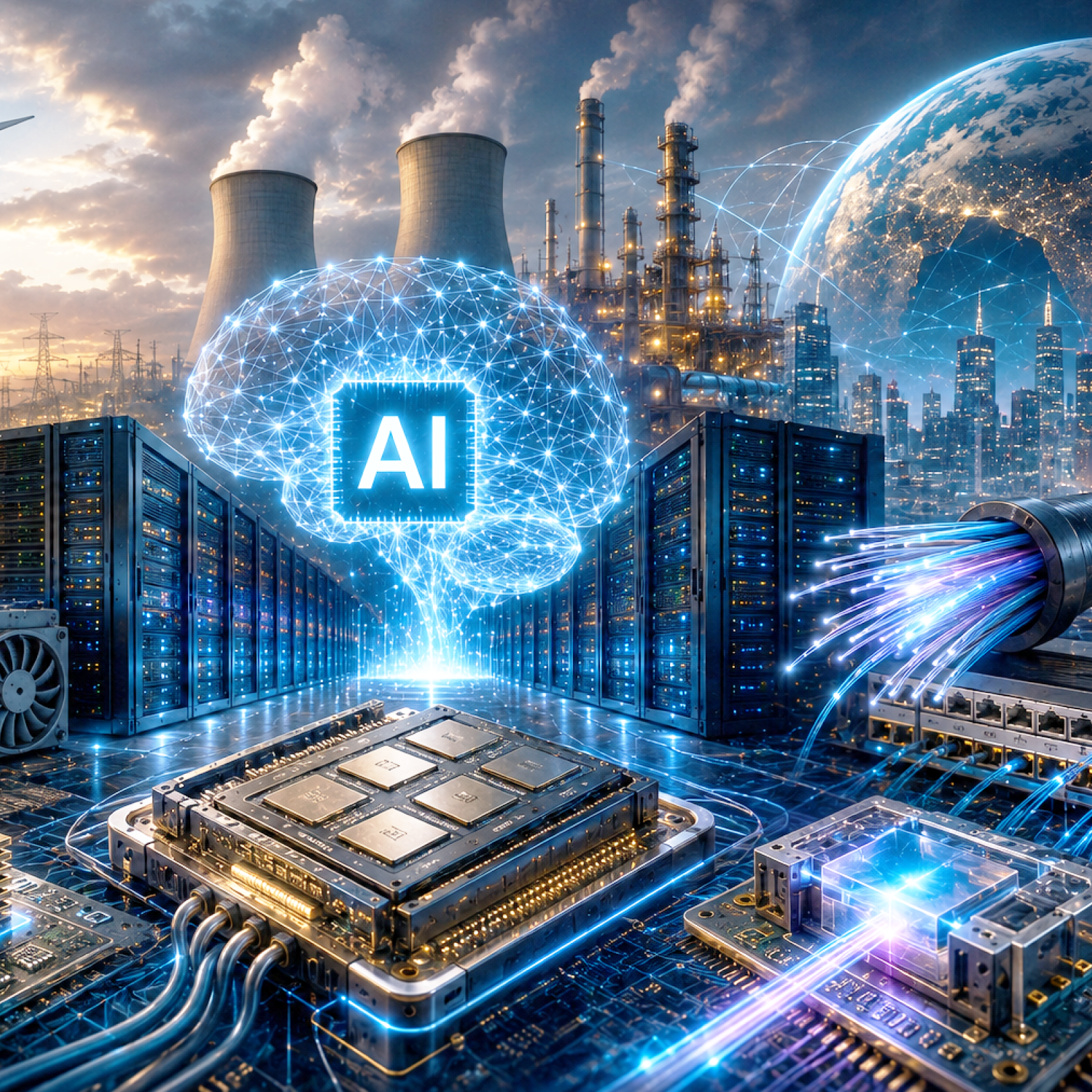
Artificial intelligence has become the visible face of the new technological race. However, the next hurdle may lie less in algorithms and more in energy, cooling, bandwidth, and the ability to process and move data on the scale required by the new economy.
Artificial intelligence is presented as an invisible revolution, with models capable of writing, programming, translating, and analysing. It appears to be purely software-based, an intangible layer rooted in mathematics and algorithms. However, this view is incomplete. As AI technology advances, it becomes increasingly dependent on heavy, expensive, and difficult-to-scale physical infrastructure. While it may appear to be a cloud economy, in practice it is an economy based on land, substations, semiconductors, fibre optics, cooling systems, water, transformers and high-capacity networks.
This is the central contradiction of the new technological era. Although AI was expected to transform entire sectors through code, it has instead forced companies and governments to address classic industrial issues such as where to build, how to power and cool, and how to finance physical assets on a massive scale. According to the International Energy Agency (IEA), data centres consumed around 415 terawatt hours (TWh) in 2024, accounting for approximately 1.5% of global electricity consumption. In its April 2026 update, the IEA revised this figure to 485 TWh for 2025 and around 950 TWh for 2030 — close to 3% of global electricity demand — and noted a 17% increase in data centre consumption in 2025. AI-focused data centres grew by 50% in the same year.
The first wave of generative AI was driven by models and applications, whereas the second is being shaped by infrastructure. For decades, it seemed as though digitalisation was dematerialising the economy. However, AI has partially reversed this trend: training and operating large-scale models requires clusters comprising thousands of accelerators that are connected by ultra-high-speed internal networks and housed in data centres that have an increasing energy density.
In the United States, the Lawrence Berkeley National Laboratory (LBNL) estimated in its 2024 report that data centres consumed 176 TWh in 2023 (4.4% of the nation’s electricity), and projected consumption of between 325 and 580 TWh in 2028 (6.7% and 12% of the country’s total). More recent data from the International Data Centre Authority, from May 2026, indicates that the US's installed capacity reached 29.2 GW, around 43% of the global total of 67.7 GW, representing a 36% increase over two years. This means that data centres now account for around 6% of the country's electricity consumption. The EIA's Annual Energy Outlook 2026 confirms this shift. Data centre servers accounted for 7% of the commercial sector's electricity consumption in 2025, and this figure is expected to grow to between 22% and 33% by 2050, equivalent to between 446 and 818 TWh of electricity consumption from servers alone. Consumption remained almost stable between 2014 and 2016; however, with the introduction of GPU-accelerated computing, the trajectory began to rise again. While AI did not invent data centres, it has changed their usage.
In this context, the issue of AI is not just about electricity consumption; it is a systemic challenge. A modern data centre is like a computing factory. It receives energy, transforms it into mathematical operations, and dissipates heat, all while delivering digital services. The greater the demand for inferences, the greater the pressure on this factory to operate continuously with high reliability and low latency.
This shifts the focus of the discussion from "How many chips are there?” to "How does the system work as a whole?”. While an isolated accelerator may be impressive, if it cannot communicate quickly enough with memory, storage, and other accelerators, some of its capacity will remain idle.
The second major limitation is data transport. Modern AI requires vast amounts of information to circulate behind the scenes, between servers and even between data centres. As models grow, computation is distributed across more chips, each of which needs to exchange intermediate results with the others. If this communication is slow, it results in inefficient utilisation of expensive equipment waiting for data.
Therefore, bandwidth becomes a financial variable. It determines the number of accelerators that can work together, the length of training sessions, the number of queries processed per second and the return on investment. Cisco predicted in 2025 that most switch ports in AI backbones would migrate to 800 Gbps by 2025 and 1,600 Gbps by 2027 – an exceptionally rapid transition.
The implication is straightforward: the next stage in the development of AI will depend as much on networks as on processors. The chip remains at the centre, but the network becomes the circulatory system. Nvidia describes the fifth generation of NVLink as being able to support all-to-all communication between 72 GPUs, with a throughput of 1,800 GB/s per GPU and 130 TB/s in total. The logic is clear: AI requires multiple chips to operate as a single, coherent machine.
It is at this point that the strategic importance of electricity becomes apparent. For much of the digital age, energy was considered an operational cost rather than a constraint on growth. The IEA describes the current period as the global economy entering the "age of electricity”, driven by data centres, AI, electric vehicles, and industrial electrification, with electricity demand growing faster than total energy demand.
In the context of data centres, energy has three dimensions: availability (grid connection and firm capacity), cost (the higher the energy intensity, the more sensitive the business model is to the price of electricity) and time (a data centre can be built in a few years, but new generation, transmission and substations require longer planning cycles). The IEA emphasises this disparity, noting that while technology advances rapidly, the electricity system requires substantial capital investment and long-term planning.
Heat is the flip side of electricity. Computing involves dissipating energy. Efficiency is measured by PUE (Power Usage Effectiveness), which is calculated by comparing the total energy consumption of the facility with that of the IT equipment. LBNL estimates that the average PUE in the US fell from 1.6 in 2014 to 1.4 in 2023. It could then drop further, to between 1.15 and 1.35, by 2028, due to the shift towards hyperscale and liquid cooling.
However, the improvement in efficiency does not eliminate the constraint; it may even exacerbate it. As computing centres become more efficient, demand grows. While efficiency gains reduce the unit cost, they may also increase total consumption. If the price falls, more computing power could be absorbed by research, programming, advertising, scientific research, medicine, finance, and defence.
Another issue arises after the problems with electricity and heat: copper. Electrical connections are still essential for computer systems as they are inexpensive and reliable over short distances. However, they encounter difficulties when higher speeds, greater distances and higher densities are combined: signals deteriorate, require more correction, consume more energy, and generate more heat. In this context, copper does not disappear; it simply ceases to be the go-to solution.
The industry is adapting. Copper will remain competitive for short links; however, fibre optics are gaining ground for longer links or those requiring higher bandwidth. A The economic boundary between the two technologies depends on the speed of signals, the cost of transceivers, rack density, and energy prices. Cisco’s report on 800G emphasises that the next generation of networks will depend on a combination of optical modules, direct-attach copper cables, ASIC switches, and the standardisation of 800GE. The transition will be hybrid, not binary.
This is where light enters the field of computing architecture. Using light to transmit and process signals, or photonics, is not a new concept; optical fibre has underpinned global telecommunications for decades. The latest trend is to bring optics closer to the interior of data centres and, in some cases, to the chip package itself. The aim of integrated and silicon photonics is to achieve with light what semiconductors have achieved with electrons: miniaturisation, integration, and large-scale production.
The concept of co-packaged optics (CPO) encapsulates this approach. Rather than keeping optical transceivers as separate pluggable modules from the chip, the optics are placed alongside the network ASIC. This reduces the distance travelled by the electrical signal, as well as losses, power consumption, and bandwidth limitations. A ANSYS describes CPO as a response to density, latency, copper reach, and energy efficiency challenges, bringing together optics and electronics within the same system.
Nvidia is incorporating this approach into its AI networking products. The Quantum-X and Spectrum-X Photonics systems use integrated silicon photonics and CPO, and offer 102.4 Tb/s, 409.6 Tb/s and 800 Gb/s port configurations. The focus is not just on speed, but also on redesigning the infrastructure so that the gains from the accelerators are not negated by data movement.
This shift is rewriting the history of semiconductors. While Moore’s Law (smaller transistors, higher density, and better performance per watt) is not obsolete, it is no longer sufficient. The new race is all about integration, combining computing, memory, networking, optics, substrates, advanced packaging, and software together to form a coherent system. Performance is now the responsibility of the entire system, not individual chips.
This shift is rewriting the history of semiconductors. While Moore’s Law (smaller transistors, higher density, and better performance per watt) is not obsolete, it is no longer sufficient. The new race is all about integration, combining computing, memory, networking, optics, substrates, advanced packaging, and software together to form a coherent system. Performance is now the responsibility of the entire system, not individual chips.
The implication for investors is clear: the AI supply chain is more extensive than it seems. The first phase focused on the most obvious winners, such as cloud platforms, GPUs, software, and memory. The next phase may depend more diffusely on power companies, network operators, cooling equipment, fibre, optical modules, switches, lasers, advanced materials, and substrates.
Not all investments will be successful: some will be cyclical, while others will face margin pressure, overcapacity, or technological obsolescence. While the physical supply chain creates opportunities, it also poses risks, including delays in power connections, component shortages, dependence on a few hyperscale customers, capex volatility, and valuations that anticipate several years of growth. The key is to look beyond the visible layer of the application.
The history of technology is often described as a progression of increasingly abstract layers: from hardware to software; from software to the cloud; and finally, from the cloud to AI. However, each of these layers still relies on tangible physical infrastructure. AI is making this infrastructure both more valuable and scarcer. The future of computing depends as much on the quality of the models as on the ability to supply power, dissipate heat, move data, and integrate systems on an industrial scale.
Computing is reaching the limits of the physical world, not because innovation is running out of steam, but because the focus is shifting. The challenge is no longer simply about packing more transistors onto a chip, but about creating an integrated architecture where electricity, silicon, memory, networking, and light all work together as one. For those operating in the market, the most important lesson from this phase of AI development is that the next frontier lies less in the visible algorithms and more in the invisible layers that enable their execution.