



Forward Dividend Yield: What it is and why it’s important in investing


Have you ever wondered how much a share can yield without its price going up?
This is where the Forward Dividend Yield comes into play. It is a key indicator for investors looking to make strategic investments and predict potential returns based on anticipated dividends.
This article will explain what it is, how it is calculated, and why it can be crucial for your next investment decision.
Forward Dividend Yield: what is it and what is it used for?
The Forward Dividend Yield is a financial metric that estimates the percentage return that investors can expect from dividends over the next 12 months. The calculation is straightforward: divide the value of a company’s projected dividends by the current price of its shares.
This metric is particularly useful for investors seeking passive income, such as those using buy-and-hold strategies or aiming to generate regular cash flows from their investments. This is particularly relevant for companies with stable and predictable dividend policies, which are common in sectors such as consumer goods, energy and mature technology.
The Forward Dividend Yield provides an indication of a stock’s potential yield, enabling you to compare different investment opportunities based not only on expected appreciation, but also on their ability to generate regular income.
How do you calculate the Forward Dividend Yield?
To calculate the Forward Dividend Yield, simply divide the expected annual dividend per share by the current share price:
Forward Dividend Yield = (Expected annual dividend per share / Current share price) × 100
Picture a company that paid a dividend of 2 euros per share in the previous quarter and continues to pay dividends on a quarterly basis. The total annual dividend amount is €8. If the current share price is €100, the Forward Dividend Yield would be: (€8 ÷ €100) × 100 = 8%.
But remember, this is only an estimate. The accuracy of the Forward Dividend Yield depends on consistent past distributions and the company’s stable dividend policy. This metric is less reliable for companies with more volatile profits or irregular payments, so it should be used with caution.
Forward Dividend Yield vs. Dividend Yield vs. Payout Ratio: what are the differences?
Although they are all linked to dividend distribution, the Forward Dividend Yield, the Dividend Yield (traditional) and the Payout Ratio measure different yet complementary aspects of the return offered by a company to its shareholders.
The Dividend Yield traditional (also known as Trailing Dividend Yield) is calculated by dividing the dividends paid in the last 12 months by the current share price. In contrast, the Forward Dividend Yield uses the expected dividends over the next 12 months, offering a more forward-looking view. This is useful when future payments are expected to increase or decrease.
Although they are often mentioned together, the Dividend Yield and the Dividend per Share (DPS) are different metrics. It is essential to understand this difference in order to correctly interpret an investment’s yield potential. The DPS shows how much money a company has paid (or plans to pay) in dividends per share, in absolute terms.
For example, if a company pays out €0.50 in dividends per share in a given year, its DPS is €0.50. The Dividend Yield is the percentage yield received by an investor in dividends in relation to the current share price. If the DPS is €0.50 and the share price is €10, the Dividend Yield is 5%.
Finally, the Payout Ratio measures the percentage of profits that a company distributes to shareholders in the form of dividends. A payout ratio of 60%, for example, indicates that 60% of profits have been distributed to shareholders, with the remaining 40% being reinvested in the company or put towards other uses, such as share buybacks.
Apple: a comparison of the tech giant’s payout ratio and dividends per share from 2016 to the present day.
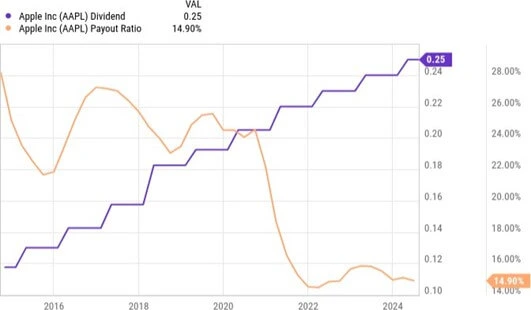
Source: Motley Fool
Together, these indicators assess not only the current and future yield of a share, but also the sustainability of its dividends. While a high yield may seem attractive, if it is accompanied by a very high Payout Ratio (above 80%, for example), this could suggest that the company is compromising its reinvestment capacity and that the dividends may not be sustainable in the long term. Conversely, a moderate Forward Dividend Yield with balanced payouts tends to indicate responsible and sustainable distribution policies.
What is a "good” Dividend Yield?
While there is no single figure that defines a "good" Dividend Yield, a yield of between 3% and 6% is usually considered both attractive and sustainable, particularly for stable companies with a consistent history of distributing profits. A Dividend Yieldbelow 2% may indicate that the company prefers to reinvest profits in growth, as is common among technology companies, or in share buyback programmes, while very high values, above 8% or 10%, may suggest risk, indicating either a significant fall in the share price or an unsustainable level of dividends.
The context in which a company operates is also important: those in more stable and mature sectors, such as energy, telecoms and consumer staples, tend to offer higher and more regular yields. Dividends are not a significant part of the picture for companies in growth sectors, such as technology or biotechnology. Therefore, a "good” Dividend Yield should always be analysed alongside other factors, such as the company’s financial stability, the Payout Ratio (the percentage of profits distributed) and consistent payment history.
How to make the most of the Forward Dividend Yield when making your next investment decision
The Forward Dividend Yield is a useful indicator for investors seeking stable income over the medium to long term. However, simply knowing what it means is not enough, you also need to understand how to apply it in practice.
The following tips will help you use this indicator at all stages of the investment process: selection, monitoring and decision-making.
• Filter out companies with a history of stable dividends and a Forward Dividend Yield of between 3% and 6%, which is generally considered to be a sustainable range;
• Focus on companies in mature sectors (energy, consumer goods, telecommunications) where dividends are an important part of the strategy for returning value to shareholders;
• Compare the Forward Yield with the Dividend Yield traditional: if the Forward is much higher, this may indicate an expected increase, or conversely, an undervalued risk;
• Combine the Forward Dividend Yield with the Payout Ratio: if the result is below 60%, there is room to maintain and increase dividends; if the result is too high (>80%), the risk of a cut is greater;
• Prioritise companies with a consistent history of dividend growth, not just high yields;
• Re-evaluate the Forward Dividend Yieldperiodically (ideally on a quarterly or biannual basis), especially after results or distribution announcements;
• Reinforce positions in companies that consistently maintain or increase the Forward Yield, offering a healthy payout and sound fundamentals;
• Reduce or sell when the yield falls without justification, profits decrease, or there are signs of financial difficulty that could compromise the dividend policy;
• Don’t just rely on the yield: always combine it with a fundamental analysis of both the company and the sector.
Answers to frequently asked questions
Below are the answers to some of the most frequently asked questions on this topic:
Not necessarily. Just because it seems attractive doesn’t mean it’s a good investment; it may indicate that the share price has fallen due to financial problems. For this reason, it is crucial to assess the company’s financial health before investing.
2. What is the difference between Forward and Trailing Dividend Yield?
The Forward Dividend Yield is an estimate of future dividends based on the last payment. The Trailing Dividend Yield (or simply Dividend Yield) is calculated using the average of dividends paid over the previous 12 months. The Trailing method is more accurate for companies with unstable dividends.
3. Is a Forward Dividend Yield of 3% good?
The answer is: it depends. If a safe financial product such as a term deposit or savings certificate offers 4% interest, a Dividend Yield of 3% might not seem worthwhile. However, the difference is all in the potential appreciation of the share. For example, if the share price increases by 15% in a year, the total return (dividends + appreciation) can be highly attractive.
Conversely, if the share price falls, the 3% Dividend Yield may not offset the capital loss. In addition, it is important to remember that the Forward Dividend Yield is sensitive to share price fluctuations. If the share price increases over the year, the effective yield will decrease proportionally.
4. Should I only use the Forward Dividend Yield when investing?
Selecting a financial intermediary when investing
Understanding the Forward Dividend Yield is an important step when building an income-focused investment portfolio. However, theory only becomes valuable when it is put into practice. With the Banco Carregosa, you can access the GoBulling trading platform, where you can view your transactions, track share performance and receive personalised, specialised information.
Key Takeaways
What is Forward Dividend Yield and why is it important?
The Forward Dividend Yield is a metric estimating the percentage return from expected dividends over the next 12 months, divided by the current stock price. It’s vital for income-focused investors, helping compare stocks and assess dividend sustainability.
How is Forward Dividend Yield calculated?
The Forward Dividend Yield is calculated by dividing the expected annual dividend per share by the current stock price, multiplied by 100. For example, if the expected dividend is €8 and the stock price is €100, the yield is (8 ÷ 100) × 100 = 8%.
What’s the difference between Forward Dividend Yield and traditional Dividend Yield?
The Forward Dividend Yield uses projected dividends for the next 12 months, offering a forward-looking view, while the traditional Dividend Yield is based on dividends paid in the past 12 months. The Forward is better for anticipating changes in dividend payments.
What are the risks of relying solely on Forward Dividend Yield?
Relying only on Forward Dividend Yield can lead to risks, such as:
- Overestimating dividends from companies with volatile earnings;
- Ignoring financial risks, like high Payout Ratios (>80%);
- Overlooking stock price appreciation, affecting total return;
- Misjudging high yields caused by falling stock prices.
Combine with fundamental analysis for informed decisions.
How can I use Forward Dividend Yield to invest safely?
To use Forward Dividend Yield safely:
- Choose companies with stable dividend histories (3-6% yield);
- Check the Payout Ratio to ensure dividend sustainability;
- Focus on mature sectors like energy or consumer goods;
- Reassess quarterly based on financial results;
- Consult Banco Carregosa for tailored strategies via GoBulling.
Banco Carregosa, looking beyond Dividend Yield and other metrics
In order to make more informed investment decisions, it is important to understand indicators such as the Forward Dividend Yield. However, interpreting this data and applying it correctly requires a careful analysis of the market context, the financial health of the companies and your investor profile. At Banco Carregosa, we provide services designed to help you develop robust strategies that align with your financial goals. Contact us.