



PSI quotes: A guide to following the main Portuguese stock market index with confidence


What do companies as diverse as EDP, Navigator and Jerónimo Martins have in common? Despite having their own unique strategies and an international presence, they are all listed on the Lisbon Stock Exchange. They are all part of the PSI, Portugal’s primary stock market index.
Tracking the PSI (formerly the PSI-20) involves more than just monitoring numbers: it requires an understanding of how the Portuguese economy evolves and the factors that influence the value of the country’s largest companies.
For both investors and those looking to better interpret market signals, it is crucial to understand what the index represents, how it is calculated, and its potential impact on investment decisions. This article explains what the PSI is, how to interpret it, and where to find reliable, real-time quotes.
What does PSI stand for?
The PSI is Portugal’s primary stock market index and comprises the largest companies listed on Euronext Lisbon. The acronym stands for Portuguese Stock Index, and the number 20 in the previous name referred to the number of companies comprising the index, although this number could vary over time.
PSI: historical price development
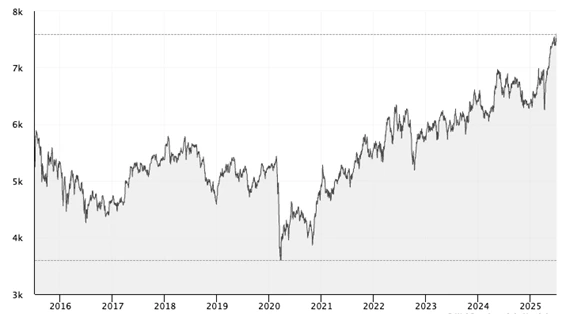
Source: Jornal de Negócios
Established on 31 December 1992, the PSI has become a benchmark in the Portuguese capital market, gradually replacing the BVL-30 – the most widely followed index until the end of the 1990s.
PSI share prices reflect the overall performance of the companies included in the index. Changes in the PSI reflect investors’ assessment of the performance and prospects of these companies.
How is the PSI calculated?
The PSI comprises the companies that are the most representative in terms of market capitalisation and liquidity. This means that they are not necessarily the companies with the highest market value, but rather those with the highest trading volume.
The weight of each company in the index is calculated based on its market capitalisation, adjusted for free float, i.e. the portion of a company's shares that are available for trading. Consequently, the overall value of the index is more heavily influenced by certain companies than others.
The composition of the index is reviewed annually in March. Additional quarterly reviews may also be conducted in the event of mergers, delistings, or significant changes in liquidity. The maximum limit per company is 12%, with the aim of avoiding excessive concentration and ensuring more balanced representation of the Portuguese market.
Which companies currently comprise the PSI?
Since March 2022, the index has not required a minimum of 18 constituents (the "20” in the name is now merely symbolic) and now only includes companies that fulfil the criteria of a free float of over €100 million and high liquidity.
A total of 16 companies make up the PSI at present:
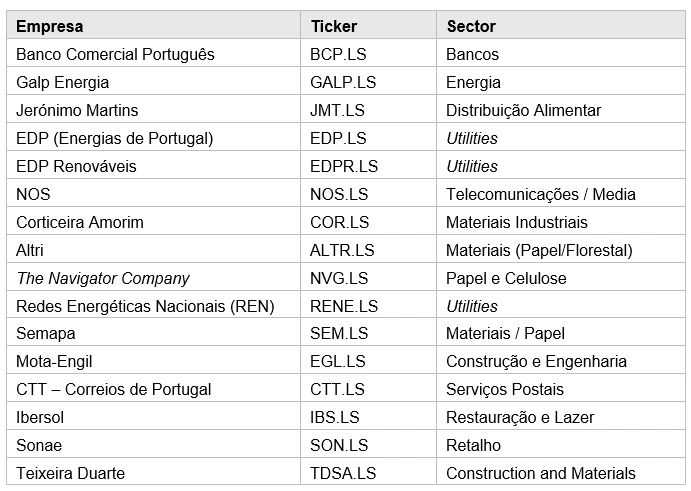
Source: EuroNext PSI Index Composition*
* accessed on 23/09/2025
You can track the performance of the companies in the PSI on the GoBulling Trading Platforms at Banco Carregosa.
Why is it important to track the PSI quotes?
The behaviour of the PSI reflects how investors view the most important Portuguese companies and, often, the country itself. Consistent increases suggest confidence in both corporate performance and the economic outlook. However, steeper or more prolonged falls may indicate concerns about the economic, political or regulatory environment.
Monitoring the PSI over time can help to identify trends and sectors that are growing in value. It can also reveal which companies are gaining weight in the index and how it reacts to economic cycles. This information could generate new opportunities or suggest adjustments to asset allocation.
Interpreting PSI quotes requires caution
The index is not without its limitations, which is why anyone investing or evaluating the market needs to understand what the figures mean.
1. It’s a weighted average, not a full picture
The PSI is a weighted average of the most liquid companies. This means that the performance of one or two major companies can have significant influence on the index. Consequently, even if most securities are stable or rising, the index can still fall.
2. Short-term movements may be considered "noise"
Variations are often caused by one-off factors, such as news items, emotional market reactions or automated orders. This is why interpreting the PSI requires context. This involves examining the volume traded and the most influential securities on that particular day. Where possible, this information should be cross-referenced with any external events that may be influencing the market’s reaction.
3. The index ignores companies that are not included
Although some Portuguese companies listed outside the PSI do not fulfil the free float criteria, they can still perform well and be a valuable addition to a diversified portfolio. However, they tend to be less liquid. Focusing solely on the PSI could prevent you from spotting possible opportunities and give you a limited view of the domestic market.
A guide to tracking the PSI quotes
Although you can track PSI quotes in real time with just a few clicks, not all sources offer the same level of reliability or depth.
1. Use reliable sources that are up to date
Use platforms such as Euronext, Bloomberg or Reuters, or portals that specialise in the Portuguese market, to track the PSI in real time. While economic newspaper websites and brokerage platforms can provide relevant information, you should always check how frequently they are updated.
2. Set up personalised alerts
Many trading platforms, such as GoBulling, allow you to set up alerts based on the limits that you define. For example, you can set up notifications to alert you when the PSI falls by more than 2%, or when a particular security reaches a certain price. This feature is particularly useful for those who want to stay informed about significant market movements without having to constantly monitor the market.
3. Refer to the index components
While it is useful to know that the PSI has risen by 1%, it is even more important to know which companies have contributed to this increase. Some platforms, such as GoBulling, allow you to easily track the performance of the securities that make up the index, highlighting the day’s biggest gains and losses. This helps you to understand what is driving changes in the index, and where the opportunities and risks may lie.
4. Don’t overlook the context
The real-time quotation received when an investor subscribes to the service – which usually incurs a nominal cost – is important, but lacks context. It’s just a number. Look for platforms that offer technical and fundamental analysis, as well as access to reports, historical graphs, and complementary indicators. Integrating data to interpret it provides a more reliable analysis and helps you to avoid making ill-considered decisions.
5. Use a reliable platform
Using the GoBulling Trading Platforms, gives you the confidence to analyse the PSI, take advantage of advanced features, and make decisions that align with your profile and objectives. Not only can you use the DEMO version to test strategies and financial products, but you can also use it to test positions held in your savings account.
How do I invest in the PSI?
Historically, there have been ETFs that have replicated the performance of the PSI 20 index. Some brokers even offered CFDs on the index. However, the Portuguese stock market’s loss of liquidity and decreasing relevance meant that these types of financial instruments disappeared.
For the average investor, directly replicating the PSI is a difficult, if not impossible, task today.
One alternative is to invest in the securities that make up the index. This can be done by buying the shares directly or via alternative financial instruments, such as CFDs:
1. Buying shares directly
The most traditional approach is to buy individual shares in each of the companies that comprise the PSI. To do this, you will need to open a trading account with a broker or bank that gives you access to the Lisbon Stock Exchange (Euronext Lisbon), such as Banco Carregosa. This allows you to buy and sell the securities of the companies that interest you the most, all while closely monitoring their performance.
2. Contracts for difference (CFDs)
If you’re looking for a more sophisticated investment strategy, CFDs allow you to profit from changes in share prices without acquiring the assets themselves. While this method offers flexibility and greater growth potential, it also carries risk and the potential for loss. Therefore, careful management and significant experience are required.
Invest in the Portuguese stock market with Banco Carregosa’s support
At Banco Carregosa, we give you access to trading platforms that offer real-time quotes, personalised analysis and expert monitoring. We also provide investment solutions tailored to your profile and objectives.
If you want to invest in the national market with confidence, you can rely on our team, who offer proximity, knowledge and stability. Although the PSI is a good place to start, the right strategy is based on a clear, well-founded plan and the right level of support. Talk to us.