



How does Artificial Intelligence affect long-term yields?


Key takeaways
• Artificial Intelligence is not currently one of the main factors influencing long-term yields. The key factors continue to be inflation, monetary policy, growth prospects, public financing needs, and term premiums.
• Rather than through direct competition between corporate and sovereign debt, the main transmission channel for long-term rates may be via the economy’s real equilibrium rate.
• If AI continues to increase productivity and the expected return on new investments, the neutral real interest rate may also increase.
• The key question for investors is whether the global economy is shifting towards a regime in which real interest rates are structurally higher than in the 2010s, with implications for the valuation of virtually all asset classes.
The development of artificial intelligence is triggering a large-scale investment cycle in areas such as public finance, defence, energy, infrastructure and reindustrialisation, which require significant funding. While AI does not account for the current level of long-term investment, it could, over time, contribute to shifting the balance between savings and investment, thereby raising the real interest rate that is consistent with economic growth.
In the years following the global financial crisis, the economic landscape was characterised by an abundance of capital. Private investment remained subdued, inflation remained low and global savings remained high. Meanwhile, the major central banks absorbed significant volumes of public debt through their asset purchase programmes. This combination of factors resulted in a prolonged period of very low, and sometimes negative, real interest rates. For investors, this meant access to cheap credit, rising prices for long-term assets, and consistent demand for yield-generating alternatives. The situation now is very different. At the time of writing, the real yield on 10-year US Treasuries was around 2.4%, while the yield on 30-year Treasuries was approaching 3%. Real yields of this magnitude were rarely offered by sovereign markets in major developed economies for much of the previous decade.
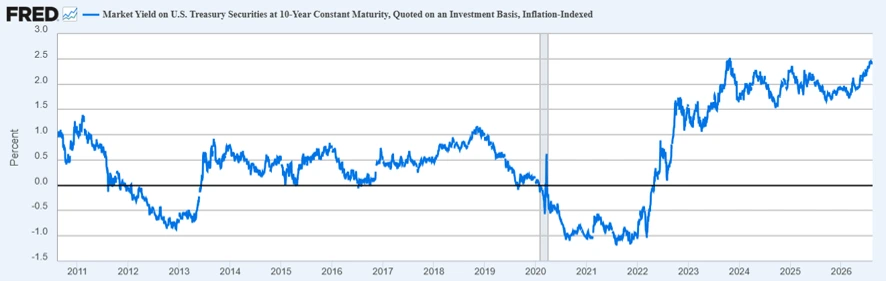
Source: Board of Governors of the Federal Reserve System, via FRED – Federal Reserve Bank of St. Louis.
This change is particularly significant for an investor. Once again offering significant real returns, the highest-quality sovereign assets will inevitably raise the bar for investing in credit, equities, property or private markets. These assets must offer an expected additional return that compensates for a substantially higher opportunity cost. However, there is no single explanation for the increase in long-term interest rates. Yields reflect expectations regarding growth, inflation, fiscal risk and debt supply, as well as the additional premium demanded by investors for holding long-maturity bonds. In this context, although Artificial Intelligence is not currently one of the main factors influencing yield levels, it could become more important as its implementation increases investment requirements and potentially boosts productive capacity of economies.
It is important to recognise that the main source of pressure on financing markets continues to be the public sector before analysing this channel. The OECD estimates that the gross sovereign financing needs of its member countries will total around 18 trillion US dollars in 2026, up from approximately 12 trillion US dollars in 2022. In total, bond markets are expected to absorb around 29 trillion US dollars of financing from governments and companies over the course of this year.
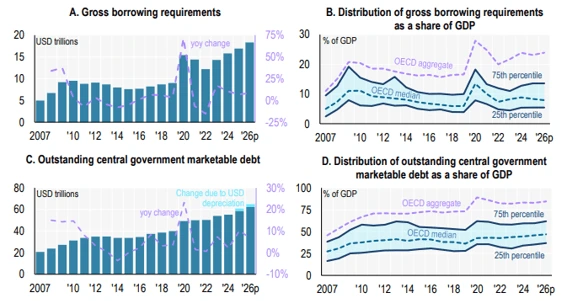
Source: OECD Global Debt Report 2026; 2025 OECD Survey on Central Government Marketable Debt and Borrowing; OECD Economic Outlook; LSEG; national authorities; OECD calculations.
These requirements are significant in scale, but the context in which they are financed has also changed. During quantitative easing programmes, central banks acted as major buyers of sovereign debt, being relatively insensitive primarily to price. These purchases were intended to implement monetary policy, rather than to maximise financial returns. As central banks’ balance sheets shrink or stop growing, a larger proportion of debt must be absorbed by private investors, such as pension funds, insurers, asset managers and retail investors, whose demand is more directly dependent on the return offered. At the same time, it is unlikely that public financing needs will quickly return to pre-pandemic levels. Significant resources will continue to be required to fund high structural deficits, an ageing population, defence, infrastructure, and energy transition. These factors alone justify discussion of a regime of real interest rates that could exceed those of the past decade.
At a time when the economy already has high capital requirements, Artificial Intelligence provides a new source of private investment. For years, the largest technology companies have epitomised a growth model that relies less on physical assets. This model is characterised by highly scalable software, high margins, robust balance sheets, and the capacity to grow without proportionally increasing invested capital. However, AI is changing this model.
The development and use of these new models requires substantial physical infrastructure, including data centres, advanced semiconductors, servers, fibre optic cables, cooling systems, electricity grid connections and new energy generation capacity. What was initially seen as a new software revolution is therefore turning into one of the largest cycles of private infrastructure investment in recent years. The BIS estimates that the five largest hyperscalers will spend over one trillion US dollars in AI-related capital expenditure between 2025 and 2026. At some of these companies, investment commitments are rising faster than earnings and free cash flow, making external financing increasingly important.
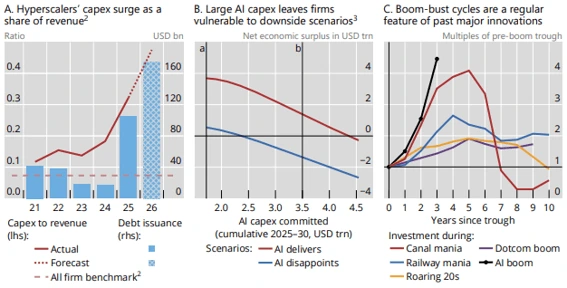
Source: BIS Annual Economic Report 2026; S&P Global Market Intelligence; Bank of America; company announcements; BIS.
The fact that Microsoft invests a dollar in a data centre does not mean that the dollar is no longer available to finance the US Treasury. The amount of financing available in an economy is not fixed. For example, savings may increase, bank credit may expand, and companies may simultaneously turn to shares, bonds, private credit, or other financing structures. The relevant economic mechanism is broader and encompasses a wider range of factors.
If investment opportunities consistently outstrip available savings, the real rate required to balance the two could also increase. In this sense, AI could have a significant impact on long-term interest rates. While the increase in bond issuance by large technology firms is a visible manifestation of this transformation, it is not the primary cause.
By mid-August, companies associated with AI investment had issued almost $220 billion worth of bonds in 2026, more than double the approximately $108 billion issued in total during the previous year. Although these figures are enormous, it is important to keep things in perspective. The global public and corporate debt market is much larger. Currently, there is insufficient evidence to suggest that technology companies are responsible for significant movements in 10- or 30-year Treasuries. At the moment, the effects are more noticeable in the credit market itself.
The increase in bond supply from hyperscalers has coincided with wider spreads, greater concessions on new issues, and lower coverage ratios for these transactions. For example, in July, an Amazon issue received demand equivalent to around 1.6 times the amount placed, compared to 3.4 times in a transaction carried out in March. This does not suggest any significant financing difficulties. Companies such as Amazon, Microsoft and Alphabet continue to enjoy the benefits of high credit quality, robust balance sheets and excellent market access. However, it does show that the volume of capital required to finance the expansion of AI is becoming economically significant.
The OECD estimates that the nine major hyperscalers will require around $4.1 trillion in cumulative capital expenditure between 2026 and 2030. If half of the investment were financed through bonds, the issuers could account for a significant proportion of the annual global corporate bond issuance.
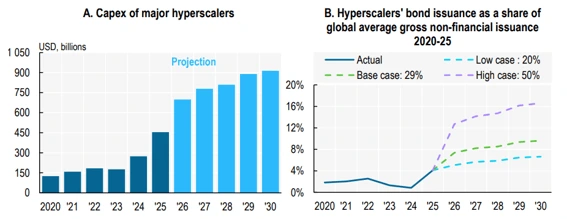
Source: OECD Global Debt Report 2026; OECD Capital Market Series; LSEG; FactSet.
Therefore, the most relevant question is not whether these issues are currently causing a rise in sovereign yields, but whether the scale of investment associated with AI could contribute to a long-term shift in the equilibrium level of real interest rates. This is where the concept of the neutral real interest rate comes in.
In simple terms, the neutral real interest rate is the rate that is compatible with economic growth close to its potential without generating persistent excess demand. While it is not a directly observable variable, estimates carry a considerable margin of uncertainty, it is an important benchmark for understanding long-term interest rate equilibrium.
The link with Artificial Intelligence stems mainly from its potential to increase productivity and improve the expected return on investment. Productivity may increase if AI enables firms to produce more with the same resources, automate processes, and develop new products and services. However, a more productive economy could also offer a wider range of profitable investment opportunities. Companies will then be more willing to invest and raise finance because the expected return on new projects will be higher. At the same time, the prospect of higher future returns may diminish the incentive to save now. If demand for investment increases more quickly than the supply of savings, the real interest rate required to balance the two may increase. This is probably the most significant connection between Artificial Intelligence and long-term interest rates.
AI does not need to directly prompt investors to shift from sovereign debt to technology debt. For the real equilibrium rate to be higher, it is sufficient for productivity, investment opportunities and the expected return on capital to persistently increase.
Here lies an apparent paradox. Artificial Intelligence is often presented as a technology with the potential to reduce inflation. Higher productivity enables the production of more goods and services using the same resources, while also automating processes, reducing costs and increasing efficiency. Assuming all other factors remain unchanged, this should ease the pressure on prices. However, lower inflation does not necessarily imply lower real interest rates. If AI increases the economy’s potential growth and the marginal return on capital, a higher neutral real interest rate may be compatible with a more productive economy.
Furthermore, there is a significant time lag between investment and increased productivity. Although the capital required to build the infrastructure is mobilised today, the full extent of the productivity gains will only become apparent over the coming years. During this initial phase, the boom in AI is increasing demand for equipment, energy, land, construction work and skilled labour. The BIS has already identified constraints in the supply of electricity and advanced semiconductors, as well as in the equipment required for electricity grids, which are linked to the pace of investment in AI infrastructure. In the short and medium term, a technology that is potentially disinflationary in the long term may exert additional pressure on physical and financial resources. The two effects are not necessarily contradictory: investment precedes productivity gains.
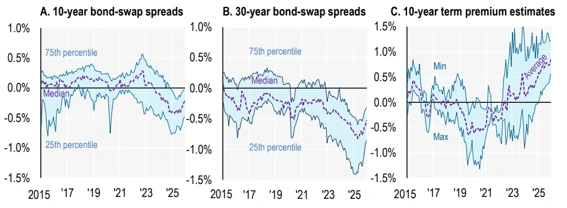
Europe intends to increase its defence spending significantly. Electrification requires power grids and new energy generation capacity. The reorganisation of supply chains requires new industrial facilities. An ageing population puts pressure on public finances. Furthermore, governments continue to have significant financing requirements. AI adds data centres, semiconductors, networks and energy to this mix.
Source: OECD Global Debt Report 2026; LSEG; AOFM; ECB; Nakajima (2026); Federal Reserve Bank of New York; UK DMO; OECD calculations.
Rather than being simply a matter of direct competition for funding, a shift may be emerging in the relationship between the desired level of investment in the economy and the available savings to finance it. This context contrasts with much of the 2010s. At that time, economic debates often focused on the abundance of savings relative to the limited number of investment opportunities, which helped to keep real interest rates at historically low levels. The scenario today is different: there are more investment opportunities and greater public financing needs, but capital is less available at the prices that prevailed in the previous decade.
This discussion has important implications for long-term investors. If real equilibrium rates remain higher in the long term, this will affect virtually all asset classes. In the bond market, it once again creates conditions for achieving significant real returns from high-quality issuers, without the need to take on excessive levels of credit risk. In the equities market, a higher discount rate makes actual cash generation, return on invested capital and capital allocation discipline more important. All other things being equal, companies whose valuations depend primarily on future results become more sensitive to interest rates. In both the property and private markets, expected returns must compete with a higher risk-free rate. Finally, within the field of Artificial Intelligence, the distinction between investment and value creation may become increasingly important. An increase in capital expenditure does not guarantee superior returns for shareholders. It is necessary to distinguish between companies that provide infrastructure, those that can monetise that capacity, and projects whose economic return may not justify the invested capital.
Against a backdrop of higher real interest rates, the ability to generate sustainable returns that exceed the cost of capital is once again at the forefront of investment selection. For years, many investors had assumed that interest rates would eventually return to the very low levels that characterised the previous decade once the inflationary shock associated with the pandemic had passed. This conclusion may be overly simplistic. If public financing requirements remain high and further investment is required in defence, energy, infrastructure and reindustrialisation, while at the same time artificial intelligence significantly boosts productivity and the number of economically viable projects, the real rate needed to balance savings and investment may remain above that seen in the 2010s.
Therefore, the key question for the markets is not whether AI is currently pushing up the 10-year Treasury yield. The aim is to understand whether the new wave of investment triggered could contribute to an economy in which persistently low real interest rates are no longer the norm, and where the cost of capital plays a more decisive role in the valuation of financial assets.
Legal disclaimer: This article has been prepared by Banco Carregosa for information and educational purposes only. Under no circumstances does it constitute an investment proposal, recommendation to purchase, or personalised financial advice. Investing in financial instruments carries risks, including the possibility of losing the capital invested. Past performance is no guarantee of future returns. We recommend that you consult an account manager or financial adviser before making any investment decisions, to ensure that they are suited to your risk profile and financial objectives.