



What is an Initial Public Offering (IPO)?


At a glance:
• An initial public offering (IPO) is the process by which a company begins to trade its shares on the stock market.
• There are distinct types of IPO, each with its own distinct structure and objectives.
• At Carregosa NextGen, we provide the support you need to make the most of an IPO, combining analysis, discipline, and risk awareness.
Every year, companies make headlines when they "go public”. This moment is often accompanied by anticipation and euphoria, as well as major market changes.
But what is really behind this event? What does it mean for a company to carry out an initial public offering (IPO), and is it a suitable time for you to invest?
This article explains what an initial public offering (IPO) is, how it works, the distinct types that exist and how you can invest in a conscious and strategic manner.
What is an Initial Public Offering?
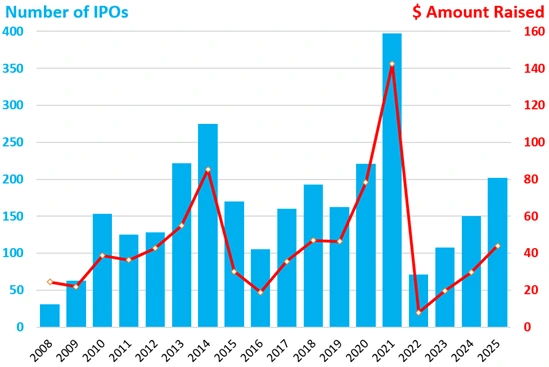
An Initial Public Offering (IPO) is the process by which a private company becomes listed on a stock exchange for the first time, making its shares available to the public.
Source: Wolfstreet
Until that point, the company would typically belong to the founders, private investors (such as venture capital funds) or a limited group of shareholders.
With an IPO, the company:
• Opens its capital to individual and institutional investors;
• Begins trading shares on a regulated market;
• Becomes subject to greater transparency and financial reporting requirements.
When you invest in an IPO, you are buying shares when the company first goes public.
Why invest in shares?
Buy shares in the brands you believe in and play a part in shaping your future and that of the company. Read this article and discover eight tips to help you get started with investing in shares.
Types of Initial Public Offering
Not all Initial Public Offerings (IPOs) follow the same model. There are various formats that are worth knowing about.
Traditional IPO
This is the most common model. The company issues new shares and relies on investment banks to coordinate the process of selling the shares to investors. There is usually a subscription period before the company first goes public.
Direct Listing
Under this model, no new shares are issued. Existing shareholders sell their shares directly on the market. Unlike a traditional IPO, there is no structured pre-placement.
SPAC (Special Purpose Acquisition Company)
A SPAC is a company formed with the specific aim of raising capital on the stock market to acquire another company. Following the acquisition, the target company is listed. While this model has grown in popularity in recent years, it has also raised questions about transparency and risk.
How does an Initial Public Offering work?
Before you can start trading shares on the market, a structured and regulated process must be followed. This involves the following steps:
1. Strategic decision to go public
The company decides to go ahead with an IPO to achieve objectives such as financing growth and expansion, reducing debt, enhancing its profile and credibility, and enabling an exit for the initial investors.
This strategic decision will profoundly change the company’s structure.
2. Engaging investment banks
Lead underwriters are selected to structure the transaction, value the company, and define an indicative price range.
They also draw up a prospectus, an essential document presenting the business model, financial results, associated risks, and future strategy.
3. Roadshow and bookbuilding
The company presents itself to institutional investors in a process known as a roadshow. The final share price and the number of shares to be issued are determined based on the demonstrated demand. This balance between supply and demand is crucial for the initial valuation.
4. Stock market debut
Shares begin trading on a regulated market such as Euronext or the New York Stock Exchange. From that point onwards, the price is determined exclusively by the market and may be subject to high volatility in the first few days.
Advantages of investing in an Initial Public Offering
Investing in an IPO (Initial Public Offering) can be an attractive option for those seeking growth who are comfortable with a certain level of risk. The main advantages are as follows:
Potential for capital appreciation
If the company meets growth expectations after being listed on the stock exchange, an initial public can provide the potential for capital appreciation. If the strategy is executed well and the results match the projections, this progress will be reflected in the share price over time.
Access to growing companies
An IPO enables you to invest in a company at an early stage in its life as a listed entity. Many companies turn to the market to finance ambitious growth plans, offering investors the chance to participate in a significant phase of their expansion.
Some of the market’s most significant historical milestones demonstrate the uniqueness and potential of such moments:
• Facebook: Facebook's listing in 2012 was marked by unbridled euphoria, but its debut was technically turbulent and disappointing in the short term. Glitches in the Nasdaq system and an overvalued share price (almost 100 times the profits at the time) caused the shares to fall by 18% in the first few days. This case serves as a reminder to investors that even for a dominant company, the entry price and technical stability of an IPO are critical factors;
• Saudi Aramco: The largest IPO in history, in terms of funds raised, demonstrated how traditional giants can mobilise global markets. It sets an example for those seeking companies with substantial cash flows and regular dividends, as opposed to companies with a pure growth profile, such as SpaceX;
• SpaceX: Although SpaceX is still a private company, it is the prime example of expansion financed by successive rounds of capital investment. With a valuation already exceeding $350 billion, Elon Musk’s company dominates 85% of US orbital launches. Its IPO is highly anticipated, thanks to its success in achieving rocket reusability and the profitability of the Starlink network. This demonstrates that disruptive business models can generate significant value even before entering the stock market.
Greater transparency
Going public makes the company subject to stricter financial reporting and supervisory rules. This means that investors have greater access to information and that there is a more structured regulatory framework.
Initial Public Offering: How to invest
Although an Initial Public Offering (IPO) can generate excitement, the decision to invest should be strategic rather than emotional. Here are the steps you should take.
1. First, define your strategic framework
Before you consider the company itself, you should consider yourself. What are your objectives with this investment? Are you looking for long-term growth, or do you want to capitalise on potential initial market movements?
IPOs tend to be more volatile and uncertain than those of established companies. Therefore, they are better suited to a growth-oriented perspective and a longer-term outlook. If you have a low risk tolerance or require short-term liquidity, this may not be the most suitable investment.
2. Analyse the business as though it had been listed for years
A common mistake is to invest in an Initial Public Offering simply because the company is well known or the sector is 'trendy'. The fact that it is a debut does not replace the need for thorough analysis.
You should analyse factors such as:
• Business model and competitive advantage;
• Historical revenue growth;
• Profitability (or a clear plan to achieve it);
• Level of debt;
• Intended use of the funds raised.
The key question is simple: is this company capable of creating sustainable value?
3. Consider whether the price is reasonable
In an IPO, the price is set based on anticipated demand and future expectations. This means that it may already reflect rather optimistic scenarios.
Even if the company appears promising, it is important to understand whether the valuation is in line with its fundamentals. Comparing multiples with those of similar companies in the same sector can help to put the entry price into context.
Investing in a good company at an overly high price can reduce the expected return.
4. Decide when to invest in the company
There are two main options: participating in the subscription phase when it is open to retail investors, or investing after trading begins on the stock exchange.
Participating in the subscription may give you access to the initial price, but this requires you to decide before any trading history has been established. Alternatively, waiting a few days or weeks can reduce your exposure to the extreme volatility of the early stages, although the price may already have changed. Ultimately, it depends on your strategy and risk profile, as there is no universal rule.
Be aware of access restrictions. Many IPOs, particularly those in international markets such as the US, may be subject to legal restrictions. Often, the subscription phase requires residency in the company’s country of origin or an account with brokers authorised for that particular offering. Facebook's IPO is a classic example of this: it was largely limited to US residents and institutional investors. In such cases, international retail investors typically enter at a later stage once the shares are trading freely on the stock exchange.
5. Include the IPO in a diversified portfolio
An IPO should not account for a disproportionate share of your portfolio. It is a more uncertain investment.
The best approach is to include it in a diversified portfolio that combines different geographies, sectors, and asset classes. This will ensure that, even if the initial performance falls short of expectations, the overall impact on your portfolio is minimised.
6. Maintain discipline after investing
Once you have invested, avoid reacting impulsively to short-term fluctuations. The first few weeks may be characterised by sharp changes that do not necessarily reflect the company’s fundamentals.
Monitor quarterly results, strategy execution, and sector developments. Investing in an IPO should be a conscious decision based on analysis and a vision that extends beyond "debut day”.
Initial Public Offering: invest strategically with Carregosa NextGen
With Carregosa NextGen, you can track new listings on major international markets and invest via the GoBulling trading platform. You will always have access to information and guidance tailored to your profile.
If you would like to learn how to incorporate IPOs into a diversified investment strategy that aligns with your goals, contact us to find out more about investing in a sound and informed manner.
A trading platform designed with you, the NextGen of investors, in mind. Everything you need for quick and secure investing, all in one place! You can test our DEMO version here.
Initial Public Offering: Frequently Asked Questions
Below, we answer some of the most common questions about Initial Public Offerings.
Is investing in an Initial Public Offering worth it?
This depends on your risk profile and time horizon. While an IPO can offer high growth potential, it also involves greater uncertainty and initial volatility.
How can I participate in an IPO?
You can either invest during the subscription phase, if it is available, or buy shares once trading begins on the stock exchange.
Are Initial Public Offerings riskier than shares that are already listed?
Generally speaking, yes. There is less trading history, which makes the initial valuation more uncertain.
Can I lose money on an IPO?
Yes. As with any share investment, its value may fall after the company goes public.
Disclaimer: This article has been prepared by Banco Carregosa for informational and educational purposes only. It does not constitute an investment proposal or recommendation to buy, nor does it constitute personalised financial advice. Investing in financial instruments carries risks, including the possibility of losing your initial investment. Past performance does not guarantee future results. Before making any investment decisions, we recommend that you consult an account manager or financial adviser to ensure that they are suitable for your risk profile and financial objectives.