



CAGR explained: What it is, how it’s calculated and what it reveals about your investments


In a nutshell
• CAGR measures the average annual growth of an investment, enabling consistent comparison of different investment trajectories;
• It must be interpreted in context and combined with other metrics, such as volatility or the Sharpe ratio. It should also be analysed in relation to the type of asset and the risk taken;
• With CAGR, you can make more confident strategic decisions by evaluating real performance.
Do you know how to accurately measure the growth of an investment over time? The Compound Annual Growth Rate (CAGR) is one of the most reliable metrics for understanding how a value evolves consistently over a period of several years. This article explains what it is, how it is calculated, and why it is an essential tool for precise analysis of results.
What is the definition of CAGR?
The CAGR measures the average growth rate of an investment over a given period, assuming that the profits generated are reinvested each year. To put it simply, it shows the yearly growth rate needed for an investment to reach its final value.
This is an intelligent approach to balancing market variations and achieving consistent performance over time. Rather than just looking at the starting point and the end points, CAGR translates the trajectory in a way that is more comparable and understandable.
In general, a CAGR of between 5% and 8% per year is considered solid for long-term, diversified portfolios, particularly when combined with controlled volatility. Conversely, rates above 10% can be observed in riskier assets (such as individual stocks, private equity or emerging markets), but usually at the cost of more pronounced price changes.
For example, to make it onto the Financial Times’ list of the world’s 1,000 fastest-growing companies in 2025 (based on growth recorded between 2020 and 2023), a minimum CAGR of 34% is required. The highest CAGR on this list was over 800%.
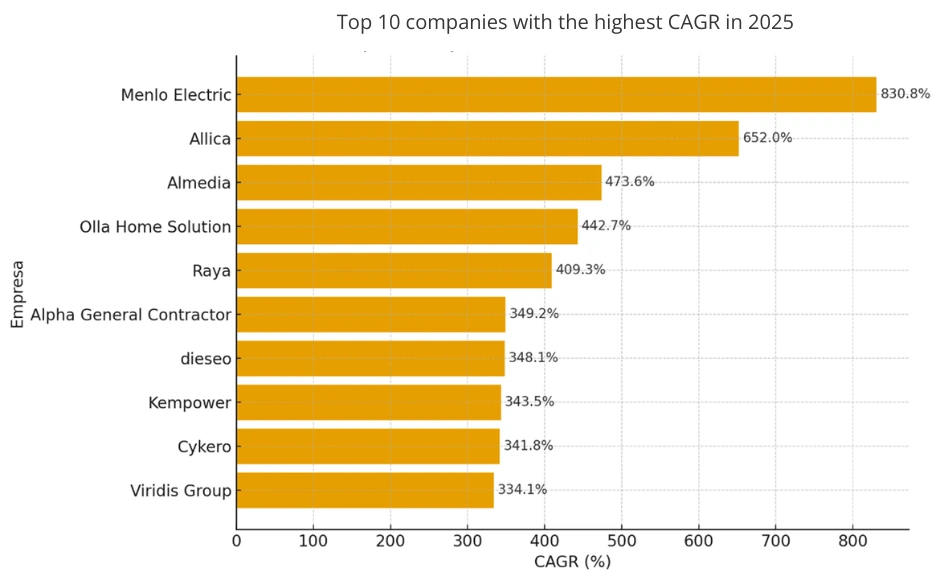
Source: Statista
In short, a "good” CAGR is not just the highest figure, but the figure that best reflects the balance between returns and stability: this balance is what makes all the difference in the long term when it comes to preserving and enhancing wealth.
Advantages of CAGR
The CAGR provides a clear picture of how an investment behaves over time. The main advantages are as follows:
1. Clear comparison
The CAGR enables balanced comparisons of investments with different durations and risk profiles. Showing the equivalent annual growth rate eliminates distortions caused by more volatile periods, making it easier to analyse alternatives.
2. Long-term vision
While many metrics focus on immediate results, the CAGR is distinctive in that it highlights consistent growth over time. This viewpoint is especially useful for those who can think long-term.
3. Straightforward reading of results
The CAGR converts complex changes into an average rate, providing a clear summary of progress. It is therefore an essential tool for monitoring the performance of diversified portfolios.
How to calculate the CAGR
The CAGR formula is as follows:
CAGR = (Final value / Initial value) ^(1/n) – 1
Where:
• Initial Value is the amount invested at the start of the period;
• Final Value is the amount at the end of the period;
• n is the number of years (or periods) between the two moments.
For example, if the value of an investment increased from €100,000 to €150,000 over three years, the calculation would be as follows:
CAGR = (150 000 / 100 000) ^1/3 – 1 = 14.5%
This suggests that the investment grew by an average of 14.5% each year, assuming this rate remained constant throughout the period.
Risks and limitations of CAGR
Although CAGR is an important metric, it should be interpreted with caution. Firstly, it should be noted that the CAGR does not reflect volatility. Two investments may have the same average growth rate, but one of them may have experienced much sharper fluctuations along the way. By reducing the variations, it can create a perception of stability that doesn't accurately reflect the actual risk.
Finally, context is essential. The CAGR should be considered alongside other indicators (such as volatility, drawdown or Sharpe ratio), to provide a comprehensive and accurate assessment of performance.
How to use the CAGR
Being able to calculate CAGR is a good start, but knowing when and how to use it is what really adds value. The following are some recommended approaches for incorporating it into your decision-making process:
1. Determine consistent periods
The CAGR is only reliable when used to compare equivalent periods. To ensure that the conclusions are fair and comparable, use similar time intervals between assets or strategies (e.g. five years).
2. Combine with other indicators
Use the CAGR alongside metrics such as volatility, Sharpe ratio and standard deviation. The aim is to achieve a balanced view between return and stability by complementing the growth rate with the risk reading.
For example, two portfolios could have an identical CAGR of 7% per year. However, if one has experienced significant changes during this period and the other has remained stable, the latter demonstrates more efficient risk management. Metrics such as volatility or the Sharpe ratio help to highlight this difference.
3. Provide context to the result
While a high CAGR can be promising, it should always be interpreted in context: type of asset, economic climate and level of risk taken. The number alone does not tell the whole story. It is the scenario in which it was achieved that gives it meaning.
For example, a technology fund may have achieved a CAGR of 15% over the last five years, which might appear impressive. However, if this growth occurred during a period of euphoria in the sector, followed by a sharp correction, its long-term sustainability may be questionable. Conversely, a property fund with a consistent return and low volatility, even if its CAGR is only 6%, may represent a more balanced strategy in the long term.
4. Apply it to your own portfolio
Recalculate the CAGR of your main assets periodically. Compare it with the average market performance or products of a similar level of risk. This is a simple yet insightful exercise to help you determine whether your growth is consistent or just a one-off.
For example, if a stock in your portfolio has grown by an annual average of 9% over the last five years, but the sector’s benchmark index has grown by 11% over the same period, this may indicate relative underperformance. Conversely, a CAGR of 6% obtained with lower-than-average volatility may suggest more efficient risk management.
CAGR: Frequently Asked Questions
We answer some of the most frequently asked questions about CAGR below.
1. Is the CAGR useful for short investment periods?
Not always. The CAGR becomes more relevant over longer time periods (usually three years or more), as this allows the effects of capitalisation and reinvested income to become apparent. One-off fluctuations over short periods can distort the result.
2. Can CAGR be used to estimate future growth?
Not on its own. CAGR is a retrospective metric: it shows what has happened, rather than what will happen. In reality, no data can predict the future. Nevertheless, some people try to identify trends or forecast future prospects.
3. How can CAGR be applied to non-linear income sources, such as dividends or variable interest?
In these cases, the calculation of the CAGR must include the reinvestment of income in order to reflect the compounding effect. Failing to consider dividends, coupons or accrued interest can lead to an inaccurate understanding of actual growth.
4. Is the CAGR relevant to non-financial assets, such as property or collectibles?
Yes, provided there is a history of measurable appreciation. In real estate, for instance, the CAGR can demonstrate the average rate at which a property has appreciated over a number of years. This makes it possible to compare it with financial alternatives or the opportunity cost.
5. What should I do if the CAGR is negative?
A negative CAGR does not necessarily indicate a poor investment. This could be due to a period of natural correction or an adverse macroeconomic context. The important thing to understand is whether the negative trend is cyclical or structural, and whether the asset is solid enough to recover.
Understand your investment pace with GoBulling
The CAGR is a key metric for evaluating the growth rate of an investment over time. The GoBulling Trading Platform from Banco Carregosa gives you access to interactive charts, historical data and personalised simulations to help you understand the true performance of your assets. Making data-driven decisions is easier when you have the right tools. GoBulling turns the CAGR analysis into a strategy, not just a calculation. Try the DEMO version.
Learn to interpret the CAGR with the support of Banco Carregosa
Although an indicator such as CAGR can help to chart trends, careful interpretation is essential for making informed decisions.
At Banco Carregosa, we work with each client on a personal level. We understand that every portfolio represents life goals, dreams and plans for the future. Our aim is for you to understand what each indicator means for you, for your assets and the decisions you need to make today. A combination of confidence, rigorous analysis and experience paves the way for personal and financial success.
Contact us to maximise the potential of your investment, and enjoy greater security and control over your assets.