



Dollar Cost Averaging: What it is and how to use it

Even the most experienced investors worry about the same question: when is the best time to invest? A practical solution to minimise uncertainty is to spread investments over time using a strategy known as Dollar Cost Averaging. This guide provides an explanation of how it works and its benefits, as well as offering practical examples of how to implement it.
What is Dollar Cost Averaging (DCA)?
Dollar Cost Averaging is an investment strategy that involves investing fixed amounts at regular intervals, regardless of market conditions. Rather than attempting to predict the optimal time to invest, which can be challenging even for professionals, DCA encourages the consistent strengthening of a portfolio to mitigate the effects of volatility.
DCA is founded on two fundamental beliefs:
• Short-term volatility is natural and inevitable: due to factors such as geopolitics, inflation and monetary policies, markets fluctuate in the short term, making it challenging to predict daily or monthly movements;
• Markets tend to appreciate over the long term: historically, indices such as the S&P 500 and the MSCI World Index have increased in value over the decades, driven by innovation, productivity, and economic growth.
Rather than trying to maximise returns, DCA aims to reduce the risk of investing everything at the worst possible time, "putting all your eggs in one basket”. Its strength lies in the fact that it involves simple repetition, which evens out the average cost in a volatile market.
Advantages of Dollar Cost Averaging
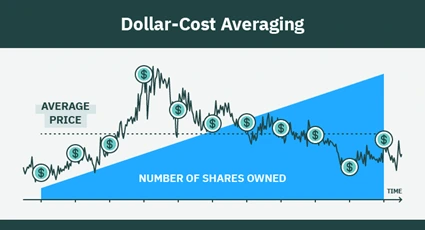
The key principle of Dollar Cost Averaging (DCA) is to invest a fixed amount at regular intervals. When the asset price is low, the fixed amount enables you to purchase more units. Conversely, when the asset price is high, the same amount results in the purchase of fewer units. This automatic mechanism results in a lower weighted average cost per unit over time — hence the term cost averaging.
To better understand the concept, imagine that you invest €100 every month: in January, at €10 per unit, you bought 10 units. In February, the price fell to €5, allowing you to buy 20 units. In March, with the price rising to €20, the same €100 only bought 5 units. In April, with the price back at €10, you bought 10 units again.
In total, over four months, you invested €400 and accumulated 45 units. The average cost per unit was €8.89, a value lower than the arithmetic average of the prices (€11.25).
Although the prices varied from €5 to €20, the DCA smoothed the impact of those fluctuations and ensured a more favorable average price. This result occurs automatically as long as the investment is consistent, without the need to predict market movements.
DCA removes the stress of trying to time your investments perfectly. By making regular and automatic contributions, investors can avoid the need to anticipate market rises or corrections. This consistency helps to prevent rash choices, which are often driven by euphoria or fear.
Disadvantages of Dollar Cost Averaging
Although Dollar Cost Averaging (DCA) still works when the market is on a clear upward trajectory, it is not the most efficient strategy in terms of return.
As the price tends to rise, each monthly investment buys fewer units than the previous month. As time goes by, the average cost per unit increases, since each new purchase is made at a higher price. Ultimately, the investor will make a profit because the asset has increased in value. However, they would have made more if they had invested their entire capital at the beginning, using the so-called lump sum investing.
Imagine the same scenario, where you invest €100 a month, but this time with prices per unit rising: in January, at €10, you bought 10.00 units. In February, with the price at €12, you acquired only 8.33 units. In March, the price rose to €14, allowing you to buy 7.14 units. In April, at €16, you managed to buy only 6.25 units. In total, over the period, you invested €400 and accumulated about 31.72 units.
Had you invested the €400 in January at €10 per unit, you would have bought 40 units, which is more than the 31.72 units you purchased using DCA.
Even in rising markets, DCA is still useful for:
• Those who don't have the full amount of capital available from the outset, but who are accumulating it little by little;
• Those who want to reduce the risk of entering a market with everything at once;
• Those who prefer discipline and consistency, especially in high volatile scenarios.
How to apply Dollar Cost Averaging: a "step by step” guide to getting started
In order to adopt a DCA strategy, you need structure, clarity of objectives and, above all, a commitment to consistency.
1. Define the fixed amount that you are willing to invest regularly
This is the starting point. Dollar Cost Averaging is based on a sustainable amount, preferably derived from predictable sources such as monthly income, dividend distributions, or income from previous investments.
2. Determine the frequency of top-ups
Monthly? Fortnightly? Quarterly? Although there is no single rule, the more regular the cycle, the more effective it will be at smoothing out market fluctuations. Ideally, this frequency should be aligned with the available income streams to avoid interruptions.
3. Choose the assets to top up
This strategy is most effective when applied to assets with long-term appreciation, such as diversified investment funds, ETFs, shares in stable companies or bonds with a good risk profile. This is always done with coherent portfolio construction logic.
4. Automate the process wherever possible
Most investment platforms, including Banco Carregosa’s GoBulling platform, enable you to arrange automatic investments. This automation safeguards against hesitation, ensuring the plan goes ahead even when interpreting the market becomes more challenging.
5. Review the strategy periodically, but not obsessively
Investors should periodically review the assets in which they are investing, checking that the amount is still appropriate for their financial situation, and making adjustments as necessary. They should always take care to maintain the discipline that makes Dollar Cost Averaging work.
6. Reinvest returns wherever possible
Dividends, interest and partial redemptions can (and should) be reintroduced into the strategy. By transforming the gains themselves into new invested capital, the investor accelerates the effect of compound growth and gives Dollar Cost Averaging a new dimension: that of an engine for continuous reinvestment aligned with a strategic vision of wealth.
7. Maintain a long-term vision and adhere to it
The true value of a strategy becomes apparent over time, rather than through short-term reactions. The ability to stick to a plan, even when the market fluctuates, is what distinguishes a casual approach from a solid capital accumulation strategy.
Alternatives to Dollar Cost Averaging
Although Dollar Cost Averaging is popular, other strategies may be more suitable depending on the investor profile, the market context, or the investor's financial objectives. Although these alternatives are based on the same principles as DCA with regard to consistency and risk mitigation, they differ in terms of how capital is allocated over time.
The following are some of the main alternatives:
• Value Averaging (VA): Rather than investing the same amount each time, this strategy adjusts contributions according to a target value for portfolio growth. You invest more when the market falls and less (or even sell up) when it rises, thus seeking to "buy low and sell high”;
• Investing based on technical signals: Some investors prefer to enter the market based on technical indicators, such as moving averages, rather than fixed dates. Although this approach involves more complexity and risk of error, it seeks to optimise entry timing;
• Variable periodic investment: Similar to DCA, but with contributions adjusted according to one’s personal financial situation or perceived market opportunities;
• Rebalancing with strategic contributions: This involves making additional investments whenever the portfolio allocation deviates from the defined objectives, taking advantage of corrections or imbalances in order to reinforce positions with greater appreciation potential;
• Lump Sum Investing: This is the opposite of DCA. It involves investing all available capital at once. In rising markets, it is more favorable, but you are exposed to greater short-term risk and have to try to predict how the market will behave in future.
Boost your Dollar Cost Averaging strategy with Banco Carregosa
For investors who prioritise planning and active wealth management, Dollar Cost Averaging can offer much more than just a market entry technique. If it is well structured, it becomes a systematic and intelligent tool for reinforcing long-term wealth management principles.
If you are considering integrating this approach into your investment portfolio or looking for an intelligent way to reinvest, our customer service team can help you develop a bespoke strategy with the criteria, monitoring and personalisation your assets deserve.
Invest with purpose and grow consistently. Talk to us.