



Top 10 Stock Market Indices


To help you manage your portfolio in a more informed and effective way, João Queiroz, Head of Trading at Banco Carregosa, lists some of the main stock market indices in which you can invest via the GoBulling platforms.
At a glance:
• The main stock market indices serve as "thermometers" of the markets and help you track the performance of the world's largest economies.
• Each stock market index has its own criteria and reflects different sectors, geographies, and companies.
• At Carregosa NextGen, we introduce you to the main stock market indices and how to invest.
Why can the same capital, over the same period, double in one market and lose value in another? The answer starts with the indices. The choice of geographical market is just as decisive for the result as the selection of the assets themselves.
By way of illustration, and considering exclusively the evolution of the indices in Total Return converted to euros over the last five years (April 2021–April 2026), the same initial capital would have registered very different trajectories depending on the chosen market, from gains of over 100% in the PSI to losses in the Hang Seng. These values are merely illustrative of the evolution of the indices, they do not include commissions, taxes or exchange costs associated with a real investment, and past returns are not indicative nor a guarantee of future returns.
In this article, we explore how these variables define the balance between risk and return.
What is a Stock Market Index and why should you follow it?
A stock market index is a statistical indicator that reflects the performance of a specific set of assets (such as shares). Instead of analysing each company individually, the index allows you to immediately understand whether a particular market, geographical region or economic sector is growing or declining.
In addition to being "thermometers" of the economy, indices play three critical functions for the modern investor:
• Sentiment Indicator: They reveal investor confidence in a specific market in real time;
• Basis for Passive Investment: Many products, such as ETFs, are specifically designed to replicate these indices, allowing you to invest in hundreds of companies at once;
• Transparency and Comparability: They facilitate historical analysis, allowing you to understand how different sectors react to global economic events.
Investing in indices is often about investing in the growth of economies, not just individual companies.
Let’s be clear
You do not invest directly in an index, but in products that replicate it (ETFs, Funds and Futures). These vehicles have costs (management fees) that will mean the investor’s actual return will be slightly lower than that of the replicated index. Investing in indices through financial products involves the risk of capital loss and exposure to market volatility.
How are Stock Market Indices made?
Not all indices are calculated in the same way, and understanding this distinction is a sign of financial maturity:
1. Capitalisation-weighted (e.g. S&P 500, PSI): Larger companies have a greater impact on the index value;
2. Price-weighted (e.g. Dow Jones): The value of individual shares determines each company’s influence on the index.
The Concept of Benchmark
For an investor, indices serve as reference points (benchmarks). If your personal portfolio yields 5%, but its benchmark index yields 10%, this is an important sign that your asset allocation strategy may need adjustments to optimise the risk-return ratio. On the other hand, consistently outperforming the benchmark is the goal of active wealth management.
A Practical Guide to Investing in the Stock Market
Investing in the stock market is more accessible than it seems, as long as you know the basic rules for doing so. Read this article and find out how you can invest safely and with confidence.
The Top 10 Stock Market Indices
Below, we detail the most influential indices, broken down by geography and sector, which are fundamental for those seeking diversification.
1. MSCI World
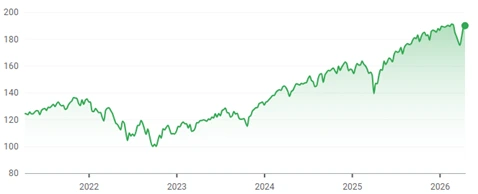
• Performance over the last 5 years: +72% (in EUR Total Return)
• Sector exposure: Technology, financial, healthcare, consumer cyclical and industrial
• Representative companies: Apple, Microsoft, NVIDIA, Amazon, Alphabet, Meta
• Geographical exposure: Global
The MSCI World is one of the most comprehensive indices in the world, designed to measure the performance of large and mid-cap companies in 23 developed market countries. Unlike national indices, the MSCI World offers a panoramic view of the global economy, capturing the growth of the planet’s most influential companies.
This index is frequently used as the "anchor" of a diversified investment portfolio. By including more than 1,500 constituents, it allows you to mitigate the specific risk of a single country. For a NextGen investor, it is the tool to gain exposure to global growth with a single instrument (such as an ETF that replicates this index).
MSCI World performance over the last 5 years
Source: Google Finance, data updated in April 2026.
Recommended reading
Read this article and discover what the MSCI World Index is, how it works and how it can help you access the world’s largest companies.
2. S&P 500
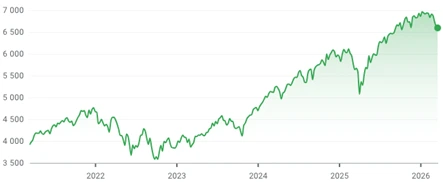
• Performance over the last 5 years: +80% (in EUR Total Return)
• Sector exposure: Technology, healthcare, energy, consumer goods and industry
• Representative companies: Apple, Amazon, NVIDIA, Microsoft
• Geographical exposure: USA
The S&P 500 tracks around 500 of the largest listed companies in the United States, selected based on criteria such as market capitalisation, liquidity and sectoral relevance. It is calculated based on market capitalisation, which means that larger companies have a greater influence on the index’s performance.
This index is one of the main barometers of the US stock market, reflecting the performance of the largest listed companies in the United States, representing approximately 80% to 85% of US stock market capitalisation. It includes global leaders in technology, healthcare, energy, consumer goods and industry. For many investors, it is the main reference for long-term strategies and international diversification.
S&P500 performance over the last 5 years
Source: Google Finance, data updated in April 2026.
Recommended reading
Read this article and discover what the S&P 500 is, how it works and the main steps to invest in this benchmark index.
3. Nasdaq-100
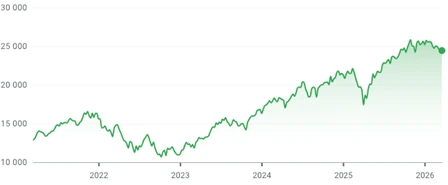
• Performance over the last 5 years: +110% (in EUR Total Return)
• Sector exposure: Technology, software, semiconductors, communications
• Representative companies: NVIDIA, Apple, Meta, Alphabet, Tesla
• Geographical exposure: USA
The Nasdaq-100 brings together 100 of the largest non-financial companies listed on the Nasdaq exchange. It is strongly associated with the technology sector, although it also includes consumer, healthcare and communications companies.
This index is calculated based on market capitalisation, but is distinguished by the exclusion of non-financial companies, which gives greater weight to companies in innovation, software, semiconductors and digital platforms. For this reason, it tends to show greater volatility than more diversified indices, but it can also benefit from more intense cycles of technological growth.
Nasdaq-100 performance over the last 5 years
Source: Google Finance, data updated in April 2026.
4. Euro Stoxx 50
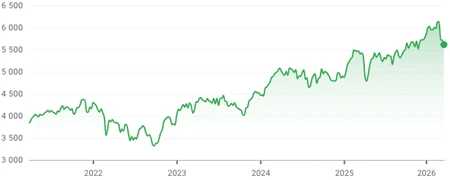
• Performance over the last 5 years: +65% (in EUR Total Return)
• Sector exposure: Industry, banking, energy, luxury
• Representative companies: LVMH, ASML, Siemens, TotalEnergies
• Geographical exposure: Eurozone
The Euro Stoxx 50 brings together 50 of the largest companies in the Eurozone and is one of the main benchmark indices for those who want to track the performance of major European companies.
The index is calculated based on free-float-adjusted market capitalisation, reflecting only the shares actually available for trading. It includes companies from countries such as Germany, France, Spain, Italy and the Netherlands, offering an aggregated view of the largest single-currency economies.
In terms of sectors, it has significant weight in industry, banking, energy and consumer goods. For investors, it is an efficient way to gain exposure to major eurozone companies without depending exclusively on a single country.
Euro Stoxx 50 performance over the last 5 years
Source: Google Finance, data updated in April 2026.
5. DAX
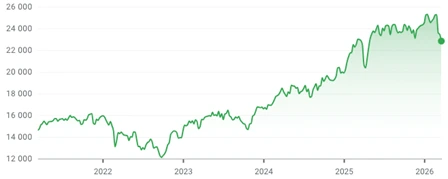
• Performance over the last 5 years: +56% (in EUR Total Return)
• Sector exposure: Industry, automotive, technology, chemicals
• Representative companies: Siemens, SAP, BMW, Allianz
• Geographical exposure: Germany
The DAX represents the largest companies listed on the Frankfurt Stock Exchange and is calculated based on free-float-adjusted market capitalisation, i.e. it only considers shares actually available for trading on the market.
As Germany is the largest economy in the Eurozone, the DAX is often seen as a thermometer of European economic performance. The index has a strong exposure to industrial, automotive, chemical and technology sectors, reflecting the export profile of the German economy. As such, its behaviour is often linked to the evolution of international trade and global growth.
DAX performance over the last 5 years
Source: Google Finance, data updated in April 2026.
6. CAC 40
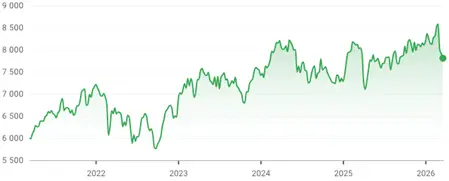
• Performance over the last 5 years: +70% (in EUR Total Return)
• Sector exposure: Luxury, energy, industry, banking
• Representative companies: LVMH, TotalEnergies, Airbus, BNP Paribas
• Geographical exposure: France
The CAC 40 includes 40 of the largest companies listed on the Paris Stock Exchange, selected based on their size and liquidity. Its calculation takes into account the market capitalisation of the companies, giving greater influence to those with the highest market value.
The index integrates multinationals with a strong global presence, especially in the luxury, energy, industry and financial services sectors. In this way, the CAC 40 does not only reflect the French economy, but also the international competitiveness of major European companies.
The CAC 40’s performance is linked to the evolution of the French economy, but also to eurozone dynamics and international markets, given the export and internationalised profile of several of the companies that make it up.
CAC 40 performance over the last 5 years
Source: Google Finance, data updated in April 2026.
7. IBEX 35
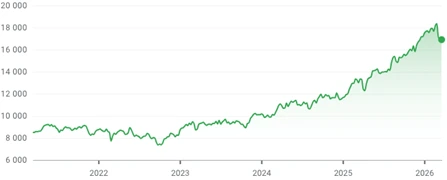
• Performance over the last 5 years: +95% (in EUR Total Return)
• Sector exposure: Banking, energy, infrastructure, retail
• Representative companies: Inditex, Santander, Iberdrola, BBVA
• Geographical exposure: Spain
The IBEX 35 tracks the 35 largest companies listed on the Madrid Stock Exchange and is the main benchmark index for the Spanish market.
It is calculated based on free-float-adjusted market capitalisation, reflecting the actual weight of companies available for trading. The index has strong exposure to the banking and energy sectors, two structural pillars of the Spanish economy, and also includes multinationals with significant global presence, such as Inditex.
The IBEX 35’s performance is linked to the evolution of the Spanish economy, but also to eurozone dynamics and international markets, given the export-oriented and internationalised profile of several of the companies that make it up.
IBEX 35 performance over the last 5 years
Source: Google Finance, data updated in April 2026.
Recommended reading
Read this article and find out how to track PSI quotes, the main index of the Portuguese stock exchange, and discover what factors you should consider when analysing its movements.
9. Nikkei 225
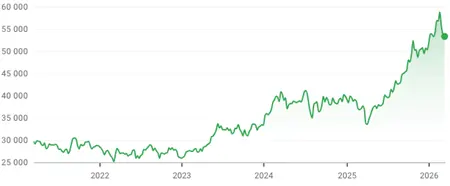
• Performance over the last 5 years: +68% (in EUR Total Return)
• Sector exposure: Automotive, technology, electronics, industry
• Representative companies: Toyota, Sony, SoftBank, Panasonic
• Geographical exposure: Japan
The Nikkei 225 is the main index of the Tokyo Stock Exchange and includes 225 large Japanese companies from various sectors, such as technology, automotive, electronics and heavy industry.
Like the Dow Jones, it is calculated based on share prices, which means that companies with higher value shares exert greater influence on its daily variation. As Japan is one of the world’s largest economies, the Nikkei 225 is an essential reference for those who want to diversify investments in Asia and monitor the region’s economic dynamism.
Nikkei 225 performance over the last 5 years
Source: Google Finance, data updated in April 2026.
10. Hang Seng Index
• Performance over the last 5 years: -15% (in EUR Total Return)
• Sector exposure: Financial, technological (information), consumer, real estate
• Representative companies: Tencent Holdings, Alibaba Group, HSBC Holdings, Meituan, AIA Group
• Geographical exposure: Hong Kong (with strong exposure to mainland China companies)
The Hang Seng Index tracks the main companies listed on the Hong Kong Stock Exchange and is one of the most important references for measuring the performance of the Chinese market and the Asia-Pacific region.
The index is determined based on market capitalisation, reflecting large companies from the financial, technology, real estate and energy sectors. Many of the companies included have a strong connection to the mainland Chinese economy.
Due to its exposure to China, the Hang Seng can be more sensitive to political decisions, regulation and economic dynamics in the region. For those who want geographical diversification outside Western markets, it is an index frequently considered.
Hang Seng Index performance over the last 5 years
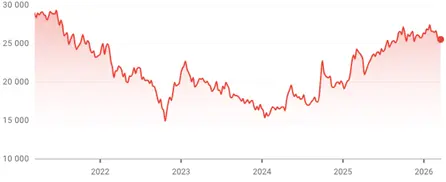
Source: Google Finance, data updated in April 2026.
Warning
The historical returns of an index are an indicator of past performance and do not constitute a guarantee of future results.
Comparison of the Main Stock Market Indices
| Index | Region | Type | Volatility | Characterisation |
|---|---|---|---|---|
| MSCI World | Global | Developed Markets | Medium | Global Exposure |
| S&P 500 | US | Diversified | Medium | Long-term |
| Nasdaq-100 | US | Technology | High | Growth |
| Euro Stoxx 50 | Eurozone | Diversified | Medium | Broad exposure |
| DAX | Germany | Industrial | Medium | European economy |
| CAC 40 | France | Multinational | Medium | Europe |
| IBEX 35 | Spain | Banking/Energy | Medium | Europe |
| PSI | Portugal | Concentrated | Medium/High | Local exposure |
| Nikkei 225 | Japan | Industrial | Medium | Asia |
| Hang Seng | Hong Kong | China-exposed | High | Emerging markets |
Note: Annualised volatility calculated based on daily returns over the last five years. Determining suitability for each Client’s Profile requires individualised analysis, within the scope of the suitability questionnaire provided for in the Markets in Financial Instruments Directive II (MiFID II).
How to use indices in your investment strategy
Indices are not just for consultation; they are tools that allow you to execute asset allocation strategies with precision. Depending on your profile and objectives, you can use them in the following ways:
Geographical Diversification
To mitigate the risk of being exposed to just one economy, you can "buy" the performance of different regions:
• USA: The S&P 500 offers exposure to the 500 largest companies in the world’s largest economy;
• Europe: The Euro Stoxx 50 allows you to invest in an aggregated way in the powers of the Eurozone;
• Asia: Indices such as the Nikkei 225 (Japan) or the Hang Seng (Hong Kong) give access to the dynamism of the Asian market.
Focus on Growth and Innovation
Those who believe in the potential of disruptive sectors can focus their allocation where innovation is strongest:
• Technology and Innovation: The Nasdaq-100 is an option for those seeking exposure to disruptive companies.
The "Anchor" of the Portfolio
Those seeking the maximum balance between risk and return in the long term:
• General Diversification: The MSCI World is frequently used as the basis of an investment portfolio, as it covers developed markets around the world.
NextGen Strategy Tip
A common strategy among investors seeking balance is the combination of different indices to build a robust and balanced portfolio. Many use a broad global index, such as the MSCI World, for the base of their portfolio, ensuring exposure to the world’s major economies. From here, it is possible to adjust exposure to specific sectors, such as technology (Nasdaq-100) or emerging markets (Hang Seng), through tactical allocations in other indices, depending on the market view and each investor’s risk profile. Concentration in a single index or geography increases specific market risk.
How to invest in the Main Stock Market Indices
It is not possible to "buy" an index directly, but rather instruments that replicate its performance. For a NextGen investor, the most efficient options are:
• ETFs (Exchange Traded Funds): Funds that copy the composition of the index with reduced costs and real-time trading;
• Investment Funds: Active management options (to try to beat the index) or passive (indexed);
• Derivatives and Certificates: Instruments for investors seeking more advanced strategies.
Invest in the Main Stock Market Indices with GoBulling Investor
To access these indices and build your investment strategy, Banco Carregosa provides the GoBulling Investor Trading Platform, a technology designed to be intuitive, agile and fully adapted to the needs of the modern investor.
• Simplified Access: Explore the main world indices and a wide range of ETFs through a clear and organised interface;
• Total Control: Monitor the performance of your assets in real time, with the security and institutional rigour of Banco Carregosa;
• Focus on Efficiency: Ideal for those who value ease of use without giving up professional execution in global markets.
NextGen Tip
The GoBulling Investor is your starting point. With a single platform, you can guarantee the necessary exposure to global growth, allowing you to implement the diversification strategies discussed in this article in a simple and direct way. You can try our DEMO version* here.
*The DEMO account is intended exclusively for familiarisation with the platform and may not necessarily fully reproduce the actual execution conditions.
Start building your strategy with Carregosa NextGen
Understanding the main stock market indices is understanding how the pulse of the world’s largest economies is measured. Each index has its own methodology, dominant sectors and level of risk and all of this influences your investment.
At Carregosa NextGen, we help you turn knowledge into strategy. Through the GoBulling platform, you can invest in the main stock market indices through ETFs and other financial instruments that replicate their performance, ensuring access to international markets in a simple and strategic way.
If you want to diversify your portfolio with a global vision aligned with your profile, talk to us and find out how to take the next step.
Main Stock Market Indices: Frequently Asked Questions
Which is the best index to start investing in?
There is no absolute "best", but rather the one most suited to your profile and objectives. For the long term and stability, the S&P 500 tends to be the global standard due to its diversification; for a focus on innovation, the Nasdaq-100 may be the choice if you believe in the technology sector; for exposure to Europe, the Euro Stoxx 50 focuses on the largest economies in the Eurozone; for proximity, the PSI allows you to invest in the largest national companies.
Can I invest directly in an index?
No. An index is a mathematical calculation and not a financial product. To invest in it, you use instruments that replicate its performance, such as ETFs or investment funds.
What is the real difference between the S&P 500 and the Nasdaq-100?
The main difference is the composition. The S&P 500 is multi-sectoral (energy, finance, healthcare, etc.), while the Nasdaq-100 excludes the financial sector and focuses more on technology and aggressive growth.
Does investing in indices guarantee a profit?
Historically, major indices tend to grow in the long term, but there are no guarantees of profitability. The value of your investments may fluctuate and you should always consider market risk before investing.
Which platform should I use to trade these indices?
At Banco Carregosa, you can use the GoBulling Investor for an intuitive experience focused on the main indices and ETFs, or the GoBulling Pro for advanced technical analysis and broader access to global markets.
Disclamer: This article has been prepared by Banco Carregosa, S.A., a financial intermediary registered with the CMVM, and constitutes commercial communication, for informational and educational purposes only. It has not been prepared in accordance with the legal requirements designed to promote the independence of investment analysis. The content does not constitute a proposal, offer, personalised investment recommendation or financial, tax or legal advice. Investing in financial instruments involves risks, including total or partial loss of invested capital, market risk, liquidity risk and exchange rate risk. Products that replicate indices (ETFs, funds, certificates, derivatives) have their own costs that reduce the investor’s effective return compared to that of the replicated index. The returns presented refer to past periods, in Total Return converted to euros, and do not include commissions, taxes or exchange costs; past returns are not a reliable indicator nor a guarantee of future returns. The investment decision must be preceded by a suitability or appropriateness assessment, under the terms of MiFID II. We recommend consulting your account manager at Banco Carregosa or an authorised financial adviser, as well as the applicable pre-contractual documentation (KID, prospectus or management regulations), before any investment decision.