



Interest Rates: What they are and how they affect investors


Interest rates directly affect yields, financing costs and market confidence, thereby influencing investment decisions. Therefore, it is important to recognise opportunities in both rising and falling markets and to know how to position yourself strategically.
This guide explains what interest rates are, how they affect your investments, and how to use different strategies to maximise your portfolio's potential in each context.
What are interest rates?
Interest rates are the price paid for borrowing. In other words, it is the amount you pay when you use someone else’s money for a certain period of time and then return the principal plus an income (interest). This is the opportunity cost of foregoing the use of one’s own money while someone else, who has no capital of their own, borrows that money to carry out their consumption or investment projects, paying interest at the end of the contract (this is the cost of the loan or borrowing). Interest rates reflect the time preferences of those who postpone consuming or investing (by lending their money) and those who anticipate consuming or investing (by borrowing).
Risk, time, scarcity, inflation, economic trends and central banks all affect interest rates. The riskier the loan, the higher the interest rate, and the longer the loan, the riskier it is, so the interest rate tends to be higher. Strong economic activity can lead central banks to raise interest rates to curb potential inflationary surges.
With more activity comes more money, more liquidity and more money to lend, so the interest rate, commonly known as the price of money, tends to fall. No wonder that managing this "price” is one of the most powerful tools available to central banks.
INTEREST RATE ON NEW LOANS GRANTED BY BANKS TO COMPANIES - ECB
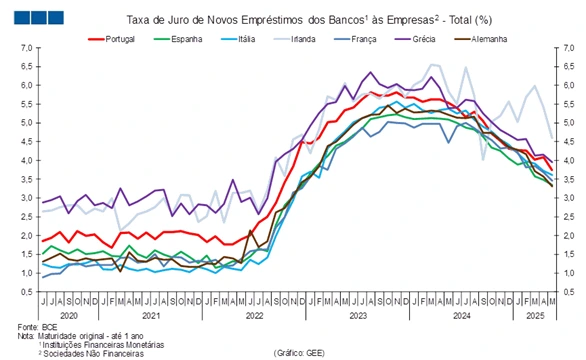
Source: Banco de Portugal
During periods of strong economic growth, demand for goods and services increases, which can lead to higher prices, in other words inflation. To prevent inflation from getting out of hand, central banks can raise interest rates, making credit more expensive and slowing down the economy. On the other hand, in times of recession, central banks can lower interest rates to stimulate consumption and investment. Lower interest rates make borrowing cheaper, which can help stimulate the economy.
These decisions will, of course, affect conditions throughout the financial market, including interest rates for individuals and businesses applying for financing. Typically, when a central bank raises its policy rate, the interest rate charged between banks tends to increase, making the cost of money more expensive for banks, companies, and private clients. Conversely, a fall in the policy rate makes money more accessible.
Qual a taxa de juro de referência em Portugal?
The history of interest rates reveals their pivotal role in the global economy. Their fluctuations are determined by factors such as inflation, economic growth, financial crises and monetary policies, and other factors.
In Portugal, the reference interest rate is set by the European Central Bank (ECB) and has fluctuated significantly in recent decades. Following the financial crisis of 2008, the EBC cut rates to historic lows, repeating this strategy during the pandemic crisis to stimulate consumption, credit and investment.
In hindsight, the average interest rate was below 2% in 1998, peaking at 4.75% in 2000 before reaching an all-time low of 0% in March 2016. The ECB’s current main refinancing rate is 2.15% (the cost of lending to banks on the open market), the deposit rate is 2%, and the rate on marginal lending is 2.40%.
Types of interest rates
As interest rates can impact investment strategies, it is important to understand what they are and how they can affect you.
Nominal vs. real interest rates
The nominal interest rate is the interest rate that has not been adjusted for inflation. For example, if you have an investment that pays 5% interest per annum, this would be considered the nominal interest rate. The real interest rate, on the other hand, is the inflation-adjusted rate, which reflects the actual purchasing power of your investment income. To calculate the real interest rate, subtract the inflation rate from the nominal interest rate. For instance, if the nominal interest rate were 5% and the inflation rate were 2%, the real interest rate would be 3%.
In a high inflation environment, the real interest rate can be significantly lower than the nominal interest rate. This has an impact on the real return on investments. Therefore, it is important to take this into account when assessing the real return on your portfolios.
Fixed vs. variable interest rates
As the name suggests, fixed interest ratesremain constant throughout the investment period, providing a certain degree of predictability. Investors have greater certainty regarding how much they will pay or receive in interest. In contrast, variable interest rates fluctuate in line with changes in market rates, often linked to a reference rate, such as the 3-, 6- or 12-month Euribor.
What does this mean for borrowers? In a scenario of rising interest rates, a fixed rate may be advantageous, as it can protect borrowers from cost increases. Conversely, in a falling interest rate environment, a variable rate could offer savings. When choosing between fixed and variable rates, investors should consider their risk tolerance and the market outlook.
Conversely, in a scenario of rising interest rates, savers should look for a variable rate, as this will benefit them. In a falling interest rate environment, however, a fixed rate may provide additional income thanks to a higher interest rate. When choosing between fixed and variable rates, savers should also consider their risk tolerance and market outlook.
Reference or policy rate
Reference (or policy) interest rates fall within the range between the deposit interest rate – the rate at which the ECB pays commercial banks for deposits – and the marginal lending rate – the rate at which banks pay the ECB for loans. These rates affect the interest rates charged by European banks on loans and deposits. In turn, this rate is reflected in the cost of funding for economic agents with their banks.
Decisions on policy rates directly impact investment returns. They can even trigger large-scale adjustments in financial markets, affecting everything from mortgages to corporate bonds. This is why investors should monitor central bank policy, in order to anticipate interest rate movements and adjust their investment strategies accordingly.
Short and long-term interest rates
Short-term interest rates refer to money market rates, such as the Euribor rate in the eurozone. These rates represent the intentions of commercial banks and other monetary institutions regarding the price at which they are willing to lend money to each other for periods of up to one year. These rates are directly influenced by the central bank. Long-term interest rates, on the other hand, have a maturity of more than one year and correspond to capital market rates, such as government bond yields.
What happens when interest rates rise or fall?
Rise in interest rates
Rising interest rates increase the cost of borrowing, reducing consumers' purchasing power and moderating demand in an attempt to control inflation. This makes it harder for companies to invest and expand, which can put pressure on their financial results.
As a result, investors tend to sell their shares, in anticipation of weaker growth prospects, which can lead to devaluations and increased volatility in the stock market. Safer investments, such as bonds, then become more attractive.
In the bond market, prices and interest rates move in opposite directions. When interest rates rise, the attractiveness of bonds with coupons (i.e. the interest rate paid periodically by the bond issuer) decreases, reducing their price on the secondary market.
For example, imagine that you purchase a €1,000 bond maturing in five years with a coupon rate of 3%, paying out €30 each year. The coupon is the fixed interest rate that the bond pays periodically. However, if market interest rates rise after six months, meaning similar new bonds offer a yield of 4%, these new bonds will offer higher returns, making your bond less attractive. If you try to sell your bond on the secondary market, you will receive less than €1,000 for it, reflecting investors’ preference for higher-yielding bonds.
Falling interest rates
When interest rates fall, the price of existing bonds with higher coupons increases, as they outperform new issues and their prices rise in the secondary market.
When interest rates fall, the prices of existing bonds tend to rise because bonds issued at higher rates previously become more attractive compared to new issues offering lower yields. This is because investors are willing to pay more for bonds that offer a higher guaranteed return than is currently available on the market.
Real estate investments, including real estate investment trusts (REITs), benefit from lower interest rates in two ways. Firstly, financing costs fall, making property purchases cheaper. Secondly, more accessible credit increases demand for property, which boosts the sector's appreciation and makes property investment more attractive.
Thanks to Banco Carregosa’s expert monitoring, investors can adapt their strategies in response to these scenarios, thereby maximising their portfolio's potential.
What to consider before investing
When it comes to interest rates, here is what you should consider before investing:
1. Assess the economic context
Before investing, you should understand the economic context of the target market, including interest rate trends, inflation and economic growth. This will help you to make informed decisions about when and how to invest. It is also important to keep up to date with market and macroeconomic events. Sources of information such as Banco Carregosa’s Quarterly Outlook can help you to do this.
2. Calculate the real rate of return
Consider not only the nominal interest rate offered by the investment, but also the expected rate of inflation. To calculate the real return, subtract the expected inflation rate from the nominal interest rate.
3. Analyse interest rate forecasts
Study the interest rate forecasts of the central banks in the markets in which you intend to invest. Keep track of central bank statistics, publications and meeting calendars to help you anticipate future changes to interest rates and adjust your investment strategy accordingly.
4. Diversify your portfolio
A diverse portfolio comprising a variety of investments, including those of different maturities and sectors, can help mitigate the risks posed by fluctuating interest rates.
5. Have a long-term strategy
Interest rates can fluctuate over time. Adopting a long-term investment strategy can help you overcome short-term fluctuations and achieve your financial goals more consistently.
6. Keep track of central bank policy
Stay up to date with central bank decisions. Changes in monetary policy can significantly affect interest rates and the wider financial market, and therefore your investments.
Interest rates: future trends
Projections indicate a gradual decline in interest rates by 2025, reflecting a slowdown in inflation and changes to the monetary policies of central banks. In Europe, the European Central Bank (ECB) is expected to maintain the reference rate (Main Refinancing Operations, MRO) at around 2%, while the Federal Reserve in the United States could reduce its rate to around 3.75%, according to market expectations.
With inflation projected at 2% in the eurozone, real interest rates could remain negative, which would limit the returns on conservative investments. Mário Carvalho Fernandes, Chief Investment Officer (CIO) at Banco Carregosa, warns that "European investors must take risks with their portfolios if they want returns that will at least allow them to maintain the purchasing power of their assets”.
The trend towards monetary easing reflects a moderation in the policies of central banks, but the impact varies between sectors. While the services sector continues to grow, industry is facing challenges due to high energy costs and uncertainties in global trade. This requires more dynamic investment strategies.
Key Takeaways
What are interest rates and how do they affect investments?
Interest rates represent the cost of borrowing or the return on an investment. They directly influence financial markets: higher rates increase borrowing costs, impacting stocks and real estate, while lower rates stimulate consumption and boost the value of existing bonds, shaping investment decisions.
What is the difference between nominal and real interest rates?
The nominal interest rate is the unadjusted rate, while the real interest rate is adjusted for inflation by subtracting the inflation rate from the nominal rate. For example, a 5% nominal rate with 2% inflation yields a 3% real rate, reflecting the true investment return.
How do European Central Bank decisions impact interest rates?
The European Central Bank (ECB) sets reference rates that affect borrowing costs for banks, businesses, and individuals. Higher reference rates increase loan costs, while lower rates ease financing, influencing investments in stocks, bonds, and real estate.
What are the risks of investing in a variable interest rate environment?
Investing in a variable interest rate environment carries risks, such as:
- Stock market volatility due to rising rates;
- Depreciation of existing bonds when rates increase;
- Reduced purchasing power in high-inflation scenarios;
- Negative impacts on rate-sensitive sectors like real estate.
Diversifying the portfolio can help mitigate these risks.
How can I invest safely amid changing interest rates?
To invest safely in a fluctuating interest rate environment:
- Assess the economic context and ECB forecasts;
- Calculate real returns, factoring in inflation;
- Diversify your portfolio across sectors and maturities;
- Monitor central bank policies to adjust strategies;
- Consult experts, like Banco Carregosa, for tailored guidance.
Protect your assets with the help of Banco Carregosa
Robust financial strategies are required in the face of market uncertainty exacerbated by interest rate fluctuations. You can rely on Banco Carregosa to guide you through the complexities of the markets, maximise your investment opportunities and help you to make informed decisions, building a resilient and profitable portfolio in the process. Contact us.