



How to choose the best Term Deposits in 2026


This article reflects Banco Carregosa’s approach to savings and investments, based on market analysis and the continuous monitoring of interest rates in Portugal.
At a glance:
• A fixed-term deposit is a low-risk financial product in which capital is deposited with a credit institution for a set period in exchange for an agreed rate of interest. It is characterised by guaranteed capital and direct supervision by Banco de Portugal.
• Although they are considered low-risk products, significant differences exist in terms of rates, conditions, and withdrawal options.
• At Banco Carregosa, our personalised advice will help you to compare rates, analyse the term and understand the associated conditions.
When it comes to safe savings, fixed-term deposits remain one of the most popular solutions. The ability to invest capital at a predetermined interest rate, combined with the product’s simplicity, makes these instruments a popular choice for those who value predictability.
However, not all fixed-term deposits are the same. Differences in interest rates, terms, withdrawal conditions, and the frequency of interest payments can affect the final return.
This article explains what fixed-term deposits are, how they work, and which factors are key when choosing the best ones in Portugal.
Fixed-term deposits: What they are and how they work
A fixed-term deposit is a financial product in which a client deposits a sum with an authorised credit institution for a set period of time. In return, the client receives interest at an agreed rate. The capital is guaranteed and the deposits are supervised by Banco de Portugal. During the term of the investment, interest is generated on the capital invested. This may be paid in advance, in arrears or periodically (monthly, quarterly, or annually), depending on the terms and conditions of the product. According to updated data from Banco de Portugal (as of 1 April 2026), the average rate for new fixed-term deposits of up to one year is 1.36% (gross AER).
Interest rates on new term deposits for private individuals
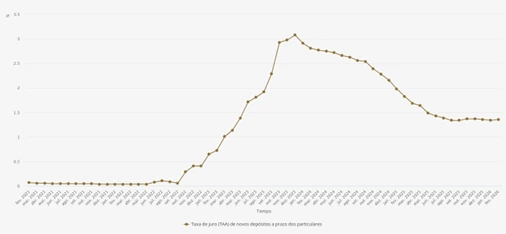
Source: Banco de Portugal, data updated in April 2026.
It is also important to understand how these rates are presented. For fixed-term deposits offered in Portugal, the return is expressed as the gross AER (Gross Annual Equivalent Rate), which shows the annual interest rate before tax. The Standardised Information Sheet (SIS) also refers to the net AER (Net Annual Equivalent Rate), which shows the net return once taxes have been deducted.
During periods of higher inflation, the potential for achieving a positive real return may be limited. Some alternatives, such as investing in equity markets — for example, through diversified indices like the S&P 500 — may offer greater potential for long-term returns, although they also involve greater volatility and risk.
In many cases, the capital remains tied up until the end of the term, although some deposits allow early withdrawal, typically resulting in a partial or total loss of interest.
What part do fixed-term deposits play in your portfolio?
Fixed-term deposits are more than just standalone products; they should be seen as a strategic component within a diversified portfolio. They typically serve three main functions:
• Emergency reserve fund: They enable you to keep your capital accessible and protected in the event of unforeseen circumstances, while avoiding exposure to market risk.
• Defensive component: They balance portfolios containing more volatile assets to reduce overall risk.
• Liquidity management: They are ideal for capital that may be needed in the short term, as they avoid market fluctuations.
• Safe haven: They function as a "safe haven” during periods of uncertainty or when other investment opportunities are unattractive, enabling investors to wait for more favourable market conditions.
Recommended reading
Find out in this article what gross AER means, how it is calculated and how this rate affects the return on your investments.
Advantages of fixed-term deposits
The popularity of fixed-term deposits among savers and investors with a more conservative profile can be explained by several features.
• Security and predictability: One of the main advantages of fixed-term deposits is that the return is predictable. The interest rate is set when the deposit is opened, so you know in advance what your return will be;
• Capital protection: Deposits are usually covered by the Deposit Guarantee Fund, which protects amounts up to certain limits per depositor and per credit institution, reinforcing the security of this type of product;
• Simplicity: Unlike other financial instruments, fixed-term deposits are easy to understand and do not require constant market monitoring;
• Choice of different terms: there are short-term deposits, such as a 3-month fixed-term deposit, as well as longer-term options, allowing the product to be tailored to the saver’s liquidity needs.
Deposit Guarantee Fund: What is it?
For many savers, security is the most key factor when choosing a fixed-term deposit. In Portugal, this security is reinforced by the Deposit Guarantee Fund (DGF), which is a vital mechanism designed to protect depositors if a credit institution becomes insolvent.
The DGF guarantees reimbursement of up to €100,000 per depositor and per credit institution, provided that the bank is a member of the fund. This reimbursement is triggered if the bank lacks the financial means to return deposited funds.
This limit applies to each account holder individually. For example, the total guarantee for a joint account can rise to €200,000 (€100,000 for each account holder), provided that the account holders do not hold any other accounts at that institution.
Term deposits are not the only thing that is protected; current accounts, savings accounts, and deposits subject to notice are protected too.
Note: Although the €100,000 limit per depositor is harmonised at a European level, the guarantee provider depends on the location of the bank's head office. At Banco Carregosa, protection is provided by the Portuguese Deposit Guarantee Fund (FGD), whereas at branches of foreign banks (such as Bankinter), it comes from the fund of the country of origin (e.g. Spain).
Recommended reading
Read this article to find out more about the Deposit Guarantee Fund, how it works and what protection you have when you deposit your money in the bank.
Limitations of fixed-term deposits
Despite their advantages, fixed-term deposits also have limitations that should be considered. The main ones are as follows:
• Potentially limited returns: compared to investments in shares, funds or bonds, fixed-term deposits tend to offer lower returns, reflecting the lower risk involved;
• Impact of inflation: if the inflation rate exceeds the deposit interest rate, the capital's purchasing power may decrease over time;
• Less flexibility: some deposits do not permit early withdrawal or impose penalties for withdrawals before the end of the investment term, which may limit access to the capital during this period.
Types of fixed-term deposits
The form that fixed-term deposits take depends on how they are remunerated and how complex the product is. In general, there are two main types: simple and structured (or indexed) deposits.
Simple term deposits
The return on simple term deposits is linked to a fixed or variable interest rate, as set out in the product’s terms and conditions.
With fixed-rate deposits, the interest rate is set when the deposit is opened and does not change during the term. This enables savers to calculate the return on their investment in advance.
However, the return on variable-rate deposits depends on the performance of a market index, such as Euribor. In this case, the interest rate on the deposit is typically the sum of the value of the relevant index and a spread set by the bank, and it can fluctuate over time.
There may also be variations within this category, such as deposits with different interest rates over the term, or deposits where the spread applied to the index varies during certain periods.
Structured or indexed deposits
Unlike simple deposits, the return on structured deposits depends on the performance of certain economic or financial indicators.
For instance, returns may be linked to the performance of shares, stock market indices, portfolios of shares, or other financial assets. While the potential return may be higher than that of a traditional deposit in such cases, it is also subject to the specific conditions defined for the product.
Before a client takes out a structured deposit, the financial institution must provide them with a Key Information Document (KID) describing the product’s essential features.
Structured deposits often do not allow early withdrawal of capital before the end of the term, so it is important to fully understand all the terms and conditions before making a decision.
As with other bank deposits, these products include the relevant information documents, such as the Standardised Information Sheet (SIS) and the Depositor Information Form. These documents clearly set out the key features and the deposit protection framework.
A step-by-step guide to choosing fixed-term deposits
Selecting the most suitable fixed-term deposit in Portugal requires more than merely comparing the advertised interest rate. Several factors should be analysed to ensure the chosen product aligns with your financial goals and savings horizon.
Before deciding, it is important to analyse the features of each deposit in a structured manner.
1. Compare the interest rates available
The first step is to analyse the best interest rates for fixed-term deposits currently on the market.
Not all banks offer the same rates, which can vary depending on numerous factors:
• The term of the deposit;
• The minimum amount required;
• Promotional offers;
• Specific conditions for new clients or new deposits.
In addition, it is important to understand whether the deposit offers a fixed or variable interest rate. With a fixed-rate deposit, the interest rate is set when the account is opened and does not change during the term. However, with variable-rate deposits, the rate depends on the performance of a market index, such as Euribor, and may therefore fluctuate over time.
2. Assess the term of the deposit
The term is one of the factors that most influences a product’s return and flexibility.
A three-month term deposit, for example, may be suitable for those who wish to maintain high liquidity, while longer terms may offer higher interest rates.
3. Consider the currency of the deposit
Although most term deposits are denominated in euros, there are also deposits denominated in foreign currencies, such as US dollars.
In these cases, the return may be influenced by both the deposit's interest rate and changes in the exchange rate between the deposit currency and the euro. Depending on whether the currency appreciates or depreciates, the final amount received when converted back into euros may therefore vary.
Savers who wish to diversify their savings or keep part of their capital exposed to other currencies can therefore use foreign currency deposits, although they should also take into account the associated exchange rate risk.
4. Check the conditions for early withdrawal
Not all deposits allow you to withdraw your capital before the end of the term.
If this option is available, the following factors must be considered:
• Whether there is a total or partial penalty on interest;
• Whether there are minimum holding periods;
• If withdrawals can be made at any time.
This analysis is particularly important for those who want to be able to manage their savings flexibly.
It is also important to check whether the deposit allows for automatic renewal upon reaching the end of the term. If the saver does not provide instructions, the deposit is often renewed for the same period at a significantly lower interest rate. It is therefore advisable to review the renewal terms and compare them with other offers on the market before each maturity date.
5. Check the frequency of interest payments
Some deposits pay interest only at the end of the term, while others offer periodic or advance payments.
The most common options are payment at the end of the term, annual payment, and quarterly or half-yearly payment.
Advance interest payments are not so common and generally do not allow for early withdrawal. This means that you must keep the fixed-term deposit until the end of the agreed period, offering no immediate liquidity.
6. Check the minimum and maximum investment amounts
The minimum deposit amount required for fixed-term deposits varies between products and financial institutions.
In addition to the minimum amount, some deposits also have a maximum investment limit. Banks use these limits to control exposure to certain interest rates or to fit specific products within commercial strategies.
In some cases, there may also be additional deposits designed to complement other products. The maximum amount permitted for these depends on the amount of capital previously invested in another deposit. Therefore, it is important to review these conditions before deciding.
7. Check if your capital is protected
Before choosing a fixed-term deposit, it is important to make sure that your investment is protected by a safety mechanism.
In Portugal, deposits held with authorised financial institutions are covered by the Deposit Guarantee Fund, which provides:
• Protection of up to €100,000 per depositor and per institution;
• Reimbursement if deposits become unavailable;
• Coverage applicable to most traditional bank deposits.
This mechanism is one of the main reasons why term deposits are considered a low-risk solution. You can check the official list of participating institutions on the Deposit Guarantee Fund website or check the product’s Key Information Document (KID), which must state which fund guarantees the capital.
8. Consider the impact of taxes
The return on a fixed-term deposit does not depend solely on the advertised interest rate (gross AER). In Portugal, interest is subject to a withholding tax of 28% on the mainland and 19.6% in the autonomous regions of Madeira and the Azores, reducing the effective return.
It is therefore essential to distinguish between:
• Gross AER: rate before tax;
• Net AER: rate after tax.
In practice, the net AER is the actual amount the investor receives.
Practical example: a fixed-term deposit of €10,000 with a gross AER of 2.5% over 12 months would result in:
• Gross interest: €250
• Tax (28%): €70
• Net interest: €180
The net return is approximately 1.8%.
9. Consider the role of the fixed-term deposit in your savings strategy
Finally, it is important to ensure that the deposit fits into your overall financial management strategy.
Some savers use fixed-term deposits as a liquidity reserve, to complement more diversified investment strategies or as a short-term savings solution.
Clearly defining the objective of the invested capital makes it easier to choose the best available fixed-term deposit.
Christmas Term Deposit: rates of up to 3.00% APR
Banco Carregosa is offering the Christmas Term Deposit, a short- and medium-term solution with guaranteed capital that reaches the highest rate in the euro range: 3.00% APR over 12 months. Campaign available from 1 October to 31 December.
| Term | APR (gross) | Net rate (PIT 28%) | Net rate (CIT 25%) |
|---|---|---|---|
| 3 months | 2.50% | 1.80% | 1.88% |
| 6 months | 2.75% | 1.98% | 2.06% |
| 12 months | 3.00% | 2.16% | 2.25% |
APR — Gross Nominal Annual Rate. Net rate — Net Nominal Annual Rate, taking into account withholding tax of 28% (personal income tax) or 25% (corporate income tax). Calculation basis Actual/360, without compounding.
Three features that set it apart
• Interest paid at the start, not at the end. Unlike most term deposits, the interest is credited to your current account by the business day following the deposit’s creation, value-dated to the same day. In practice, you receive the return upfront, rather than waiting until maturity.
• Accessible amounts, per deposit. Subscription starts from €5,000, with a maximum of €150,000. These limits apply to each individual deposit created, not to the total amount placed.
• The option to open all three Term Deposits at once. You may open more than one Christmas Term Deposit, with different terms. You could, for example, split your savings between a 3-month deposit and a 12-month one, matching the availability of your capital to your needs.
• Guaranteed capital and Deposit Guarantee Fund coverage. Capital is guaranteed in full at the maturity date, and deposits benefit from the protection of the Deposit Guarantee Fund up to €100,000 per depositor.
Access conditions
Before subscribing, it is important to be aware of the conditions:
• Subscription period: the Christmas Term Deposit is available for subscription between 1 October and 31 December.
• New funds. Subscription is reserved for amounts transferred from another credit institution within the 30 days prior to the deposit’s creation and which have not yet been used in any way.
• Subscription exclusively through Banco Carregosa’s online banking.
• A current account with Banco Carregosa is required.
• No early withdrawal, additional deposits or automatic renewal are permitted.
• If you deposit the maximum amount of €150,000, please note that the Deposit Guarantee Fund covers up to €100,000 per depositor and per institution.
Subscription the Christmas Term Deposit
Conditions in force as at the date of publication. Please consult the Standardised Information Sheet before subscribing. Find out more here, and if you are already a Banco Carregosa client you can subscription it here.
Fixed-term deposits: solutions from Banco Carregosa
Banco Carregosa offers a range of fixed-term deposits tailored to different savings objectives. These include short-term solutions, options with periodic returns, and the possibility of capital top-ups. Use the simulator to calculate your returns.
Deposit Gross AER (up to) Amounts Term Withdrawal Investor profile Bem-Vindo 3.00% Between €5,000 and €100,000 3 or 6 months With interest penalty Ideal for investors looking to make the most of immediate liquidity at competitive entry rates. Win-Win / Soma e Segue 2.50% / 2.25% Between €5,000 and €100,000 3 / 6 months With interest penalty Investors seeking complementary liquidity solutions. 3, 6, 12 and 24-month terms 2.10% Between €25,000 and €1,000,000 3, 6, 12 or 24 months With interest penalty Ideal for those who require complete flexibility in terms of repayment periods and cash flow planning. USD 3.20% Between $25,000 and $1,000,000 3, 6 or 12 months With interest penalty Customers with ongoing expenses in dollars or seeking strategic exposure to the appreciation of the USD. Monthly return 2.20% Between €25,000 and €1,000,000 12, 24 or 36 months No withdrawal Anyone looking for a regular monthly income stream to supplement their budget. Growing savings 2.45% From €10,000 12 months With interest penalty Ideal for those looking to gradually build up their capital by taking advantage of the option to make additional deposits during the term.
Table updated as of October 09, 2026. Interest rates are subject to change without notice. We recommend that you always check the current rates at https://www.bancocarregosa.com/en/solucoes-de-poupanca-e-investimento/depositos-a-prazo-en/.
Welcome at 3 months (3% APR) or Christmas at 12 months (3% APR): which to choose?
The same rate over different terms does not produce the same result. In a 3-month deposit, the rate is guaranteed only for that period; once the term ends, reinvestment will be on the conditions in force at that time, which may be more or less favourable. In a 12-month deposit, the rate is fixed for a year.
In practice: if you anticipate that interest rates will fall, locking in 3.00% for twelve months protects you from that decline. If you expect them to rise, or if you need your capital available sooner, the shorter term gives you flexibility, albeit with the risk of reinvesting at a lower rate.
The choice depends not only on the headline rate, but also on your time horizon, your liquidity needs over the period and your own reading of how interest rates will evolve.
Note, too, that the choice need not be exclusive: as the limits apply to each deposit, you can split your capital across different terms, keeping part available in the short term while fixing the return on the remainder for twelve months.
Why choose Banco Carregosa?
Opening a fixed-term deposit with Banco Carregosa comes with a range of competitive advantages that distinguish our institution within the Portuguese financial system:
• Higher returns: compared to the sector average, our interest rates are often among the most competitive in the domestic market. This is evident in the Banco de Portugal monthly statistics, which allow average returns across the banking system to be compared with the terms offered by institutions specialising in Private Banking;
• Investment specialisation: As a savings and investment bank, asset management is done in a more agile and targeted manner;
• Institutional security: Banco Carregosa is registered with Banco de Portugal (BdP) under number 0235, and with the Portuguese Securities Market Commission (CMVM) under number 0169. We are members of the Deposit Guarantee Fund (FGD), which provides regulatory protection of up to €100,000 per depositor;
• Financial strength: Banco Carregosa remains a secure institution, underpinned by high solvency ratios that guarantee the protection of your assets.
Are you under 35?
In addition to the solutions presented, Banco Carregosa offers a range of complementary fixed-term deposits through Carregosa NextGen. These are designed for younger investors or those in the initial stages of building their wealth. You can find out more here.
Fixed-term deposits vs. Other alternatives
Fixed-term deposits are one of the simplest and most conservative ways to invest savings. While they offer guaranteed capital and predictable returns, they usually provide more limited returns, particularly over longer investment periods.
For this reason, many investors choose to supplement fixed-term deposits with other investment solutions that offer greater potential for growth or diversification. Ultimately, the choice depends on each person’s risk profile, time horizon, and financial objectives.
Fixed-term deposits vs. Savings Certificates
Savings certificates are government bonds issued by the Portuguese state and aimed at small-scale investors. Although they offer guaranteed capital and minimal risk, like fixed-term deposits, there are significant differences in terms of returns, liquidity, and subscription conditions.
Which product is chosen depends on the saver’s profile, how much is available and the desired time horizon. In some cases, it is possible to include both in the same savings strategy.
Savings certificates stand out for their flexibility, with a low minimum amount, the option to make top-ups and redeem without penalty after three months, and quarterly capitalisation, which allows savers to benefit from the effect of compound interest over time. However, the base rate is capped at 2.5%, which may be lower than the best rates available on the term deposit market.
Fixed-term deposits often offer higher interest rates, particularly for new customers or larger sums. They also allow you to secure an interest rate for the entire term, which can be useful if interest rates are falling.
In practice, the two solutions can complement each other: savings certificates are ideal for flexible, long-term savings, while fixed-term deposits are perfect for making the most of specific amounts in the short or medium term and offer more competitive rates.
Fixed-term deposits vs. Pension Savings Plan (PPR)
The Pension Savings Plan (PPR) is a regulated financial product that combines savings and investments. Although originally designed to supplement the state pension, the PPR has evolved into a versatile instrument that can help you to achieve a variety of financial goals, with options to suit each investor’s risk profile.
When you subscribe to a PPR, you are investing money in a product that is invested over time, in accordance with a predefined strategy. This amount is professionally managed and invested in different assets, such as bonds, shares or a combination of both, depending on the PPR’s profile. Depending on the markets and the strategy adopted, the capital may appreciate or depreciate over time.
The Complete Guide to Savings and Retirement
Read this article to find out what a PPR is, how it works and whether investing in one is worthwhile.
Fixed-term deposits vs. Shares
Direct investment in shares means acquiring a stake in the capital of publicly listed companies. Unlike fixed-term deposits, shares do not offer guaranteed returns, but they can appreciate in value over time.
In addition to the potential for share price appreciation, some companies pay dividends to shareholders, providing an additional source of income. However, this type of investment is subject to market volatility and requires an appetite for risk.
Fixed-term deposits are ideal for those who prioritise security, while shares are better suited to those willing to accept a higher level of risk in exchange for the potential for greater returns. Therefore, rather than asking which is better, it is important to understand that each product meets diverse needs, objectives, and risk profiles.
Fixed-term deposits vs. ETFs
ETFs (Exchange-traded funds) track the performance of a specific index, sector, or basket of assets. Like shares, they can be bought and sold at any time during the trading day.
One of the main advantages of ETFs is that they provide simple and generally more cost-effective access to broad, diversified markets, such as global or regional equity indices. For investors with a medium- or long-term outlook, ETFs can be an efficient way to participate in financial market growth.
Banco Carregosa: tailor-made fixed-term deposits
Fixed-term deposits are a savings solution that prioritises capital preservation. They are ideal for those looking to diversify their savings and investment portfolio with reduced risk.
Maximise your savings safely. Complete the form to find the fixed-term deposit solution that best suits your goals.
Fixed-term deposits: FAQs
You can find answers to the most frequently asked questions about fixed-term deposits below.
What is the difference between gross AER and net AER?
The gross AER (Gross Annual Equivalent Rate) indicates the annual interest rate before tax. The net AER (Net Annual Equivalent Rate) reflects the return after the deduction of 28% withholding tax in mainland Portugal and 19.6% in the Azores and Madeira. In practice, the gross AER (Annual Equivalent Rate) reflects the return that will be credited to the saver. For example, a deposit with a gross AER of 2.5% corresponds to a net AER of around 1.8%. When comparing deposits, you should always use the net AER as your final reference.
Do fixed-term deposits incur fees?
As a product, fixed-term deposits do not incur any fees. However, depending on the institution and the specific product taken out, the associated current account may be subject to maintenance fees. Some banks charge account maintenance fees, which can reduce the actual return on a deposit. Before opening an account, it is essential to consult the product’s Key Information Document (KID) and the bank's fee schedule, which should itemise these fees. In practice, a deposit with an apparently higher interest rate may yield less than another if it has associated fees.
Is it possible to hold fixed-term deposits with more than one bank?
Yes. There is no limit to the number of fixed-term deposits that a saver can hold with different institutions. Spreading your deposits across banks can be a beneficial strategy for taking advantage of promotional rates for new customers and maximising coverage under the Deposit Guarantee Scheme, which provides protection of up to €100,000 per depositor and per institution.
Which fixed-term deposits are the best in Portugal?
The best ones depend on several factors, such as the interest rate, term, withdrawal conditions, and the minimum amount required. It is essential to compare these features before choosing the best fixed-term deposit for your needs and objectives.
Are fixed-term deposits suitable for businesses?
Yes. They can be used as a cash management tool by businesses to make the most of surplus liquidity that is not needed in the short term. The terms (rates, durations, and amounts) often differ from those offered to individuals and are usually negotiated on a case-by-case basis. It is important to note that deposits held by legal entities are also covered by the Deposit Guarantee Fund, up to a limit of €100,000 per depositor and per institution. However, institutional investors are not covered by this protection, as provided for in the legislation governing the operation of the DGF.
Are fixed-term deposits safe?
Bank deposits are covered by the Deposit Guarantee Fund, up to certain limits per depositor and per institution. This provides an additional layer of security for this type of product.
How should fixed-term deposits be used in an environment of falling interest rates?
When interest rates are falling, it can be sensible to secure a higher rate while it is still available. This will allow you to secure a predictable return and protect yourself from any future reductions.
Which term deposit offers the best rate at Banco Carregosa?
At present, two deposits reach the highest rate in the euro range, both at 3.00% APR: the 3-month Welcome Deposit and the 12-month Christmas Term Deposit. A rate of 3.00% APR corresponds to 2.16% net, after withholding of personal income tax at 28%. Both are available from €5,000. The difference lies in the term and the access conditions: the Welcome Deposit has a 3-month term and allows early withdrawal with an interest penalty; the Christmas Deposit has a term of up to 12 months, is intended for new funds transferred from another institution, is subscribed through online banking and, because interest is paid in advance, does not allow early withdrawal.
When is interest on the Christmas Term Deposit paid?
Unlike most term deposits, the interest is credited to your current account by the business day following the deposit’s creation, value-dated to the same day. The investor receives the return at the start of the term rather than at maturity.
Disclaimer: This article has been prepared by Banco Carregosa for informational and educational purposes only. It does not constitute an investment proposal or recommendation to buy, nor does it constitute personalised financial advice. Investing in financial instruments carries risks, including the possibility of losing your initial investment. Past performance does not guarantee future results. Before making any investment decisions, we recommend that you consult an account manager or financial adviser to ensure that they are suitable for your risk profile and financial objectives.