



Passive Management: What it is, its advantages, risks, and vehicles


At a glance:
• Passive Management is an investment strategy which aims to replicate the performance of a benchmark index rather than trying to outperform it.
• It is primarily implemented through ETFs and index funds, and tends to involve lower management costs than Active Management.
• Although it eliminates the risk associated with the manager’s decisions, it retains the market risk of the replicated index. Therefore, it is not a low-risk strategy.
• At Banco Carregosa, our specialists will support you in assessing which approach best suits your risk profile and investment objectives.
Passive investment funds have attracted a record amount of investment globally. They now account for a significant proportion of the fund market. Academic studies suggest that Active Management tends not to outperform benchmark indices on average and after costs, although some managers do succeed in doing so. So, what exactly is passive investment?
What is Passive Management?
Passive Management is an investment allocation strategy. It is characterised by reproducing the performance of a given benchmark index, as is the case, for example, of the S&P 500 or the MSCI World, one of the largest funds in the market, where the benchmark serves to guide the manager’s work. Thus, Passive Management allows the investor to obtain exposure to the same return as the benchmark, with valuation fluctuations in line with the market index being replicated.
In Passive Management, it is the fund’s own rules which determine the assets that make up the portfolio, and which define the benchmark index. For example, a passive fund of global equities could invest in companies that make up the MSCI World Index in a way that mirrors their value. Another form of Passive Management is exchange-traded funds (ETFs), which replicate a specific benchmark index.
Passive Management, by definition, does not seek to outperform the market, but rather to track it. While this reduces the risk associated with the manager’s decisions, resulting in lower management costs, it does not eliminate market risk: if the benchmark index falls in value, the investment falls in the same proportion.
Unlike Active Management, which aims to achieve a return greater than the benchmark, it allows for a more flexible selection of the assets that will make up the portfolio. While this flexibility can result in better-than-index performance, it can also result in underperformance. Put simply, Passive Management tracks the benchmark more predictably, whereas Active Management seeks to outperform it while accepting the risk of failing to do so.
Passive Management vs. Active Management: what are the differences between the two approaches?
| Criterion | Passive Management | Active Management |
|---|---|---|
| Objective | To replicate the benchmark | The objective is to outperform the benchmark index |
| Asset selection | Determined by the index and the fund’s rules | Determined by the fund manager |
| Management fees | Generally lower | Generally higher |
| Market risk | Remains in line with the index | Remains the same |
| Predictability relative to the index | High | Variable |
| Monitoring by the investor | Low | Greater, if you wish to evaluate decisions |
| Suitable for those who… | Prioritise simplicity, low costs, and returns in line with the market | Seek the potential for above-index performance and accept the risk of not achieving it |
In the abstract, neither approach is better than the other; the choice depends on the objectives, time horizon, and risk profile of each investor. Many investors opt to include both within the same portfolio.
"The choice between Passive and Active Management is practical, not ideological. The important thing is to understand the risks you are taking and the associated costs.” — Filipe Silva, Head of Investment at Banco Carregosa.
What are the advantages of Passive Management?
An investment fund under Passive Management gives you access to a wide asset diversification of companies that make up the chosen benchmark index, in terms of both the number of companies and economic sector. This means that some assets can appreciate while others can depreciate.
Conversely, since the objective of Passive Management is to track rather than outperform the benchmark, there is less pressure to achieve above-average results. Consequently, the strategy of the portfolios is simpler. This reduces the monitoring needs of investors.
Moreover, the indices used as benchmarks have a long performance history, in some cases of several decades, having gone through several crises and moments of growth. Studies point to efficient performance when viewed over the long term.
Active Management Funds that underperformed against the benchmark index
From a purely returns-based perspective, the longer the investment horizon, the greater the proportion of active funds that fail to outperform the index.
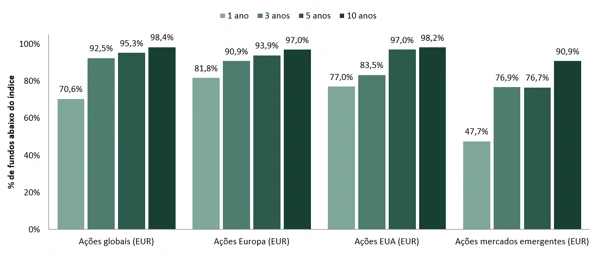
Source: S&P Dow Jones Indices, SPIVA Europe Scorecard. Active Management funds domiciled in Europe; returns net of costs, in the currency indicated. Periods ending on the reference date of the cited edition. The figures refer to market averages and not to individual managers. Past performance is no guarantee of future results.
Finally, passive funds are more predictable in their performance because they track the return of the benchmark index, rather than depending on the accuracy of a manager’s decisions. Therefore, passive management may be more suitable for investors who prioritise predictability, diversification and low costs, bearing in mind that exposure to market risk remains.
What are the risks of Passive Management?
Despite all its advantages, Passive Management carries risks:
• Market risk: during market downturns, the value of the portfolio will tend to fall if the shares comprising the benchmark fall in value. In this situation, an active manager could seek to mitigate the impact by making pre-emptive adjustments to the portfolio. However, there is no guarantee of success as this would require the manager to correctly anticipate market movements.
• Loss of opportunities: Passive Management can lead to the loss of specific opportunities that Active Management would have invested in opportunistically, especially in periods of growth.
• Concentration in the largest companies: many of the indexes used are capitalization-weighted. In other words, the larger a company’s capitalisation, the greater its weight in an investment portfolio. This increases exposure to companies with greater market capitalisation, including those which are eventually overvalued.
What is the cost of Passive Management?
One of the key differences between the two approaches is cost. Passive Management does not require continuous analysis or active asset selection, and involves fewer transactions. For this reason, its fees tend to be lower than those of Active Management.
The key indicator to look at is the TER (Total Expense Ratio), which shows the fund’s total annual costs as a percentage of the investment amount. In addition, there may be transaction costs, custody fees, and foreign exchange costs for ETFs denominated in another currency.
While the difference may seem small in a single year, it adds up over time. Over a period of two or three decades, a difference of just a few tenths of a percentage point per year can have a significant impact on the final value. This is why cost is one of the most important factors, and one of the few that investors are aware of in advance.
Passive Management: what are the instruments available?
Passive Management can be achieved using a variety of financial instruments, either individually or in combination.
ETFs (Exchange Traded Funds)
Exchange Traded Funds (ETF) are one of the most widely used investment vehicles. They are traded on an exchange and track a specific portfolio of assets. In addition to replicating benchmark indices, ETFs can also emulate sector- or theme-specific indices, such as those in the technology sector. The difference between Passive and Active ETFs is that the former maximise returns by minimising the number of transactions (purchases and sales) in the portfolio.
Investment Funds
While traditional investment funds are usually actively managed, there are also passively managed funds that track a specific index. Investment funds can be made up of shares, bonds, or both. The former invest in shares of listed companies, usually targeting a specific region or sector. Bond investment funds invest in debt securities, including government bonds, which are generally considered to be less risky because governments tend to comply with their obligations. Mixed funds comprise a combination of shares and bonds, resulting in greater diversification of product types and, consequently, associated risks.
Banco Carregosa can assist you in Passive and Active Management
What is the best strategy for you? There is no universal answer; it all depends on the objectives, dynamics, and knowledge of each investor.
For example, in the case of Passive Management, the investor should be prepared for a long-term investment with returns in line with the market and the volatility inherent in the tracked index.
Active Management is suitable for those seeking to "beat” the market and who expect their return to outperform the benchmark indices.
At Banco Carregosa, you will find a team of experienced professionals who are trained to help you make informed choices and choose the best approach for your case.
Founded in 1833 as a foreign exchange house in Porto, Banco Carregosa is the oldest financial institution operating in the Iberian Peninsula. It now operates in Private Banking and Wealth Management. It is supervised by both Banco de Portugal (registration no. 0235) and the CMVM (registration no. 0169).
In risky contexts, the professional, specialised advice offered by Banco Carregosa is essential for protecting your investments and assets. Contact our team to benefit from continuous, personalised, expert monitoring.
Passive Management: FAQs
Is Passive Management less risky than Active Management?
Not necessarily. Although Passive Management eliminates the risk associated with the manager’s decisions, it retains market risk. If the tracked index falls in value, the investment will follow suit.
Which is the better option, Passive Management or Active Management?
There is no one-size-fits-all answer. It depends on your objectives, time horizon, risk profile and sensitivity to costs. Many investors combine both approaches.
What is the difference between an ETF and an index fund?
Both can be passively managed. The main difference is that, like a share, an ETF is traded on the stock exchange throughout the trading session, whereas an index-tracking investment fund, commonly known as an index fund, is subscribed to and redeemed at the net asset value calculated at the end of the day.
Does Passive Management always replicate the index exactly?
No, there is usually a deviation from the index known as "tracking error”, resulting from the fund’s costs, replication method and portfolio rebalancing timing.
Legal disclaimer: This article has been prepared by Banco Carregosa for information and educational purposes only. Under no circumstances does it constitute an investment proposal, recommendation to purchase, or personalised financial advice. Investing in financial instruments carries risks, as well as the possibility of losing the invested capital. Past performance is no guarantee of future returns. You should consult your account manager or financial advisor before making any financial decisions to assess whether they are suitable for your risk profile and financial objectives.