



Russell 2000: What it is and how to invest in it


At a glance:
• The Russell 2000 is an index that tracks the performance of around 2,000 small US listed companies.
• Investing in the Russell 2000 gives exposure to the small-cap segment, which is often associated with greater growth potential.
• At Banco Carregosa, you can invest in this index via financial instruments such as ETFs or funds that mirror its performance.
Have you heard of the "giants of tomorrow”? For investors looking to capitalise on the economic cycle at its most fundamental level, the Russell 2000 is an essential component. This index comprises 2,000 smaller companies and represents the agility and upside potential that often evades the attention of the mainstream.
But how can you invest in small caps strategically? In this article, we analyse the Russell 2000 and the advantages of including it in a balanced portfolio. We also consider what you should think about before investing in small US companies.
What is the Russell 2000 index?
The Russell 2000 is a stock market index that tracks the performance of around 2,000 small-cap companies listed in the US.
It is derived from the Russell 3000, a broader index comprising 3,000 companies and representing over 98% of the US stock market’s total market capitalisation. The Russell 3000 formed the basis for two other indices: the Russell 1000 (Large Caps) and the Russell 2000 (Small Caps). Our analysis will focus on the latter.
In practice, the Russell 2000 Index is designed to track the performance of small-cap companies, which have lower market capitalisation than the market giants included in other indices.
Assuming an annual return of around 12%, if you had invested €1,000 in the Russell 2000 index in 2025, your investment would have grown to approximately €1,128.
Compared with other investments, this performance reflects the disparity observed in 2025. While the Russell 2000 faced pressure from the cost of capital and domestic tariffs, major indices such as the S&P 500 showed greater resilience, benefiting from a shift in investment towards high-quality large-cap stocks.
Performance of the Russell 2000 over the last 5 years
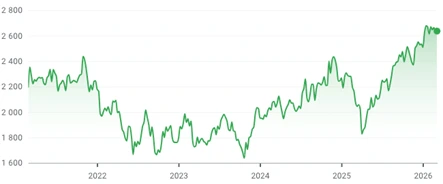
Source: Google Finance
While these companies are not widely known to the general public, many of them operate in innovative sectors and offer significant growth potential, particularly during periods of economic expansion.
For this reason, the Russell 2000 is often used as an indicator of the dynamism of US small-cap companies and the wider US economy.
Current context of the Russell 2000
Although the index provides exposure to small-cap companies with significant upside potential – some of which could become the ‘giants of tomorrow’ – it is important to consider recent performance when making an informed decision. Between 2025 and early 2026, the Russell 2000 underperformed relative to larger-cap indices, such as the S&P 500.
This situation is due to a number of specific macroeconomic factors:
• Interest rates and credit: the Federal Reserve's maintenance of high policy rates, coupled with uncertainty over the timing of rate cuts, has limited smaller companies' access to credit, which rely more on external financing;
• Trade policies: the impact of trade tariffs on purely domestic companies has posed additional challenges to the profitability of this sector;
• Moderate growth: in a moderate US economic growth environment, investment flows tend to concentrate on high-quality large caps, which stifles the dynamism of small caps.
The current context highlights the importance of carefully considering the time horizon and avoiding the concentration of the entire portfolio in a single segment.
Advantages of investing in the Russell 2000 index
Investing in the Russell 2000 comes with specific characteristics that appeal to certain types of investor profiles. Discover some of the main advantages:
Exposure to growth-stage companies
Small-cap companies are typically in the early stages of their development cycle. This means they may offer higher growth rates than more established companies. Investing in the Russell 2000 index enables you to benefit from the potential capital appreciation associated with this market segment.
Diversification within small-cap companies
The index comprises around 2,000 companies from various sectors of the US economy. Investing in an instrument that tracks the Russell 2000 provides exposure to a wide range of companies, thereby reducing the risk of concentration in a single share.
A complement to other indices
For investors who already have exposure to indices such as the S&P 500 or the NASDAQ-100, for example, the Russell 2000 can be an interesting addition to their portfolio. Adding exposure to smaller companies can provide the portfolio with additional diversification based on company size.
Recommended reading
Find out what the S&P 500 is in this article, how it works and the key steps to investing in this benchmark index.
Risks of investing in the Russell 2000 index
As with any investment in the equity markets, investing in the Russell 2000 index also carries risks that must be carefully considered.
Greater volatility
The share price of small-cap companies tend to fluctuate more sharply. During periods of economic uncertainty or market turbulence, the share prices of small-cap companies may fall more sharply than those of large-cap companies.
High exposure to interest rates
This is one of the main structural weaknesses of the index in the current environment. Unlike large companies, small businesses tend to be more reliant on variable-rate credit. In an environment of high and prolonged key interest rates ('higher for longer'), these companies are disproportionately penalised by rising financing costs.
Sensitivity to the economic cycle
Smaller companies may have fewer resources with which to weather periods of economic slowdown. For this reason, the Russell 2000 index is particularly sensitive to changes in the economic cycle. This was evident in 2025, when tariffs and domestic trade policies negatively impacted the performance of smaller companies.
Lower liquidity in some companies
Although the index is widely traded via ETFs and funds, some of the companies included in the Russell 2000 have lower market liquidity. This can lead to greater volatility at certain times.
Currency risk
Like other US indices, the Russell 2000 is denominated in US dollars. Investors using euros, for example, may be affected by exchange rate fluctuations when calculating their final return on investment.
Recommended reading
Find out in this article what market volatility is, why it happens and how to protect and prepare your investments.
How to invest in the Russell 2000 index
Investing in the Russell 2000 index does not involve buying shares directly in the individual companies that make up the index. However, there are financial instruments that allow you to replicate its performance easily.
Before investing, consider the following key points:
1. Define your investment objective
Before investing, it is important to clarify your objectives.
The Russell 2000 can be used for a variety of purposes, including:
• Increasing exposure to the US market;
• Diversifying a portfolio already invested in large caps;
• Seeking growth potential in the small-cap segment.
2. Bear in mind that you cannot invest directly in the index
As with other stock market indices, it is not possible to invest directly in the Russell 2000. Investment is made through financial instruments that seek to replicate its performance, such as ETFs or index-tracking funds. These instruments enable you to track the index’s performance with a single investment.
3. Choose an ETF or fund that tracks the index
The most common way to invest in the Russell 2000 is through ETFs that track the index. However, when comparing different instruments, it is important to analyse factors such as:
• Management fees;
• Index replication method;
• Liquidity of the instrument;
• Dividend distribution or reinvestment policy;
• Currency of the ETF.
4. Consider your investment time horizon
The Russell 2000 is generally best suited to medium- and long-term investments.
Due to the volatility associated with small-cap companies, short-term fluctuations are relatively frequent. Adopting a long-term approach helps to mitigate the impact of these fluctuations.
5. Include the Russell 2000 in a diversified portfolio
Despite the growth potential, it rarely makes sense to concentrate an entire portfolio on a single index.
The Russell 2000 should be used as part of a more diversified strategy that combines:
• Different geographical regions;
• Different asset classes;
• Companies of various sizes.
6. Monitor your investment with discipline
Once you have invested, it is important to regularly check that the index’s performance remains in line with your defined objectives.
• Review the portfolio periodically: instead of checking the investment daily, it may be more sensible to carry out a periodic review – for instance, every three or six months – to assess whether the Russell 2000 continues to fulfil its intended role within the portfolio;
• Compare performance with other indices: small-cap stocks may outperform large companies, and vice versa. Comparing the performance of the Russell 2000 with that of indices such as the S&P 500 helps put the results into context;
• Assess the weighting of the index in the portfolio: If the rise in the Russell 2000 causes its weighting in the portfolio to increase significantly, it may be necessary to rebalance the investments to maintain the desired level of diversification;
• Keep an eye on the economic climate: small businesses are generally more sensitive to factors such as interest rates, access to credit, and economic growth. Monitoring these indicators can help you to better understand how the index is performing.
Invest in the Russell 2000 with GoBulling
Launched in 2007, GoBulling is Banco Carregosa’s online trading platform and the first Portuguese financial intermediary to offer zero commissions on Euronext. The platform is available in GoBulling Investor and GoBulling Pro versions and offers access to multiple markets and financial instruments. It allows you to track market information and execute trading strategies in a single environment. It is the ideal partner for investing in the financial markets. Try the DEMO version.
Alternatives to the Russell 2000
The Russell 2000 is one of the main benchmarks used to track the performance of small US companies. However, it is not the only way to gain exposure to the equity markets.
Other indices that allow you to invest in larger companies, different geographical regions or with various levels of diversification. Considering various benchmarks can help you build a more balanced portfolio and reduce your reliance on a single market segment.
S&P 500
The S&P 500 tracks the performance of the approximately 500 largest companies listed on the US stock market. Unlike the Russell 2000, which focuses on small-cap companies, the S&P 500 comprises large, leading companies from a variety of economic sectors, including technology, healthcare, finance, and energy. It is often used as the primary benchmark for the US stock market.
NASDAQ-100
The NASDAQ-100 comprises 100 of the largest non-financial companies listed on the Nasdaq stock exchange. The index is renowned for its significant representation of technology and innovation companies, including major players in the digital sector. Compared to the Russell 2000, the NASDAQ-100 has a greater concentration of large companies and of companies in the technology sector.
MSCI World
The MSCI World index comprises large and medium-sized companies from various developed countries around the world. Investing in this index gives investors exposure to markets such as the US, Europe, Japan, and Canada. It is a popular alternative for creating a diversified global portfolio.
STOXX Europe 600
This index comprises around 600 large-, medium- and small-cap companies listed on European stock exchanges. Offering a comprehensive view of the European economy, it may be an option for investors seeking to balance a portfolio that is overly concentrated in the US.
Russell 1000
This index focuses on the 1,000 largest companies in the Russell universe. It serves as the large-cap benchmark within the same family of indices, enabling the performance of large companies to be compared with that of smaller firms in the Russell 2000.
Other market benchmarks
These indices represent specific markets or distinct methodologies that can be used to supplement your strategy:
| Index | Region/Focus | Key features |
|---|---|---|
| FTSE All-World | Global | Includes developed and emerging markets, offering the broadest possible view of the global economy. |
| Dow Jones | US | Comprises just 30 large, long-established companies, which is too concentrated for a direct comparison. |
| DAX | Germany | It is the main benchmark for Europe’s largest economy and focuses on the largest German companies. |
| Nikkei 225 | Japan | It is a historical indicator of the Japanese market and of major Asian multinationals. |
| FTSE 100 | United Kingdom | It comprises the 100 largest British companies, many of which have significant international operations. |
| IBEX 35 | Spain | It tracks the 35 largest Spanish-listed companies, focusing on banking and energy. |
| Russell 3000 | US | It is a comprehensive index, combining the Russell 1000 and the Russell 2000 to cover 98% of the US market. |
Investing in the Russell 2000 with Banco Carregosa
Investing in the Russell 2000 is an interesting way to gain exposure to the US small-cap segment. It can complement investments in better-known indices and help to diversify your portfolio.
At Banco Carregosa, investors can access ETFs that track the Russell 2000 via the GoBulling platform. This gives them access to major international markets and specialist support.
Contact us to find out how you can integrate the Russell 2000 into a diversified investment strategy that is aligned with your financial goals.
How to invest in the Russell 2000: Frequently Asked Questions
You can find answers to the most frequently asked questions about investing in the Russell 2000 below.
Is the Russell 2000 riskier than the S&P 500?
Yes, for structural reasons. In addition to the natural volatility of small caps, the Russell 2000 is more exposed to variable interest rates. In an environment of high interest rates (such as that expected in 2025), these companies will face higher financing costs than multinationals in the S&P 500. This will increase credit risk and put pressure on margins.
Is the Russell 2000 suitable for novice investors?
While it can be included in a beginner’s portfolio, it should be used as a supplement rather than the core of the investment. In the current environment of moderate growth and recent volatility, it is important for investors to have a medium- or long-term investment horizon to offset periods of underperformance relative to large caps.
What is the minimum amount required for investing in the Russell 2000?
In many cases, it is possible to start investing with relatively small amounts via ETFs. There is no fixed amount for the index itself, only for the instruments that track it. Through the GoBulling platform, you can start investing relatively affordable amounts via ETFs that provide exposure to the Russell 2000.
In what ways do Fed rates impact the Russell 2000?
Small businesses rely heavily on bank loans to grow. Consequently, the Russell 2000 tends to react very positively to indications that interest rates are about to be cut, since this would instantly reduce the cost of their debt and improve their profit prospects.
Disclaimer: This article has been prepared by Banco Carregosa for informational and educational purposes only. It does not constitute an investment proposal or recommendation to buy, nor does it constitute personalised financial advice. Investing in financial instruments carries risks, including the possibility of losing your initial investment. Past performance does not guarantee future results. Before making any investment decisions, we recommend that you consult an account manager or financial adviser to ensure that they are suitable for your risk profile and financial objectives.