



A practical guide to investing in the stock market


At a glance:
• Investing in the stock market involves buying financial assets, such as shares and ETFs, through a regulated intermediary. The aim is to grow your wealth over time, while accepting a certain level of risk.
• Investing in the stock market gives you the opportunity to benefit from companies’ growth and build wealth over the long term.
• Before investing, it is essential to set objectives, define your risk profile, and select the most suitable instruments.
• Banco Carregosa offers solutions and support to help you develop a diversified investment strategy tailored to your investor profile.
Between the end of 2020 and the end of 2025, the price indices shown in the chart recorded cumulative gains of between 47% and 114% (in their respective base currencies). These figures do not include reinvested dividends and may not reflect the return an investor would receive in euros. Although this was a particularly strong period for several markets, past performance does not necessarily indicate future returns.
If you have never invested before, the idea of "making your money work for you” may seem unattainable. Provided you take into account your risk profile, time horizon and the possibility of loss, there are basic principles that can help you get started in an informed way. Here’s how to get started.
Aggregate of the changes that have occurred between the last trading day of 2020 and the last trading day of 2025
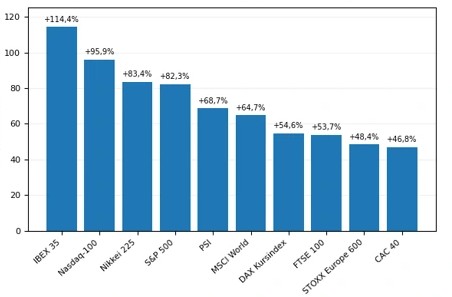
Source: Nasdaq Global Indexes, S&P Dow Jones Indices, Euronext, MSCI, STOXX Ltd., Nikkei Inc., BME and FTSE Russell. Cumulative changes in the respective price indices in their respective base currencies between the last trading day of 2020 and the last trading day of 2025. The price indices do not include reinvested dividends. Data accessed on 21 August 2026. Calculations are based on the closing levels shown.
What is the stock market?
A stock market is an organised and regulated marketplace for trading financial instruments such as shares, ETFs, certain types of bonds, and derivatives.
The aim of many ETFs is to track an index, sector or market. The degree of diversification of a portfolio depends on the assets it comprises: a broad-market index ETF can be highly diversified, whereas a thematic or sector-specific ETF may be highly concentrated. A diverse range of instruments is essential for building balanced portfolios that align with each investor’s risk profile and objectives.
"Investing in the stock market isn’t about guessing the next winner. It’s about establishing a disciplined approach that can withstand the emotional ups and downs of the market.” — João Queiroz, Head of Trading at Banco Carregosa.
The benefits of putting your money into the stock market
The stock market can be a valuable tool for building wealth as part of a well-defined strategy. Historically, equity markets have grown throughout full economic cycles. Despite the occasional dip, innovation and increased productivity are generally reflected in company valuations. When you buy shares, you gain exposure to the economic and financial performance of companies, and you can benefit from increases in share prices or dividend payment.
In the long term, reinvesting dividends and the effect of compound growth on returns can significantly increase your return on investment. The stock market offers liquidity, particularly in the most actively traded instruments, which can be bought and sold quickly during trading hours. It also offers accessibility, as it is now possible to invest small amounts and access international markets that were previously reserved for large institutions.
Investing in the stock market vs. property: what are the differences between the two?
While the stock market and property can be effective ways to build wealth, they have distinct characteristics. Between the end of 2020 and the end of 2025, the selected indicators showed significant increases, with notable variations between markets. This comparison should be treated as a guide only. Stock market and house price indices have different methodologies, levels of liquidity, and sources of return.
The stock market indices below only consider price movements, not reinvested dividends. Transaction-based house price indices are used for property, which do not include rental income. Therefore, the figures do not reflect the total return on an investment and cannot be directly compared.
To balance the comparison, the performance of each equity market is compared with the house price index for the same geographical area, expressed in the same currency.
| Criterion | Stock market (end of 2020–end of 2025) | Property (Q4 2020–Q4 2025) |
|---|---|---|
| Cumulative change in the index over the period | Portugal: PSI +68.7% (excluding dividends)Europe: STOXX Europe 600 +48.4% (excluding dividends)United States: S&P 500 +82.3% (excluding dividends) | Portugal HPI +77.7% (excluding rental income) EU-27 HPI +26.9% (excluding rental income) US FHFA Purchase-Only HPI +43.2% (excluding rental income) |
| Volatility | Higher | More moderate |
| Liquidity | High for the most actively traded instruments | Low |
| Costs and entry | Low; possible with small amounts | High (taxes, registration fees, maintenance) |
| Recurring income | Dividends | Rents |
Source: INE/Eurostat, House Price Index (Portugal); Eurostat, House Price Index (EU-27); and Federal Housing Finance Agency (FHFA), Purchase-Only House Price Index (USA). Cumulative change between Q4 of 2020 and Q4 of 2025. These indices measure changes in house prices and exclude rents. Data accessed on 21/08/2026. Calculations based on the official levels and changes indicated. Note: Indicative comparison. Past performance does not guarantee future returns.
Results vary depending on the market. During the analysed period, for example, house prices in Portugal rose by more than the main national stock market index. However, in the United States and across the European Union as a whole, the opposite was true. This shows that there is no one-size-fits-all solution: relative performance depends on geography, the chosen time period, and the selected indicators.
Instead of choosing one or the other, combining the stock market and property can help achieve a balance of growth and stability, while always remaining in line with each investor’s profile and objectives.
If you’re interested in the property sector, there are ways to gain exposure to it without buying a property directly. REITs are companies that specialise in property and are listed on the stock market. The VIP Fund is an open-ended property investment fund. In this case, redemptions are subject to the conditions outlined in the fund’s documentation, and may be suspended in exceptional circumstances. These solutions provide access to the property sector, but they have different liquidity, risk and operational characteristics to direct property investment.
A step-by-step guide to investing in the stock market
Investing in the stock market requires a methodical approach and a clear strategy and defined objectives. Rather than trying to identify "the next big stock”, the focus should be on building a solid foundation for consistent investment.
1. Choose a trading platform and open an account
The first step is to select a regulated financial intermediary and open an account with them. When comparing options, check the following: the legal entity you are contracting with, who supervises it, how assets are held in custody and segregated, the fee structure, the available markets, and the applicable investor compensation scheme.
With Banco Carregosa, you can use the GoBulling platform to manage your portfolio. Remember to analyse the cost structure, including fees and custody charges, as these will affect your net return.
2. Know your risk profile and decide on your investment amount
Before you continue, it’s important to understand how you react to volatility. Your profile depends on your financial objectives, time horizon, level of knowledge and experience, liquidity needs, tolerance of price fluctuations, and financial capacity to withstand losses.
Once you determine your profile, you need to decide how much to invest and whether to make a one-off investment or regular contributions. While they do not eliminate volatility or guarantee better returns, regular investments spread out the risk.
3. Choose the assets you want to buy
Decide whether you are looking for the potential of individual shares or the performance of the index tracked by the ETFs before placing your order. When selecting a region or sector, consider the level of economic development and political stability, as well as the associated exchange rate risk of currencies other than the euro. Investing in a single country increases that country’s economic risk; for this reason, many investors diversify across developed and emerging markets.
Instead of just choosing between companies A and B, set out some criteria. These could include consistency of profits, cash flow generation, debt levels, competitive advantages, quality of corporate governance, and the price paid relative to the company’s value. Just because a share has performed well historically does not mean that it is fairly valued.
| Criteria | Stocks | ETFs |
|---|---|---|
| Exposure | To a specific company | To an index, sector or region |
| Diversification | Depends on you | Variable: may be high in a broad-index ETF or low in a sector-specific, thematic or concentrated one |
| Typical profile | Those who want to choose companies | For those who prefer simplicity |
| Take note | Company-specific risk | Costs (TER) and replication method |
4. Place your first buy order
Select the asset and the order type on the platform.
The aim of a market order is to be executed quickly at the best available price. The final price is not guaranteed and may differ from the price displayed, particularly in volatile markets or low-liquidity markets.
With a limit buy order, you specify the maximum price you are willing to pay. The order will only be executed at that price or lower. It may not be executed at all, or it may only be partially executed.
5. Increase or reduce your position
Once you have made your initial purchase, you can choose to increase or reduce your exposure to that asset. Increasing your position will alter its average price, so this decision should be based on your strategy and analysis of the asset, rather than on your intention to recoup a loss. Selling part of your position can help you take profits or lower your risk.
6. Rebalance your portfolio
Over time, some assets perform better than others, causing the portfolio to become "out of balance”. The process of rebalancing involves making adjustments to positions in order to maintain the initial allocation defined across asset classes, regions, sectors, and risk levels. Keep in mind that rebalancing can lead to transaction costs and potential tax consequences.
7. Set risk rules
Although stop-loss and take-profit rules can support risk management and bring discipline to decision-making, they do not guarantee the execution price. When the specified level is reached, a standard stop order is converted into a market order, which may result in execution at a different price. A take-profit order specifies the level at which you want to realise your profits. The primary advantage of this approach is that it mitigates the impact of emotions by implementing a structured plan before executing a trade.
8. Monitor returns, costs, and taxes
Keep an eye on your portfolio from a strategic perspective, bearing in mind the tax implications. Here are some useful indicators:
• Return: how much you gain or lose.
• Allocation: how capital is distributed across assets and regions.
• Total costs: commissions, management fees, and foreign exchange charges.
• Drawdown: a fall in a portfolio’s value relative to its previous peak. The maximum drawdown is defined as the largest decline recorded between a peak and the subsequent trough.
• Consistency: regular investment helps to maintain discipline. The growth of your wealth depends on the amount you invest, the returns you receive, how long you invest for, the costs involved and the risks you take.
How gains are taxed in Portugal
As a rule, dividends of Portuguese origin received by tax residents in Portugal are subject to a 28% withholding tax. The net gain from capital gains and losses on securities is generally subject to separate taxation at the same rate.
However, there may be options or situations of mandatory aggregation, as well as exclusions linked to the holding period, with different rules applying to different assets and sources of income. As a general rule, income earned abroad must be declared in Annex J of the tax return, and tax credit for tax paid abroad may be available.
Note: this information is of a general nature and relates to the framework in force on 21 August 2026. It does not constitute tax advice. Tax rules may change. You should always consult the tax authority or a tax adviser regarding your specific circumstances.
Risks of investing in the stock market
Understanding the risks is essential to your strategy. It is important to distinguish between risk and volatility. A temporary fluctuation does not necessarily result in a permanent loss, but if the asset is sold or its value deteriorates, it may turn into an actual loss. The main risks are:
• Short-term volatility: markets react to news, earnings reports and decisions made by central banks. This puts an investor’s discipline to the test.
• Market (systemic) risk: during market corrections or recessions, the value of many risky assets may fall simultaneously. While diversification mitigates specific risk, it does not eliminate the impact of global crises.
• Company- or sector-specific risk: this refers to the impact of weak results, poor management or technological disruption on specific companies.
• Concentration risk: the greater the concentration of a portfolio in a single asset, sector or region, the greater the impact of an adverse event.
• Currency risk: investments in assets denominated in currencies other than the euro are subject to currency fluctuations.
• Liquidity risk: it may be difficult to sell thinly traded instruments at the desired price.
• Credit and interest rate risk: this is relevant when the portfolio includes bonds.
• Risks associated with complex or leveraged products: these products can amplify losses and require a specific level of understanding.
• Behavioural risk: decisions driven by fear during market falls or euphoria during market rises can undermine sound strategies. This risk is often underestimated.
Common mistakes to avoid
• Investing without a strategy, objectives or a defined time horizon makes it easier to make impulsive decisions.
• Concentrating too heavily on a single share or sector, thereby increasing specific risk.
• Trying to get the timing of the market right, which is difficult even for professionals.
• Ignoring costs and taxes, which erode returns over time.
• Investing your emergency fund or money you need in the short term.
• Using credit or leverage without understanding the potential losses.
How to invest in the stock market: strategic support from Banco Carregosa
The first step is knowing how to invest in the stock market. The most important thing, however, is to do so strategically and with discipline, in line with your goals.
With Banco Carregosa, you can trade shares and ETFs on the major international markets via the user-friendly GoBulling investment platform, which provides expert guidance to help you make more informed investment decisions.
About Banco Carregosa
Having started business in 1833 as a foreign exchange house in Porto, Banco Carregosa is the oldest financial institution operating in the Iberian Peninsula. Since 2008, it has operated as a bank specialising in private banking and wealth management. It is supervised by both the Bank of Portugal (registration no. 0235) and the CMVM (registration no. 0169).
Recent accolades:Best Pure Play/Boutique Private Bank – Portugal 2025 and 2026 (Euromoney); Best Bank for Private Wealth Management Iberia 2024 (Global Brands Magazine). You can view more awards here.
Contact us today to find out how you can start investing in a structured way that’s tailored to your profile.
How to invest in the stock market: FAQs
How much money do you need to invest in the stock market?
You can start with small amounts, either through ETFs or by investing in fractional shares with brokers offering them. Bear in mind that minimum fees and other costs can render very small transactions rather inefficient. It is more important to be consistent and have a long-term strategy than to start with a large amount.
Is investing in the stock market risky?
There is always an element of risk and volatility. Although a diversified, long-term strategy can mitigate some of this risk, it cannot eliminate the possibility of capital loss.
Which is better: investing in shares or in ETFs?
It depends on your profile. Shares provide direct exposure to specific companies, whereas ETFs can facilitate diversification depending on their composition.
Which is the better option: the stock market or savings certificates/deposits?
Deposits and government debt products aimed at retail investors tend to be less volatile and more predictable in terms of capital and returns. However, they have different characteristics with regard to guarantees, liquidity, and risk. Although the stock market offers greater potential for long-term capital appreciation, it also carries a higher level of risk and provides no capital guarantee. When making your choice, you should take into account your investment objective, time horizon, and the need to preserve capital.
How do you choose a platform for investing in Portugal?
Check that the organisation is authorised by consulting the registers of both the CMVM and Banco de Portugal. If the organisation is European and operating in Portugal, also consult the registers of the supervisory authority in its country of origin. Also check what markets it offers, what its fee structure is, and what level of investor protection it provides.
Legal disclaimer: This article has been prepared by Banco Carregosa for information and educational purposes only. Under no circumstances does it constitute an investment proposal, recommendation to purchase, or personalised financial advice. Investing in financial instruments carries risks, as well as the possibility of losing the invested capital. Past performance is no guarantee of future returns. You should consult your account manager or financial advisor before making any financial decisions.