



Dividend yield: What it is, what it’s used for, and how to calculate it


Some investors buy shares purely for future appreciation, while others prefer to see immediate results. If you belong to the latter group, dividends indicate that the company is in good financial health and values rewarding its shareholders. But how can you tell if the dividends paid are really attractive? This is where the relevance of the dividend yield becomes relevant. When interpreted correctly, this indicator can help you identify companies that consistently reward their investors. Find out what it means, how it works, and how to interpret it.
What is Dividend Yield?
Dividend yield is a metric that shows how much a company pays out in dividends for every euro invested in buying its shares. In practical terms, it is the percentage of the share price that is paid back to investors in the form of dividends, typically on an annual basis.
Stocks with the highest dividend yield in October 2025
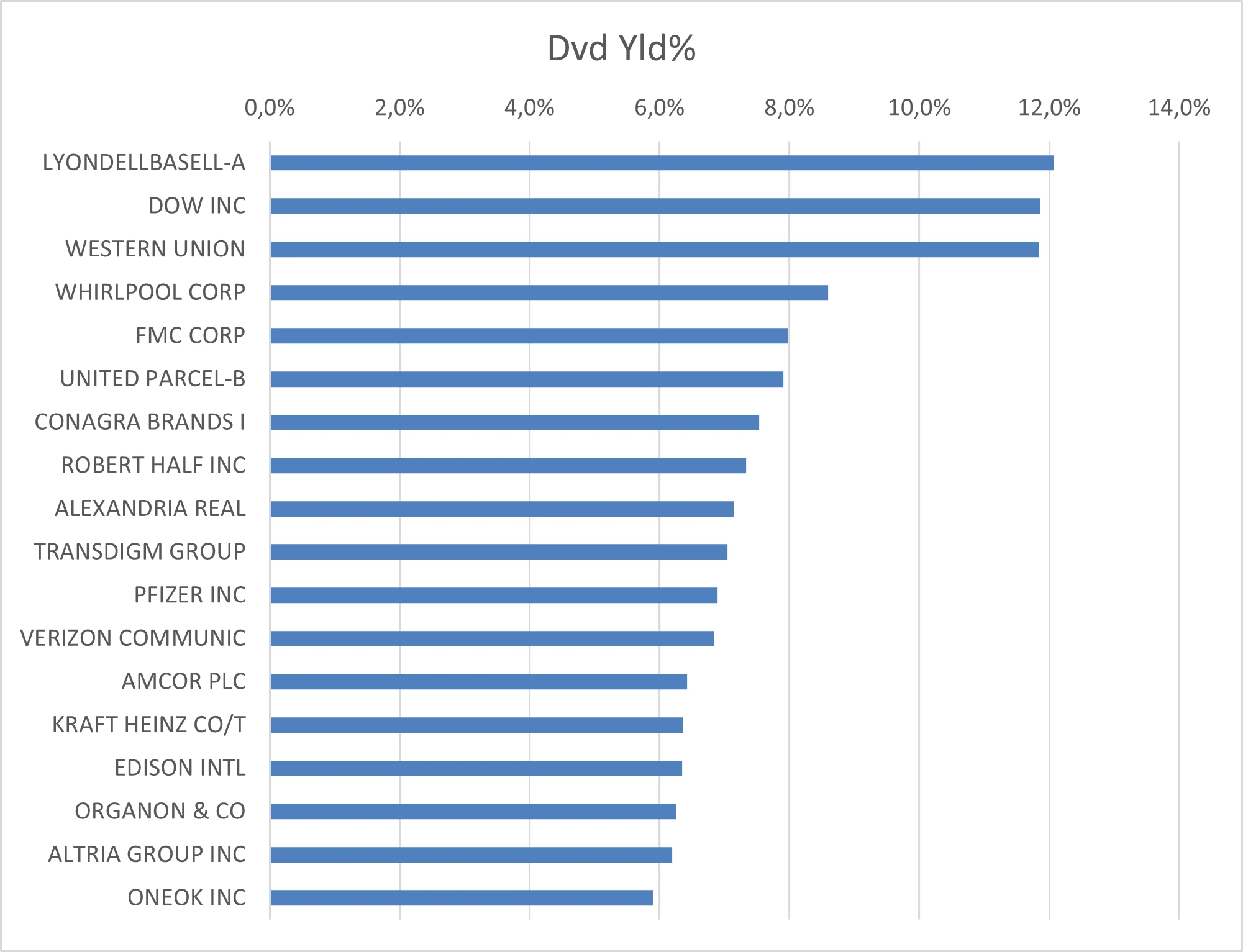
Source: Motley Fool
* consultation carried out on 13/10/2025
The formula for calculating this is simple: Dividend yield = (annual dividend per share / share price) × 100. For example, if a share costs €10 and pays an annual dividend of €0.50, the dividend yield is 5%.
Advantages of the Dividend Yield
The dividend yield is a useful indicator that can influence your investment decisions. Below are some of its main advantages.
It is a passive return indicator
The dividend yield allows investors to estimate the passive returns they could receive by simply holding a share. It is an attractive option for generating regular cash flow for a portfolio and is particularly relevant for those seeking a stable income.
It makes it easier to compare companies
Using the dividend yield makes it easier to compare companies in the same sector in terms of their profit distribution policy, regardless of their different share prices.
It can be used to identify reliable companies
Companies that maintain a consistent dividend yield over time tend to be more established and demonstrate robust financial management. While not an absolute rule, this indicator can be used as a starting point for further analysis.
Dividend Yield vs. Forward Dividend Yield: What’s the difference?
At first glance, these two concepts seem very similar because they both relate dividends to share price. However, the difference lies in the time horizon that is considered, which often causes uncertainty among investors.
Traditional dividend yield analysis considers historical data and is calculated based on dividends paid by the company in the previous year, relative to the current share price. Put simply, it provides an overview of the dividends that investors have received.
In contrast, forward dividend yield is based on market projections or official company announcements regarding future dividends. Rather than providing an overview of the past, this indicator offers an estimate of what is expected to happen.
Consider, for example, an investor who only analyses past dividend yields. They may end up evaluating values that will not be repeated, particularly if the company has announced a reduction in dividends. However, focusing exclusively on the forward dividend yield carries the risk of relying on overly optimistic or conservative estimates that may not materialise. Therefore, the most prudent approach is to use both metrics to conduct a more comprehensive analysis.
Dividend yield: Precautions to take
Although the dividend yield is useful, it should not be analysed on its own. A high figure does not necessarily indicate that a company is financially sound. For example, it could suggest a sharp fall in the share price, which raises further questions. Conversely, companies in a growth phase may distribute low or no dividends, choosing instead to reinvest their profits. This does not make them any less attractive as investments.
Furthermore, making investment decisions based solely on dividend yield can result in choices that are not well-rounded, as it ignores fundamental factors such as the sustainability of profits, the company’s level of debt, and its growth potential.
What factors influence a company’s Dividend Yield
This indicator is influenced by several factors, either directly or indirectly:
The company’s dividend policy
Not all companies distribute their profits in the same way. Some pay dividends regularly and consistently, while others only do so when profits are higher. This decision depends on the policy defined by the Board of Directors, which can vary from year to year.
The consistency and health of profits
Dividends should be directly proportional to profits. Companies that generate stable and predictable profits tend to offer more attractive and sustainable dividend yields. Conversely, dividends are more vulnerable and the yield less reliable when profits are irregular or overly dependent on economic cycles.
The market price of shares
The dividend yield increases when the share price decreases, even if the dividend amount remains the same. This may suggest that there are problems within the company, as indicated by the market. Therefore, it is essential to understand the reasons behind the fall in price before being tempted by a high yield.
The sector of activity
Companies in stable, mature sectors such as energy, telecommunications and utilities typically distribute higher dividends. In contrast, technology, pharmaceutical and expansion companies may choose to reinvest their profits, resulting in lower yields but greater potential for long-term appreciation.
The economic context
During periods of economic growth, many companies are more willing to distribute profits, while in times of uncertainty they tend to adopt a more cautious stance, which is reflected in dividends. Therefore, the dividend yield is influenced by the pace of the economy. It can increase when share prices fall or when companies maintain high dividends, and decrease when they reduce distributions.
How to interpret the Dividend Yield
Interpreting the dividend yield requires attention to detail and a prudent approach.
When the dividend yield is high
At first glance, a dividend yield above the sector average may seem attractive, as it suggests a higher return for every euro invested. However, this figure may be inflated due to a fall in the share price, which is not always the result of positive developments. This may suggest that the company is experiencing difficulties and that high dividends are a temporary measure prior to any cuts being made.
When the dividend yield is low
A dividend yield that is low does not necessarily indicate a negative outlook. Some companies choose to reinvest their profits in growth rather than distributing dividends. In these cases, investors may see a return in the form of increased share value over time. In other words, a lower yield now could lead to capital gains in the future.
For this reason, when analysing dividend yields, it is important to consider the company’s profile: is it a well-established organisation that prioritises profit distribution, or a growing company with its sights set on the future? Every type of company has the potential to play an important role in a well-informed investment portfolio.
Investment considerations beyond the Dividend Yield
When building your investment portfolio, the dividend yield shouldn’t be the only criterion to consider. When analysing companies that distribute dividends, it is necessary to consider other fundamental factors.
1. Payout ratio
The payout ratio indicates the percentage of profits earmarked for dividend payments. A figure that is too high (above 70% or close to 100%) may suggest that the company is jeopardising its growth by maintaining unsustainable dividends. A balanced ratio indicates financial health and a long-term outlook.
2. Dividend growth
What is more important than an attractive dividend yield right now is the company’s ability to increase dividends in the future. Analysing dividend growth over the last five to ten years enables you to determine whether the distribution policy is consistent or if high dividends are a one-off exception.
3. Stability of profits
Regular dividends depend on stable profits. Companies that achieve consistent results over time are more reliable. Dividends may be at risk of being maintained or increased if there are significant fluctuations in profits.
4. Free Cash Flow (FCF)
The Free Cash Flow indicates the amount available after essential investments have been made, revealing a company’s true capacity to distribute dividends. A high dividend yield alongside weak cash flow could be a sign that something is wrong.
5. Company debt
A company may offer attractive dividends, but this could be offset by a weak balance sheet. High levels of debt make distribution policy more vulnerable, particularly in an environment of high interest rates. Reducing debt provides room for growth and profit distribution.
6. Business model and sector of activity
Some sectors, such as utilities and telecommunications, tend to distribute dividends more frequently than others, such as technology and pharmaceuticals, which favour reinvestment. For instance, a technology company yielding 1.5% could be a better investment than a utility company yielding 4%, provided it shows consistent and sustainable growth. Understanding the sector is therefore key to defining realistic expectations and avoiding inaccurate comparisons.
7. Share appreciation
Finally, the potential for a share to appreciate is just as important as its current yield. A company that pays low dividends but experiences strong growth can achieve better overall results than a company that pays high dividends but is stagnating. The best approach is to strike a balance between yield and growth.
Dividend Yield: Frequently Asked Questions
Below are the answers to some of the most frequently asked questions about dividend yelds.
1. Is the dividend yield guaranteed each year?
No. Companies can adjust their dividend policy according to their financial performance, their reinvestment needs, or market context. The current yield does not guarantee future performance.
2. Are dividend yields only comparable within the same sector?
Yes. It can be misleading to compare yields of companies from different sectors. For example, some sectors, such as utilities, tend to distribute dividends more generously, whereas others, such as technology, favour reinvesting their profits.
3. Can you live on dividends alone?
It depends. Some long term build diversified portfolios with a focus on generating passive income through consistent dividends. However, implementing such a strategy requires substantial capital, discipline, and rigorous risk management.
4. What is the relationship between dividend yield and payout ratio?
The dividend yield indicates the return obtained by investors, while the payout ratio represents the proportion of profits allocated to dividend payments. Together, these indicators help assess whether the dividend distribution policy is sustainable or whether the company is distributing an excessive proportion of its profits.
Invest with the GoBulling Trading Platforms
To maximise dividend yields when building your investment portfolio, it is important to use tools that simplify the analysis and execution of your strategies. With access to over 40,000 instruments in more than 30 international markets, Banco Carregosa's GoBulling Trading Platforms allow you to invest with confidence in the global financial markets. With the GoBulling Pro and GoBulling Investor platforms you can track the performance of dividend-paying companies in real time, analyse key metrics such as dividend yield, and make investment decisions that align with your risk profile.
Dividend Yield strategy at Banco Carregosa
The dividend yield offers insights into profitability, risk and investment strategy. While it is an excellent starting point for the attentive investor, it should be complemented by a more comprehensive analysis.
If you’re looking to build an income-focused portfolio or one that includes solid companies that value their shareholders, Banco Carregosa can support you. We provide the resources necessary for making informed decisions and putting your capital to work, including access to professional platforms, specialised monitoring and a wide selection of assets. Contact us.