



Nasdaq Composite: What it is and how to track this index


At a glance:
• The Nasdaq Composite is one of the United States’ main stock market indices and tracks the performance of the thousands of companies listed on the Nasdaq Stock Market.
• Although the index is closely associated with the technology sector, it also includes companies from other sectors, including healthcare, consumer goods, and industry.
• Tracking the Nasdaq Composite can be useful for NextGen investors looking to understand trends in innovation, technology, and growth. However, any exposure should align with each investor’s risk profile, time horizon, and investment objectives.
Artificial intelligence, semiconductors, cloud computing, streaming, and electric mobility are all key features of the digital economy and are, in one way or another, linked to the companies that make up the Nasdaq Composite. If you’re familiar with the major US tech firms, you’ve probably already come across this index without realising it.
But does investing in the Nasdaq Composite simply mean "betting on tech”? Or is there a more structured approach to gaining exposure to this market?
This article explains what the Nasdaq Composite is, how it came about, how it works, and how you can incorporate it into a well-considered investment strategy tailored to your profile.
What is the Nasdaq Composite?
The Nasdaq Composite is a stock market index that tracks the performance of more than 3,000 companies listed on the Nasdaq Stock Market, one of the leading stock exchanges in the United States.
Unlike other, more selective indices, the Nasdaq Composite comprises almost all companies listed on the Nasdaq stock exchange, ranging from tech giants to smaller firms.
Although the index is often associated with the technology sector, it actually comprises companies from a variety of sectors, including healthcare, consumer goods, industry, and services. Nevertheless, technology accounts for a very significant proportion of its weighting.
The index’s link to the tech sector is explained by the fact that companies such as Apple, Microsoft and NVIDIA tend to be among its largest holdings.
Nasdaq Stock Market vs. Nasdaq Composite vs. Nasdaq-100
Although the terms are often used interchangeably, the Nasdaq Stock Market, the Nasdaq Composite and the Nasdaq-100 represent different concepts. The table below summarises the main differences:
| Concept | What it is | What it represents | Main difference |
|---|---|---|---|
| Nasdaq Stock Market | US stock exchange | The market where shares are listed and traded daily | It is the stock exchange, not an index |
| Nasdaq Composite | Broad stock market index | It measures the performance of companies listed on the Nasdaq Stock Market. It is not an asset or a market, but rather an indicator of these companies’ overall performance | It is a comprehensive index tracking thousands of companies listed on the Nasdaq Stock Market |
| Nasdaq-100 | A more limited index | It includes 100 of the largest non-financial companies listed on the Nasdaq Stock Market | It is a more focused index, with greater weighting given to large technology companies |
Origin of the Nasdaq Composite
Created in 1971, the Nasdaq Composite gained particular prominence during the tech boom of the 1990s.
During the ‘dot-com bubble’, the index rose significantly, followed by a sharp correction in the early 2000s. This episode has since become one of the most widely studied examples of euphoria and risk in financial markets.
Performance of the Nasdaq Composite over the last 5 years
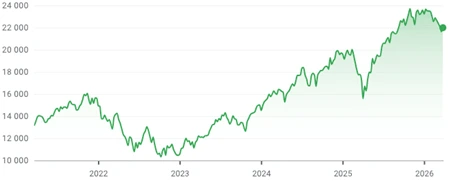
Source: Google Finance
Over the last two decades, the index has once again stood out, thanks to the structural growth of major technology companies, the digitalisation of the economy, and the global expansion of the technology sector.
Over the last five years, the Nasdaq Composite has surged by approximately 67%, climbing from around 13,200 points at the start of 2021 to over 22,000 points in 2026.
Nevertheless, one key characteristic remains: it tends to be more volatile than sector-diversified indices, especially when interest rates rise or there is a correction in the technology sector.
How does the Nasdaq Composite work?
The Nasdaq Composite is a market capitalisation-weighted index. The performance of the index is more heavily influenced by companies with the highest market capitalisation, in other words, significant movements in large-cap companies have a greater impact than fluctuations in smaller companies.
According to Nasdaq’s official methodology, the index comprises domestic and international ordinary shares listed on the Nasdaq Stock Market. There are no specific criteria relating to geography, sector, market capitalisation, or liquidity. However, certain types of instruments are excluded, including ETFs, preference shares, warrants, rights, and other derivatives.
This methodology demonstrates how the Nasdaq Composite can be both comprehensive, as it includes thousands of companies – and sensitive to the performance of its large, listed companies. In other words, the index does not operate on a ‘one company, one vote’ basis: the weighting of each company depends on its market capitalisation.
Which main indices do you need to know about?
In the article "10 Main Stock Market Indices”, João Queiroz, Head of Trading at Banco Carregosa, lists some of the main stock market indices in which you can invest via the GoBulling platform to help you manage your portfolio more effectively and make more informed investment decisions.
Which companies are included in the Nasdaq Composite index?
The Nasdaq Composite comprises thousands of companies listed on the Nasdaq stock exchange, including household names such as Apple, Microsoft, Nvidia, Amazon, Alphabet, Meta, and Tesla. However, it is not solely made up of tech giants. The index also includes companies from sectors such as healthcare, consumer goods, industry, and services. However, since it is weighted by market capitalisation, larger companies have a greater impact on the index’s performance. Consequently, when major tech firms experience significant rises or falls in value, the Nasdaq Composite tends to reflect this.
The advantages of tracking the Nasdaq Composite
Tracking the Nasdaq Composite can offer several strategic advantages. The main ones are as follows:
Exposure to global innovation
The index includes some of the world’s most innovative companies, many of which are leaders in fields such as artificial intelligence, cloud computing, and semiconductors.
Above-average growth potential
The technology sector has historically delivered growth rates above the market average, which can result in substantial long-term appreciation.
Broad exposure within a single exchange
With thousands of eligible companies, the index offers greater diversity than more concentrated indices. It provides a straightforward means of accessing a broad spectrum of listed companies via a single investment. However, this spectrum does not eliminate the sectoral and market capitalisation concentrations described below.
Risks associated with the Nasdaq Composite
As with any investment, there are risks that should not be ignored. Here are a few things to bear in mind.
Greater volatility
Changes in interest rates and revisions to growth forecasts tend to have a stronger impact on the index.
Concentration in large companies
The performance of the index may depend significantly on a small number of tech giants.
Sensitivity to the technology cycle
The sector reacts to its own cycles, investment in AI, corporate spending on cloud services, and semiconductor cycles, which can also accentuate corrections when expectations are revised.
Currency risk
If you invest in assets denominated in dollars, you will be exposed to fluctuations in the EUR/USD exchange rate. If the dollar depreciates against the euro, some of your gains could be offset, even if the value of your shares increases. There are ETFs with and without currency hedging; therefore, the importance of understanding the implications of currency hedging cannot be overstated when choosing an ETF.
Regulatory risk
Some of the largest companies in the index are under regulatory scrutiny relating to antitrust, artificial intelligence and international taxation. This could potentially impact valuations and results.
What is the best way to gain exposure to the Nasdaq Composite?
There are several ways to gain exposure to the Nasdaq Composite Index, ranging from straightforward, diversified solutions to more active and selective approaches. The most suitable option for you depends on your risk profile, how much time you are willing to dedicate to monitoring, and the role that this index will play in your portfolio.
ETFs that track the Nasdaq Composite
If you’re looking for a practical, diversified solution, ETFs that track the index are usually one of the simplest ways to gain exposure, depending on the investor’s profile.
By investing in an ETF linked to the Nasdaq Composite, you automatically gain exposure to thousands of companies listed on the Nasdaq Stock Market via a single financial instrument.
In practice, this means that you are reducing the risk of investing in a single share while gaining exposure to the Nasdaq market’s overall performance, which may be positive or negative.
Before choosing an ETF, you should analyse factors such as management fees, tracking types, dividend policies (accumulation or distribution), and currency hedging.
Technology or thematic ETFs
If you are looking for more concentrated exposure to the technology sector, which carries significant weight in the Nasdaq Composite, you could consider ETFs focused on technology, innovation, or specific areas such as semiconductors or artificial intelligence.
While these vehicles do not replicate the Nasdaq Composite exactly, they capture a significant portion of its growth momentum and offer greater sectoral focus.
The advantage lies in more targeted exposure to structural trends. The disadvantage is lower diversification and greater sensitivity to cycles in the technology sector.
Direct purchase of shares listed on Nasdaq
Another option is to invest directly in the shares of companies included in the Nasdaq index.
If you opt for direct purchase, you will have greater control over your investments and can focus on companies that you have analysed and consider to be suitable for your strategy. However, you will assume greater specific risk, as performance will depend on each company’s individual performance.
This strategy requires a more in-depth analysis that takes into account indicators such as earnings growth, margins, competitive position, debt levels, and market valuation. It also requires regular monitoring.
Investment funds (whether actively or passively managed)
Another option is investment funds that are exposed to the Nasdaq market.
You can choose between:
• Passive funds that track the index, similar to ETFs but with a traditional fund structure;
• Active funds that pick companies listed on the Nasdaq based on their own analysis criteria.
Although active funds aim to outperform the index, they tend to incur higher costs. In contrast, passive funds seek to track the Nasdaq Composite more closely and generally have lower fees.
Comparison table showing the different ways to gain exposure to the Nasdaq Composite
| Type of exposure | How it works | Advantages | Risks/limitations |
|---|---|---|---|
| Index-tracking ETF | Buying an ETF that seeks to track the performance of the Nasdaq Composite or a similar index | Diversification, simplicity, and stock exchange trading | Market risk, tracking error, costs, and currency risk |
| Technology or thematic ETF | Exposure to sectors such as technology, AI, semiconductors, or cloud | Focus on specific trends | Greater sector concentration and volatility |
| Individual shares | Direct purchase of companies listed on Nasdaq | More control over the company selection process | High level of specific risk and the need for ongoing analysis |
| Investment funds | Active or passive funds with exposure to Nasdaq-listed companies | Professional management and potential for diversification | Costs, management risk, market risk, and the potential for underperformance relative to the index |
Do you want to track the Nasdaq Composite in real time?
With the GoBulling Investor platform, you can invest in a diversified manner that suits your profile by accessing the leading ETFs and funds that track this index.
Carregosa NextGen: investing with greater knowledge
Banco Carregosa’s NextGen segment is aimed at clients aged 18-30 and offers savings and investment solutions in a regulated account. Banco Carregosa is registered with the Bank of Portugal under no. 0235, and with the CMVM under no. 0169.
With the GoBulling Investor platform, we can help you incorporate indices such as the Nasdaq Composite into a diversified investment strategy. You can access the main financial markets and invest in shares, ETFs, and investment funds. The platform also provides research tools, rankings, portfolio analysis, and educational content.
Carregosa NextGen draws on the experience of an institution with a history dating back to 1833. In 2026, it was recognised for the second consecutive year as the Best Pure Play/Boutique Private Bank at the Euromoney Private Banking Awards. This award is entirely at the discretion of the awarding body.
Are you looking to grow your wealth with greater confidence and clarity? Contact us and we will help you take the next step.
Nasdaq Composite: FAQs
We’ve answered some of the most frequently asked questions about the Nasdaq Composite index below.
Are the Nasdaq Composite and the Nasdaq Stock Market the same thing?
No, the Nasdaq Stock Market is a stock exchange on which companies are traded. The Nasdaq Composite is an index that tracks the performance of many of these companies.
Can you invest directly in the Nasdaq Composite?
You cannot invest directly in an index. However, you can gain exposure through financial instruments such as ETFs, investment funds, or Nasdaq-listed shares, depending on your risk profile and objectives as an investor.
Is the Nasdaq Composite solely technology-based?
No, although it has strong links to the technology sector, it includes companies from a variety of sectors and regions. Nasdaq's official methodology does not specify any sector- or country-based criteria for inclusion in the index.
Is the Nasdaq Composite suitable for beginners?
Although tracking the index can be a useful way to improve financial literacy, any investment associated with it should be based on the investor’s risk profile, time horizon, knowledge, experience, and objectives.
What are the main risks?
The main risks include market volatility, over-concentration in a small number of large companies, currency risk, market risk, liquidity risk and tracking error risk in products that attempt to replicate the index.
Does the Nasdaq Composite guarantee future returns?
No. No index or financial product can do that. Investing in financial instruments always carries the risk of losing some or all of your capital.
Disclaimer: This article has been prepared by Banco Carregosa for informational and educational purposes only. It does not constitute an investment proposal or recommendation to buy, nor does it constitute personalised financial advice. Investing in financial instruments carries risks, including the possibility of losing your initial investment. Past performance does not guarantee future results. Before making any investment decisions, we recommend that you consult an account manager or financial adviser to ensure that they are suitable for your risk profile and financial objectives.