



Equities: what they are and how they work


Have you heard of equities but not quite sure what they are?
You're not alone. The investment world is full of jargon, and "equities" is one of those terms that crops up everywhere but isn’t always properly explained.
In this article, we break down the concept: we explain what equities are, how they work, their advantages and risks, and what you should know before investing in them. If you’re taking your first steps in investing or want to better understand this asset class, this guide is for you.
What are equities?
Equities, also known as shares, represent an ownership interest in a company. When you buy shares in a listed company, you acquire a stake in it, however small. In practice, this makes you a partner or shareholder.
Investing in equities gives investors the right to participate in profits (in the form of dividends, when distributed) and the potential to benefit from share price appreciation over time. In addition, under certain circumstances, shareholders have the right to vote on strategic company decisions.
The S&P 500 index, which includes shares in 500 of the largest companies listed in the United States, achieved positive returns in 25 out of 32 years (78%) between 1993 and 2024. Over this period, it achieved an average annual appreciation of +8.5%.
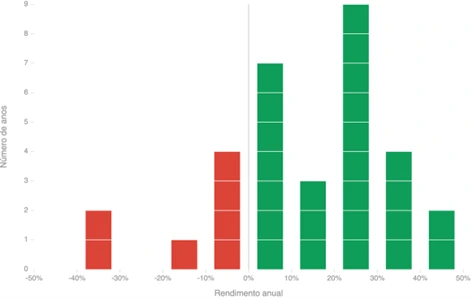
Source: Curvo
Shares are one of the oldest and most popular investment options precisely because they offer the potential for long-term returns. It goes without saying that they also carry greater risk and volatility than more conservative assets, such as bonds or term deposits.
The term "equity” originates from the Latin aequitas, meaning justice, balance or equality. In a financial context, "equity” refers to the net value someone holds in a company or asset after all debts have been deducted. Put simply, it’s the part that truly belongs to you.
Equity vs. Private Equity: what’s the difference?
Although these two terms are similar, they refer to quite different concepts. Understanding the difference between them is essential for any informed investor.
•(Listed) Equity refers to ownership interest in a company. By investing in equities (shares), an investor acquires a share in a company listed on the stock exchange and becomes a shareholder. This type of investment occurs on public markets, where shares can be traded freely.
• Private Equity, by contrast, refers to investments made in companies that are not listed on the stock exchange. These are holdings acquired by specialist funds (private equity funds), which invest capital with the aim of restructuring, expanding or optimising the company. The holding is then sold at a profit, usually in the medium to long term.
What are the advantages of investing in equities?
Equities can form a key part of a well-diversified investment portfolio. Below are some of the main advantages:
Participation in growth
Investing in equities makes the investor a co-owner of the companies. This means that, as companies grow, your investment can keep pace with them, as reflected in share appreciation and, in many cases, in dividend payments.
Geographical and industry diversification
Equities provide access to various markets and sectors, including American technology, European energy, Asian healthcare and global luxury goods. This diversity of investment helps to spread risk and capitalise on opportunities in different parts of the world at a time when a local mindset can be limiting.
Liquidity and flexibility
Equities usually offer greater liquidity than many other types of investment, which are often much more inflexible. You can buy or sell at any time during trading hours, enabling you to adapt your portfolio as economic or personal circumstances change.
Transparency and access to information
Listed companies must regularly publicise their results, plans and indicators, enabling you to make informed decisions. With the support of Banco Carregosa, this information is analysed and interpreted to create an investment strategy that aligns with your wealth objectives.
What types of equities are there on the market?
Not all shares are the same. Within the world of equities, there are different categories, each with their own specific characteristics, risk levels and benefits. Understanding these differences allows you to make investment decisions that are better suited to your profile and objectives.
• Common stock: this is the most common type. Holders have the right to vote at shareholders’ meetings and to receive dividends, although there is no guarantee of a fixed return or priority in the event of liquidation.
• Preferred stock: they have priority in the distribution of dividends and in the event of liquidation, but they do not usually confer voting rights. They are typically considered to have a mix of characteristics of a share and a bond.
• Shares with or without voting rights: some companies issue different types of share, which makes it possible to raise capital without diluting management control.
• Growth stock: these belong to companies with strong growth potential that often don’t pay dividends, preferring to reinvest profits in order to expand. They are usually associated with a higher level of risk, but also offer greater potential for appreciation.
• Dividend stock: these are sought by investors who want a regular income. These are shares in well-established companies that consistently pay dividends over time.
How do I invest in equities?
Although investing in equities may seem complex at first, with access to financial literacy content and the right support, it becomes a clear and strategic process that is aligned with your financial goals. Here’s how to take your first steps in a structured way:
1. Define your objectives and investment time horizon
Before you invest, you need to understand what you want from your investment: do you want capital growth, income generation through dividends, or protection against inflation? The time horizon, whether short, medium or long term, also influences which type of shares are best suited to your risk profile.
2. Know your risk profile
Not all investors react in the same way to market fluctuations. Understanding your risk tolerance level is essential for avoiding rash decisions. Banco Carregosa can help you accurately identify this profile, enabling you to adjust your capital allocation to suit your needs and objectives.
3. Opt for professional management
If you are unable or unwilling to follow the market on a daily basis, you can opt for discretionary management solutions. In this case, specialists will make decisions on your behalf and monitor your investments on an ongoing basis.
4. Diversify from the start
Diversification is the golden rule. Spreading investment across different sectors, regions and company sizes helps balance risk and seize complementary opportunities. A well-diversified portfolio is more resilient during periods of uncertainty, offering more consistent and robust results over time.
5. Regularly monitor and adjust your portfolio
As the world changes, so do the markets. This is why it is important to periodically review your equities portfolio, ensuring it remains aligned with your strategy, risk tolerance, and life events. With Banco Carregosa, this becomes a systematic process that is closely monitored and aligned with your objectives.
The drawbacks of investing in equities
Although investing in equities can be an excellent way to build wealth over time, it’s important to recognise that this type of asset is not without risk. One of the main issues is market volatility: share prices can rise or fall abruptly in response to financial results, economic changes, political instability and market rumours. This uncertainty can lead to losses, particularly among those who invest in the short term or without a clear strategy.
In addition, investing in shares carries company-specific risks. For example, the business may not perform as expected. A company’s financial health and, consequently, the value of its shares can be affected by management problems, high debts, competition or regulatory changes. Finally, there is also the risk of liquidity: not all shares can be traded easily, which can make it difficult to take advantage of market opportunities (buying or selling) at critical moments. Therefore, before investing in equities, it is important to understand your risk profile, diversify your portfolio, and adopt a long-term outlook.
Common mistakes when investing in equities (and how to avoid them)
Although investing in shares can be an excellent way to increase your wealth, it is possible to make costly mistakes, as with any type of investment. Many of them stem from haste, a lack of information, or unrealistic expectations. The first step towards investing with more confidence and strategy is knowing how to recognise them.
• Investing without analysing the company: don't buy shares just because it's trendy or someone has recommended it. You need to analyse the business itself, its financial results, and the sector in which it operates.
• Trying to predict the market in the short term: it is almost impossible to predict the short-term ups and downs of the market. Trying to time things perfectly can result in impulsive decisions and unnecessary losses.
• Lack of diversification: investing all your money in a single company or sector increases your risk. Diversification reduces exposure to isolated negative events.
• Failing to consider your risk profile: investing in shares requires an ability to tolerate volatility. Those who cannot cope with price fluctuations may make rash decisions at the wrong time.
• Ignoring the costs involved in the operation: commissions, brokerage fees and capital gains tax can have a significant impact on returns, especially if you trade frequently.
• Focusing only on the short term: equities are generally considered to be medium- to long-term investments. Expecting a quick profit often leads to frustration and losses.
• Investing without a clear strategy or defined objectives: without defined objectives, such as income generation or capital appreciation, it is difficult to make consistent decisions.
Alternatives to investing in equities
These are some alternatives that can complement, or even replace, exposure to equities in certain cases:
Bonds: stability and predictable returns
Investing in public or corporate debt means you receive periodic interest, known as "coupons”, which is less volatile than equities. Bonds are of particular interest in a context of high interest rates.
Ideal for: those who want to preserve their capital and obtain a more stable income.
Investment funds: professional management and diversification
Investment funds can be a good alternative. There are conservative, moderate and aggressive funds, which integrate different asset classes.
Ideal for: those who prefer to delegate their portfolio management to specialised professionals.
Real estate: tangible assets and income generation
Investing in property is still a reliable way to protect your capital over time. It is possible to obtain regular income and diversification through the direct purchase of property (residential, commercial or tourist) or via real estate funds (REITs).
Ideal for: those who want access to one of the most traditional forms of investment.
Private Equity: exposure to companies before they go public
With Private Equity, you can invest in companies that are not listed on the stock exchange. Although the time horizon is longer and the capital is less liquid, the return can be very attractive. Open doors to selected opportunities with Banco Carregosa.
Metals and alternative investments: protection in times of uncertainty
In periods of geopolitical instability, gold, precious metals, art and rare wines, among other tangible assets, gain relevance. They are safe haven assets that can be used to diversify portfolios in a way that is not correlated with traditional financial markets.
Key Takeaways
What are equities and why are they important?
Equities, or shares, represent an ownership interest in a company listed on the stock exchange. By investing in equities, you become a shareholder with the potential to profit from share price appreciation and dividends. They are important because they offer growth in the long term and diversification, allowing investment in global sectors and markets.
What are the main types of equities?
Equities are divided into several categories:
- Common stock – confer voting rights and participation in dividends, but without a guaranteed return;
- Preferred stock – offer priority in dividends, but generally without voting rights;
- Growth stock – from companies with high potential for appreciation, but greater risk;
- Dividend stock – from well-established companies that pay consistent dividends.
Each type is suited to different objectives and risk profiles.
What are the benefits of investing in equities?
Investing in equities offers:
- Capital growth – potential for appreciation with the growth of companies;
- Dividends – regular income from companies that distribute profits;
- Diversification – access to different sectors and geographies;
- Liquidity – the ability to buy or sell shares quickly.
These benefits make equities attractive for diversified portfolios.
What are the risks associated with equities?
The main risks include:
- Volatility – share prices can vary significantly;
- Company-specific risk – issues such as poor management or competition can affect value;
- Market risk – economic or political crises can impact markets;
- Liquidity risk – some shares may be difficult to sell quickly.
Diversification and a long-term strategy help mitigate these risks.
How do I start investing in equities safely?
To invest in equities safely:
- Define clear objectives – determine whether you seek growth, income, or protection against inflation;
- Know your risk profile – assess your tolerance for volatility;
- Diversify – invest in different sectors and markets;
- Seek professional support – rely on the specialised management of Banco Carregosa.
Regularly monitoring your portfolio ensures alignment with your objectives.
Investing in equities with Banco Carregosa
Investing in equities can be an effective way to increase and enhance the growth of your assets, but achieving this with confidence requires more than just a hunch. At Banco Carregosa, we can help to clarify, streamline and align your path more closely with your profile.
We connect your capital with the most relevant global opportunities through rigorous analysis and active management, providing ongoing support every step of the way. If you’re looking for vision, proximity and bespoke solutions, talk to us.