



Bonds: Everything you need to know to investing


Put simply, investing in bonds is the same as lending money to an entity, which can be a company, an institution or even the government. For this reason, investors often use them to diversify and stabilise their investment portfolio. Find out more about bonds, their benefits and risks, and how to invest in them.
What are bonds?
Bonds are a financial instrument by which an investor lends money to a specific entity. Unlike shares, the investor never owns any part of the entity.
Yields on German sovereign debt at 2-year, 10-year, and 30-year maturities
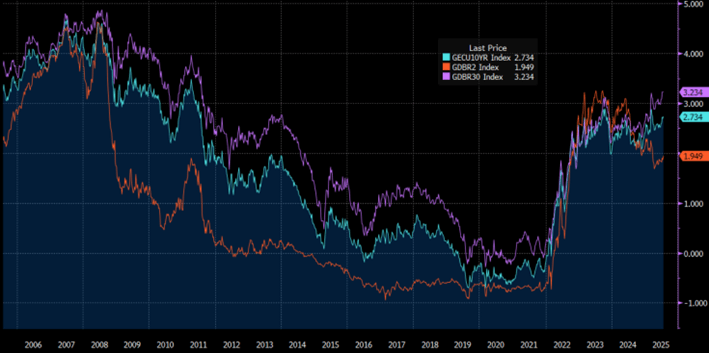
Yield on German 2-year debt Yield on German 10-year debt Yield on German 30-year debt
Source: Banco Carregosa
When buying a bond, investors will receive a periodic return, known as a coupon, and at maturity the face value of the investment is returned to the investor. In other words, instead of going to banks, entities borrow money from investors in order to finance themselves.
Bonds remunerate their holders in the form of coupon payments, which may take one of the following forms:
• Zero Coupon: the bond is purchased at a discounted price and the investor receives a higher nominal value at maturity;
• Fixed Rate: with fixed-rate bonds, the coupon rate is set at the time of issuance and remains unchanged until the bond matures;
• Variable Rate: The coupon is linked to an index, typically Euribor, and is paid out on a quarterly, bi-annual or annual basis.
Coupons are calculated daily and normally paid in one of the following 3 periods: quarterly, bi-annually and annually.
What types of bonds are there?
There are four types of bonds, which differ according to the risk they carry, the way in which they pay and the conversion conditions:
1. Senior bonds
Senior bonds are debt securities with a guarantee of priority for repayment to the investor in the event of bankruptcy. They carry a lower risk premium than other bonds.
2. Subordinated bonds
Subordinated bonds are the last to be repaid if the company goes bankrupt. These bonds take precedence over the shareholders and carry a higher risk premium than senior bonds.
3. Convertible bonds (Convertible Bonds)
Convertible bonds may be senior or subordinated. They give the right to be converted into shares of the issuing company. The terms and conditions are set when the bonds are issued. They are convertible into another financial instrument under certain conditions. For example, they can be converted into shares of the company at a conversion ratio specified in the terms and conditions of the issue.
4. Senior secured bonds
Senior secured bonds can be senior or subordinated. They usually have a call date, which is the date on which they can be redeemed. If they are not redeemed, the coupon may vary according to the terms and conditions of the bond issue. The issuers of this type of bond are usually companies in both the non-financial and financial sectors, the best known being CoCos, a type of subordinated debt that is last to be repaid in the event of bankruptcy, and therefore carries high risk premiums.
What are the benefits of investing in bonds?
Investing in bonds can be a good strategy for those who are looking for diversification and stability in their portfolio.
1. Predictable income
Bonds provide regular interest payments (coupons). Investors know in advance how much they will receive in each payment, making financial planning easier.
2. Lower volatility
Compared to shares, bonds tend to be less volatile, making them an attractive option for investors who want to avoid sudden price swings and maintain portfolio stability.
3. Portfolio diversification
Bonds can help diversify a portfolio by balancing the risks associated with other assets, such as shares. This diversification can be the key to limiting losses in times of market instability.
4. Protection against inflation
Certain types of bonds, such as inflation-linked bonds, adjust their value based on inflation rates. This protects investors’ purchasing power over time.
5. Accessibility
There are bonds for different investment profiles, and with different nominal values. This allows investors with different levels of capital to participate in the bond market.
6. Assessed credit risk
A bond’s credit rating assesses the likelihood that the issuer will make interest payments and repay the principal, allowing investors to select bonds according to their risk profile.
What are the risks of investing in bonds?
As with any type of investment, it’s important to consider the rewards and risks of bonds:
1. Credit risk
The main risk of investing in bonds is credit risk, which refers to the possibility that the issuer will be unable to meet its financial obligations. For example, if a company goes bankrupt, it may not be able to pay interest or repay the face value of the bond. Even if an investment appears safe at first, changes in the issuer’s economic or financial situation may affect its ability to pay.
2. Liquidity risk
Some bonds may have less liquidity in the market, which means it may be difficult to sell them quickly without incurring losses. This risk is particularly relevant for bonds issued by smaller companies or those with lower credit ratings.
3. Repayment at nominal value
Although bonds are usually repaid at face value at maturity, this does not guarantee a positive return, especially if inflation has eroded the purchasing power of the amount repaid.
4. Lower potential return
While bonds offer greater security and stable income, they tend to offer lower returns than other investments such as shares or investment funds. For this reason, bonds may not be suitable for investors looking to maximise capital growth.
Government vs. Corporate Bonds
Investing in bonds may be an excellent way to diversify your portfolio, but before taking the first step, it is important to understand the different options available. The two most common types are government bonds and corporate bonds, but the investment process is not always straightforward.
Government bonds
Government bonds are generally regarded as one of the safest forms of investment. When you buy this type of bond, you are lending money to a state.
In principle, the risk of default is low, especially when the issuer is a country with a stable economy and a good credit rating. However, as with any type of investment, the risk is never zero. Even governments can run into financial difficulties in exceptional circumstances, which can affect their ability to repay their debts. Nevertheless, this type of bond is still a safe choice for more conservative investors, or incorporated into an overall investment strategy as a way of diversifying risk.
Corporate bonds
Corporate bonds, on the other hand, are a riskier but potentially more rewarding alternative. When you invest in a corporate bond, you are financing a company.
However, the risk associated with this type of investment is higher, as it depends directly on the financial health of the issuing company. If the company is facing economic difficulties, there may be a greater risk of default, affecting the security of the investment. To compensate for this additional risk, corporate bonds usually offer higher interest rates, making them an attractive option for investors willing to accept a higher level of risk.
The risk associated with bonds is always linked to the issuer's rating. Depending on this rating, the market determines a risk premium, which is the bond's yield. Throughout the life of the bond, the yield changes to reflect changes in interest rates, ratings or time to maturity.
Direct or indirect investing in bonds: which is best for you?
Although bonds are an attractive investment option, buying bonds directly may not be the ideal solution for all investors. The minimum investment required to buy corporate bonds is often high, which can make this option inaccessible to investors with a smaller initial capital.
In addition, the direct management of bonds requires specialist knowledge to assess market conditions, the risk profile of the issuer and the maturity of the securities. This is where the indirect investment solution comes into play, providing a more accessible and efficient way to invest in bonds. Investment funds and unit-linked products give you access to a diversified portfolio of corporate and government bonds, without the high minimums or the complexity of direct management.
Bond investment funds
On the one hand, bond investment funds allow you to invest in a range of bonds from different issuers in order to reduce risk through diversification. These funds are managed by specialised professionals who constantly monitor the market and adjust the composition of the fund to maximise return and minimise costs. By investing in a bond fund, you benefit from the experience and expertise of asset managers without having to worry about buying and managing individual bonds.
Unit-linked
Another interesting solution is unit-linked investment products, which allow you to invest in bonds in a more personalised way. The advantage of these products is that you can adjust your portfolio according to your needs and investment objectives, while also enjoying tax advantages for investments of 5 or 8 years. These products offer the security of bonds alongside the flexibility of an investment product that can be tailored to your risk profile and time horizon.
How do I invest in bonds?
With this step-by-step guide, you’ll learn how to invest in bonds in line with your long term financial goals.
1. Define your bond investment objectives
Define your financial goals before you start investing. Identify your investment timeframe, your financial goal and your risk tolerance level. Defining these points will help you choose the type of bond that best suits your profile.
2. Evaluate the options available
Research the different bonds available on the market. Consider factors such as:
• Interest rates: Compare the interest rates offered by the different types of bonds and check that they are competitive;
• Credit rating: Check the issuer’s credit rating, which gives an indication of its ability to repay the debt;
• Maturity: Consider the duration of the bond and how it fits with your financial goals.
3. Choose a financial intermediary
To invest in bonds, you need to go through a financial intermediary, such as a bank, broker or online investment platform. With Banco Carregosa, you’ll have access to government and corporate bonds, as well as the support of our experts to optimise the combination of different options with your current portfolio and return expectations. It is also possible to invest in bonds through investment funds or through asset management.
4. Select the bonds
Next, it’s time to choose the bonds you want to buy. Use the information you’ve researched and the advice of experts to make informed decisions.
Aggregate yield on short-duration corporate bonds (1 to 3 years)
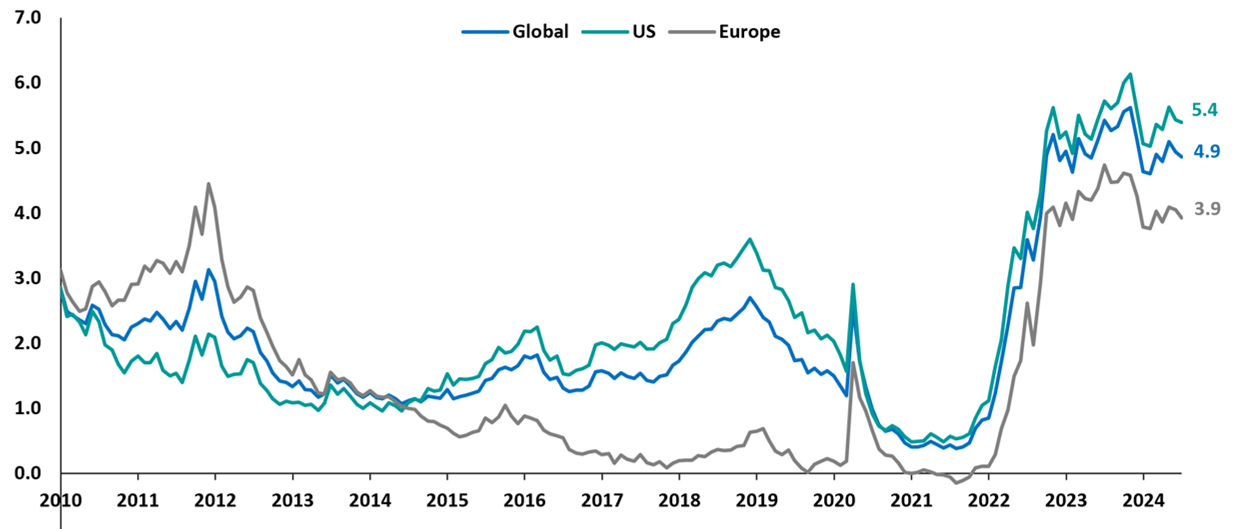
Source: iFast
Consider diversifying between different types of bonds and issuers to reduce risk.
5. Make the purchase
Once you have selected your bonds, complete the purchase. Check that the price of the bond is within your budget and that all charges associated with the purchase are clear.
6. Monitor the investment
Once you’ve invested, it’s important to monitor the performance of the bonds in your portfolio. Check the following regularly:
• Interest payments: Confirm that coupon payments are received as expected;
• Changes in interest rates: Be aware of changes in interest rates as they can affect the value of your bonds;
• Credit rating: Monitor the credit rating of the issuer to assess the risk of default.
7. Consider selling
If necessary, consider selling the bonds before maturity. You may do this if you need immediate liquidity, if market conditions change significantly, or if you want to take profits or limit losses.
8. Re-evaluate and adjust your portfolio
Re-evaluate your bond portfolio regularly and make any necessary adjustments. You may decide that it’s time to rebalance between different types of bonds, replace underperforming bonds with more promising options, or even consider new investment opportunities.
Key Takeaways
What are bonds and how do they work?
Bonds are financial instruments where the investor lends money to an entity (government or company) and receives periodic interest payments (coupons) and the capital at maturity, functioning as a low-risk alternative for diversifying investments.
What are the main types of bonds?
The types include:
- Senior bonds – priority in repayment, lower risk;
- Subordinated bonds – higher risk, but with higher interest;
- Convertible bonds – can be converted into shares;
- Senior secured bonds – no fixed maturity, with possible redemption.
What are the advantages of investing in bonds?
The advantages include predictable income, lower volatility than shares, portfolio diversification, protection against inflation (in inflation-linked bonds) and accessibility for different investor profiles.
What are the risks of investing in bonds?
The risks include:
How to invest in bonds safely?
To invest safely:
- Choose bonds with a good credit rating;
- Diversify between issuers and types of bonds;
- Consider bond funds for professional management;
- Consult experts, such as those at Banco Carregosa, for guidance.
Investing in bonds with Banco Carregosa
If you are considering investing in bonds, you need to be well informed about the characteristics and rules of this type of investment to understand whether it suits your profile. Buying bonds involves a rigorous analysis of prices, interest and credit risk.
You can rely on the experience of the team of experts at Banco Carregosa to select and manage risks on your behalf.