



ROA (Return on Assets): What it is, why it’s important, and how to calculate it


The case of the German fintech Wirecard is a good example of why it’s important to analyse the ROA indicator. In 2018, the company was a rising star, for example being worth more on the stock exchange than the Deutsche Bank. However, in 2020, it failed to identify assets worth €1.9 billion, which resulted in insolvency and substantial losses for investors. To this day, its former CEO is still evading the authorities.
However, a closer examination of the profitability indicators, particularly ROA, revealed that the figures told a different story: the return on assets was only half of that of direct competitors. Despite revenue growth, data from Bloomberg shows that Wirecard’s ROA was half that of competitors such as Visa or Mastercard. This suggests either inefficiency or overvaluation of assets.
Needless to say, analysing this indicator alone cannot explain everything that went wrong in the Wirecard case. However, it serves as a strong reminder that a company cannot be assessed based solely on isolated figures such as profits or revenues. It is essential to understand how a company transforms its resources into tangible financial results, and this is precisely where the ROA indicator comes into play. Read on to find out what this metric is and how you can use it to protect your investments.
What is an ROA and how do you calculate it?
An ROA, or Return on Assets, measures a company's ability to generate profit from its assets. It answers the question: "How much profit do you make for every euro of assets?”.
The formula is simple:
ROA = Net profit / Total assets
For example, a 5% ROA means that for every €100 in assets, the company generates €5 in profit. This metric is vital for evaluating operational efficiency and long-term profitability.
What makes an ROA so important to investors?
Positive results alone are not sufficient information for an investor to make an informed decision about a company. You also need to know how efficiently it achieves them. An ROA can help you understand whether a company:
• Manages assets efficiently: companies that use their assets efficiently tend to have a higher ROA;
• Avoids unproductive capital: idle assets that don’t generate revenue have a negative impact on this indicator;
• Is competitive in the sector: by comparing the ROA of similar companies, we can see which company is creating the most value from the same type of organisational structure.
The Wirecard case demonstrates that an apparently profitable company can still be inefficient or pose hidden risks if its ROA is low.
What is considered a good ROA?
There is no single reference value that applies to all companies. The definition of a good ROA varies greatly depending on the sector, business model, and context of the company.
In general, an ROA of 5% or less is considered low, whereas an ROA above 20% is considered very high. However, these figures should always be interpreted alongside those of other companies in the same sector.
For example, an ROA of 1% to 5% may be acceptable for a company that requires a lot of physical assets, such as a car manufacturer. On the other hand, a high ROA is more common in a software company, which uses few tangible assets, because the assets accounted for on the balance sheet are relatively low.
Intel's ROA over the years and the difficulty of making profitable investments
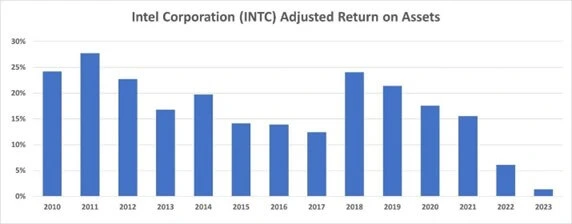
Source: Seeking Alpha
Banks and financial institutions typically have a lower ROA because the profit margins on their assets, which are mainly loans, are lower.
Conversely, tech companies tend to have a higher ROA because they generate more revenue with fewer physical assets.
How to interpret the ROA
ROA should not be interpreted in isolation. To analyse it correctly, you need to pay attention to three dimensions: sectoral, temporal and strategic.
Companies in the heavy industry sector, such as equipment or car manufacturers, typically have a lower ROA than tech or service companies, which operate with lighter assets.
For example, a software company with an ROA of 20% may be considered average for the industry, whereas a construction company with an ROA of 5% could be the most efficient in its market niche.
What to do: Always compare ROA with industry benchmarks. While a company may initially appear inefficient, if its ROA is above average compared to its direct competitors, this is a positive sign.
2. Observe the trend over time
ROA is not just a single figure; its power is revealed when it is analysed as a time series, i.e. over several quarters or years. A stable and growing ROA suggests that operational efficiency is improving continuously.
Conversely, a volatile or falling ROA may suggest problems such as poor capital allocation, inefficient acquisitions, or market saturation.
What to do: Compare ROA with the company's strategic decisions. Mergers, expansions and entry into new markets can all affect assets and temporarily distort ROA.
3. Analyse the quality of assets
Companies can have highly productive assets, such as proprietary technology or a recurring customer base, or inefficient assets, such as unused property, obsolete stock, and bad debts.
In accounting terms, a low ROA can indicate underutilised, unprofitable, misallocated or overvalued assets.
What to do: Assess the assets in terms of their composition, determining the amounts in cash, inventory and intangibles. A low return on assets may indicate that a company is highly capitalised and ‘tying up capital’.
4. Use ROA alongside other indicators to get a full picture
It is important to remember that no single indicator is sufficient on its own. To provide a more complete picture of the company’s financial health, ROA should be cross-referenced with other ratios. These are the ones you should consider:
• ROE (Return on Equity): Reveals the return on equity. A high ROE combined with a low ROA suggests excessive leverage;
• Net Margin: Shows the reinvestment capacity. A high ROA with a low margin may be unsustainable;
• Asset Turnover: Indicates the efficiency in generating income from assets. A low ROA with high turnover may indicate compressed margins.
For example, if a company has an ROA of 3% and an ROE of 15%, this indicates that it is highly leveraged. While this can increase shareholder returns, it also increases risk.
5. Consider the company’s life cycle
It is natural for companies at different stages of their life cycle – start-up, growth, maturity and decline – to have different ROAs.
• Startups: can have negative ROA for years while investing heavily in intangible assets;
•Growing companies: tend to have an increasing ROA as they reach scale;
• More mature companies: can show stable ROA, and be good dividend payers;
• Companies in decline: often show a falling ROA, which is a warning sign.
What to do: Align ROA with your desired portfolio strategy and risk profile. Companies with a consistently high ROA tend to be less volatile, making them more suitable for conservative investors.
How to use ROA for stock selection
The first step is to learn how to interpret ROA. The second, more strategic step is to use it to select companies based on their efficiency, sustainability, and financial stability.
1. Screen out companies with above-average operating efficiency
ROA can be an excellent initial filter for separating companies that truly generate value from those that merely "consume resources”.
Start by creating a list of companies from a specific sector. For example, you could choose utilities, retail, technology or energy. This will provide you with an average ROA benchmark to use when comparing companies that pique your interest.
2. Compare the results with the ROA
A company may report high profits for reasons that are not sustainable, such as one-off sales of an asset, subsidies, accounting manipulation, or increased debt to finance artificial growth. Comparing the results with the ROA can help detect such cases.
3. Identify companies that are "unfairly” undervalued
ROA can also reveal hidden opportunities, such as companies that are highly efficient but have not yet been recognised as such by the market.
What to look for:
• Companies with an above-average ROA for their sector, but whose shares are trading at low multiples (e.g. a P/L ratio or EV/EBITDA ratio below average);
• Family businesses, rarely in the spotlight of the financial press, but with disciplined management and constant growth.
4. Keep an eye on how your portfolio companies are developing
ROA remains a useful tool for monitoring the operational health of a company over time, even after an investment has been made. A progressive drop in ROA may indicate poor capital allocation, mismanaged expansion, a loss of strategic focus, or an entry into lower-margin markets.
5. Adjust the risk profile of the portfolio based on the ROA
ROA can help balance your investment portfolio. Companies with a high and stable ROA tend to be less volatile and more resilient during difficult economic cycles, as well as good dividend payers at maturity. Conversely, companies with a low ROA but growth potential can offer higher returns, albeit with more risk.
Manage your equity investments with Gobulling
The GoBulling Trading Platform is ideal for analysing stocks using ROA and other indicators. Its intuitive and customisable interface provides access to global stock markets, performance analysis tools and real-time notifications. This enables you to evaluate company efficiency and adapt your strategies with confidence.
Key Takeaways
How to start investing as a beginner?
Set goals, assess your risk tolerance, and start with small investments in ETFs or blue-chip stocks. Use GoBulling Investor to practice with the DEMO version.
What are the best sources for learning to invest?
Follow financial reports, books, and specialized podcasts. Avoid social media "tips.” GoBulling Investor offers educational articles and rankings.
Why diversify your portfolio?
Diversifying reduces risks by investing in different assets and sectors. Explore funds and ETFs on GoBulling Investor for a balanced portfolio.
What’s the best platform for beginners?
GoBulling Investor is ideal, with a simple interface, analysis tools, and educational content. Available on app or browser, with a DEMO version.
How to avoid mistakes when investing?
Avoid impulsive decisions, invest in familiar sectors, and review your portfolio regularly. Rely on advice from Banco Carregosa.
ROA: achieving profitability through strategy and support from Banco Carregosa
ROA is a key concept in value investing, providing an indication of how efficiently a company generates profit.
At Banco Carregosa, we provide our clients with specialised analysis, personalised advice and professional financial assessment tools. You can rely on us to help you get started in the markets or optimise your portfolio.
Talk to our experts to find out how we can help you achieve your financial goals using the most effective indicators, such as ROA.