



IRR: What it is, why it’s important and how to calculate it


At a glance
• The IRR (Internal Rate of Return) is a measure of the annual profitability of an investment, taking into account cash flows over time;
• It makes it possible to assess whether the expected return justifies the capital and risk involved, which is essential for comparing investment alternatives;
• It should be analysed in conjunction with indicators such as NPV (Net Present Value), for more complete and informed financial decisions.
How can you objectively measure the expected profitability of a project or financial investment? How can you tell whether an investment is really worth the capital invested and the risks taken?
This is where the Internal Rate of Return (IRR) comes in. It is one of the most widely used indicators for estimating the actual return on an investment over time. Find out what it is, how it is calculated, and how it can help you make more informed, strategic decisions.
What is the IRR, or Internal Rate of Return, and how is it calculated?
Put simply, the IRR is the annual return on an investment at which the Net Present Value (NPV) is equal to zero – in other words, the point at which the investment "pays for itself”.
Imagine making an initial investment of €10,000 that yields €3,000 a year for five years. Put simply, it would be reasonable to assume that the project would generate €15,000 in income after 5 years, with payback shortly after the third year. However, this income is received over several years and not all at once. This raises an important question: how much are these amounts really worth today? Is it more or less than the original investment of €10,000?
In order to answer this question, you need to calculate the Internal Rate of Return (IRR) of the project, which is the annual rate of return that makes the Net Present Value (NPV) of the investment equal to zero.
In this case, the IRR is the rate (r) that makes the following equation true:
10.000 = 3.000/((1+r)^1 )+3.000/((1+r)^2 )+3.000/((1+r)^3 )+3.000/((1+r)^4 )+3.000/((1+r)^5 )
The value of each term in the equation represents the present value of the income generated each year. For example, 3.000/((1+r)^1 ) is the present value of the income in the 1st year, 3.000/((1+r)^2 ) is the present value of the income in the 2nd year, and so on.
Since future money is worth less than money today, each cash flow must be "updated” by dividing it by (1+r)^n, where n is the number of years.
Year-on-year, these would be the expected returns:
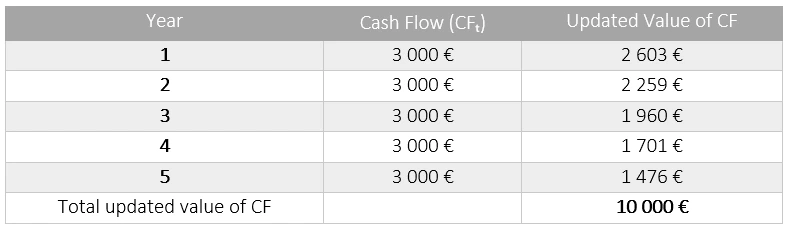
Therefore, the IRR is the rate of return that makes the initial investment equal to the sum of the present values of future returns. In this example, solving the equation using Excel or a financial calculator yields an approximate IRR of 15%, which is considered a healthy investment by most investors.
This means that the investment provides an average annual return of around 15%. In other words, the future cash flows will exactly offset the initial investment. Essentially, the project must yield an annual return of at least 15% in order to pay for itself within 5 years.
If the investor’s required minimum rate of return is lower than this (for example, 10%), the project is attractive. If it is higher than this, however, the investment is no longer viable.
How to use the IRR in "perpetual” investments
The above formula is ideal for investments with a defined time horizon. But what about rental income from property or dividends? Or when the investment generates equal and (hopefully) infinite returns? It would no longer be possible to update each flow individually – there would be an infinite number of terms!
Instead, calculating the Internal Rate of Return (IRR) is simpler, although it no longer takes into account the present value of future income. In this case, the IRR is determined by the direct relationship between annual income and the initial investment.
The formula is:
IRR = "Annual Income" /"Initial Investment"
So, if the investment is €200,000 and generates €50,000 a year, the IRR is 25%, which is the point at which the present value of these infinite flows exactly matches the amount invested.
As an alternative, if you want to consider the present value of future income, you can set a maximum timeframe for the investment – for instance, 10 or 20 years – and use the formula from the previous example to calculate the real IRR. This gives you a more realistic estimate that you can use to compare with other financial investments.
What if yields increase over time?
In the previous example, we assumed that the €200,000 investment would generate a constant perpetuity of €50,000 per year.
In reality, however, the value of many investments (such as rents, dividends or royalties) increases over time. For example, it may increase 2% a year to keep up with inflation or the natural rise in prices.
Now imagine that, in the same example, income is expected to grow by 2% a year indefinitely.
In this case, we’re not talking about a simple perpetuity, where the income remains constant, but an increasing perpetuity: an investment that generates income forever, albeit with an annual increase.
In this scenario, we use the increasing perpetuity formula, also known as the Gordon Model, to calculate the Internal Rate of Return (IRR):
I=R_1/(r-g)
where:
• I is the initial investment;
• R_1 is the return in the first year;
• r is the rate of return (IRR);
• g is the annual growth rate of income.
Therefore, the IRR is 27% a year. If the income remained constant at €50,000, the IRR would be 25% (50,000 ÷ 200,000). However, due to an annual growth rate of 2%, the return increases to 27%.
Advantages of the IRR
As the above example shows, the IRR is one of the most widely used metrics in investment analysis. Here are the main advantages of evaluating this financial KPI.
• It enables you to compare different projects: it expresses the return as a percentage, which makes it easier to analyse alternatives of different sizes;
• It takes into account the time value of money: it recognises that cash flows in different periods have different values, providing a more realistic view of profitability;
• It supports long-term decision-making: It is useful for projects involving multiple cash flows over time, such as business or property investments;
• It is widely recognised in the market: The IRR is used by analysts, managers and individual investors alike as a benchmark for economic viability.
Limitations of the IRR
Although the IRR is useful, it also has limitations that must be considered in financial analysis.
• It does not measure the actual amount gained, only the percentage return. This can be misleading when projects involve very different levels of investment;
• It assumes that flows are reinvested at the same rate as the IRR, which may not be realistic in a context of variable markets;
• It is sensitive to estimates of future flows, and its accuracy can be affected by uncertain or volatile projections.
IRR vs. NPV: which should you use?
Although both the IRR and the NPV are fundamental tools for assessing the viability of an investment, they provide different insights.
• NPV: Indicates the value that the project generates by discounting the cash flows at the required rate of return;
• IRR: Expresses the percentage return that the investment offers over time.
In practice, the two indicators complement each other: when used together, they enable you to evaluate both the profitability of an investment and the additional value it generates in relation to the capital invested.
IRR: Frequently Asked Questions
Below are the answers to the most frequently asked questions about the Internal Rate of Return.
1. What exactly is the IRR and what is it used for?
The IRR (Internal Rate of Return) is the rate of return that makes the Net Present Value (NPV) of an investment equal to zero. It is used to objectively assess the viability of investments and compare alternatives.
2. When is IRR most useful?
The IRR is particularly useful for projects involving multiple cash flows, such as business investments, property funds, bonds or shares with future dividends, provided these projects have a defined time horizon. It is also used to analyse the viability of new projects, mergers, acquisitions and long-term investment decisions.
3. What does it mean if the IRR is above or below the required rate?
An investment is considered attractive if its IRR exceeds the minimum required rate of return (such as the cost of capital or a reference interest rate). If the IRR is lower, the project tends not to compensate for risk or opportunity cost. When the IRR is equal to the minimum required rate of return, however, the investment is balanced.
4. Does the IRR apply to personal investments or only to business projects?
The IRR can be used in both contexts. It is useful for evaluating the profitability of business projects and analysing personal investments. Examples could include property funds, bonds or shares that generate cash flows over time.
5. Does the IRR measure the risk of an investment?
No, the IRR only measures the expected return and not the associated risk. To provide a full analysis, it must be combined with other metrics that consider volatility, alternative scenarios, and the probability of achieving the projected cash flows.
Maximise your IRR with Banco Carregosa
The IRR is a powerful metric for evaluating the viability and potential return on projects or financial investments. However, it is most effective when used alongside other tools, such as NPV, and incorporated into a robust investment strategy.
At Banco Carregosa, we help investors interpret indicators such as the IRR, turning financial data into the basis for strategic decisions. Talk to us to learn how to apply the IRR effectively by combining technical analysis, market insight and specialised monitoring to maximise the profitability of your investments.