



12 Global Indices worth tracking

At a glance:
• Global indices are indicators that track the performance of groups of companies, markets, or regions.
• The most closely tracked indices include the S&P 500, Nasdaq 100, Dow Jones, MSCI World, Nikkei 225, Euro Stoxx 50, FTSE 100, DAX 40, Russell 2000, MSCI Emerging Markets, PSI and CSI 300.
• The composition, sectoral exposure and geographical exposure of each index are all distinct, as is their risk level. Therefore, before investing in instruments that replicate or track indices, you should consider your investor profile, time horizon, the associated costs and risks, and the liquidity and currency of the investment.
• Banco Carregosa provides specialist advice to help investors analyse investment solutions that align with their wealth management goals.
If you want to understand the global economy, identify investment priorities and recognise regions with the greatest growth potential, the main global indices are a useful reference point.
While they do not tell the whole story or replace in-depth analysis, they provide a clear overview of market trends, helping to identify priority areas and filter opportunities more effectively.
"Although tracking global indices can help you to understand market trends, it is no substitute for personalised analysis. The composition, currency, costs, liquidity, and risk of each instrument must be assessed in light of each investor’s profile, time horizon, and objectives.” — João Queiroz, Head of Trading do Banco Carregosa.
Global indices: the 12 key stock market indices to track
In order to support the construction of a diversified portfolio, the experts at Banco Carregosa organise the main global indices according to their geographical focus and asset profile:
| Index | Region / Focus | Key feature | Typical use in portfolios |
|---|---|---|---|
| S&P 500 | USA (Broad) | Covering the 500 largest companies; it is a barometer of the US economy | Core of the portfolio (Growth) |
| Nasdaq-100 | USA (Technology) | Covering the 100 largest non-financial companies; has a strong technological focus | Focused on Innovation and Growth |
| Dow Jones | USA (Blue Chips) | 30 industrial and traditional consumer giants | Defensive / Value profile |
| Russell 2000 | USA (Small Caps) | Small-cap companies; highly sensitive to the US domestic economy | Alpha-seeking / Higher risk |
| Euro Stoxx 50 | eurozone | The 50 largest blue-chip companies from 8 countries in the region | Geographical diversification |
| DAX 40 | Germany | German industrial titans and exporters | Industrial Focus/Growth |
| FTSE 100 | United Kingdom | Strong exposure to commodities, banking and multinationals | Value profile / Dividends |
| PSI | Portugal | The domestic market; strong exposure to the energy, banking, retail and pulp/paper sectors | Proximity and dividends |
| Nikkei 225 | Japan | Japanese tech giants and exporters | Developed Asian exposure |
| CSI 300 | China | The largest companies listed on the Shanghai and Shenzhen stock exchanges | Geopolitical risk / Potential |
| MSCI World | Developed markets | Over 1,400 companies from 23 developed countries | Global Long-Term Base |
| MSCI Emerging Markets | Emerging markets | Exposure to rapidly growing economies (e.g. India, Brazil) | Frontier Market Diversification |
1. S&P 500
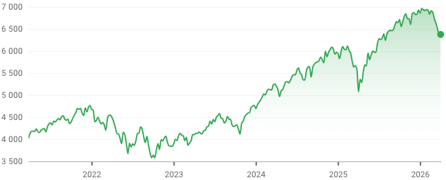
It is the most reliable barometer of US economic health, comprising the 500 largest companies listed on US stock exchanges and accounting for around 80% of available market capitalisation.
• Analytical advantage: an excellent global benchmark. It offers robust sector diversification that goes far beyond technology.
• Note: due to its market capitalisation weighting, the index is heavily dependent on the performance of the largest companies (Big Tech), which can hide weaknesses in the rest of the market.
Performance of the S&P 500 over the last 5 years
Source: Google Finance. Data accessed in May 2026.
2. Nasdaq-100
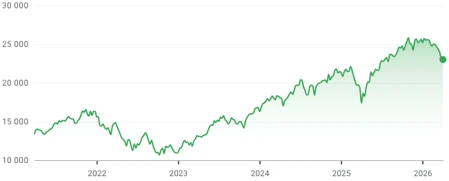
It tracks the 100 largest non-financial companies listed on the Nasdaq stock exchange, mainly in the technology, consumer, and biotechnology sectors.
• Analytical advantage: it is the ultimate tool for capturing the growth of companies focused on innovation, artificial intelligence, and digital disruption.
• Note: historically, it has been more volatile than the S&P 500 and has been highly sensitive to cycles of rising interest rates.
Performance of the Nasdaq-100 over the last 5 years
Source: Google Finance. Data accessed in May 2026.
3. Dow Jones Industrial Average
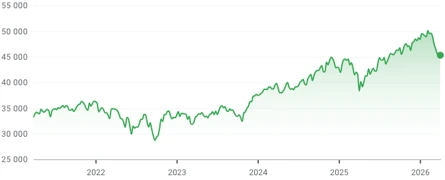
This is one of the world’s oldest indices. It comprises just 30 major US companies that are historically significant and financially stable (blue chips).
• Analytical advantage: it provides a focused view of well-established, mature companies with a strong focus on industries and traditional consumers.
• Note: as it is weighted by share price rather than the company size, the performance of this index may be distorted by sudden movements in a single listed company with a high market capitalisation.
Performance of the Dow Jones Industrial Average over the last 5 years
Source: Google Finance. Data accessed in May 2026.
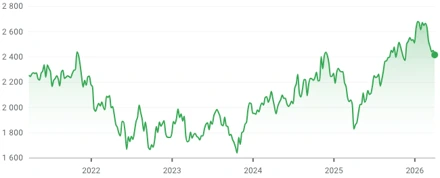
4. Russell 2000
It focuses on US small and medium-sized companies (small caps) and acts as a true barometer of the US domestic market.
• Analytical advantage: it allows investors to identify companies with growth potential in the early stages of expansion, which are often the target of mergers and acquisitions.
• Note: it presents a higher credit risk and is extremely sensitive to cycles of monetary tightening (i.e. high interest rates), as these companies rely heavily on short-term bank financing.
Performance of the Russell 2000 over the last 5 years
Source: Google Finance. Data accessed in May 2026.
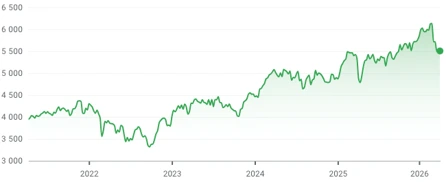
5. Euro Stoxx 50
Comprising the 50 largest and most liquid companies from 11 Eurozone countries, it serves as a barometer for developed corporate Europe.
• Analytical advantage: it provides direct exposure to the European market, avoiding the currency risk associated with the dollar. It focuses on world-leading brands in the luxury consumer goods, banking, and energy sectors.
• Note: historical growth in the eurozone tends to be more moderate than in the US market. This reflects the fact that the Eurozone has a more mature and regulated economy.
Performance of the EURO STOXX 50 over the last 5 years
Source: Google Finance. Data accessed in May 2026.
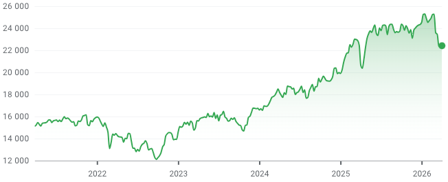
6. DAX 40
It measures the performance of the 40 largest German companies listed on the Frankfurt Stock Exchange, thereby reflecting the industrial might of Europe.
• Analytical advantage: it is ideal for analysing the sentiment of major European exporters, as well as the global industrial and automotive sectors.
• Note: direct comparison with pure price indices requires careful analysis, as it is a ‘total return’ index (which reinvests dividends in the calculation of its value).
Performance of the DAX 40 over the last 5 years
Source: Google Finance. Data accessed in May 2026.
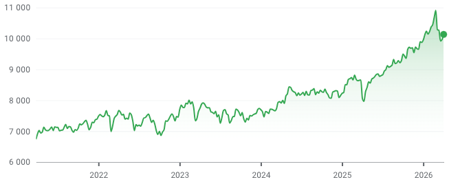
7. FTSE 100
It comprises the 100 largest companies listed on the London Stock Exchange. These companies are characterised by a strong international presence, with the majority of their revenue being generated outside the UK.
• Analytical advantage: it has a defensive composition focused on ‘traditional’ sectors such as banking, commodities, energy and healthcare. It has also historically been a strong dividend generator.
• Note: it has almost no exposure to the technology sector, which restricts its ability to grow quickly during periods of digital expansion.
Performance of the FTSE 100 over the last 5 years
Source: Google Finance. Data accessed in May 2026.
8. PSI
This is the benchmark index for the Portuguese market, reflecting the performance of the main domestic companies listed on Euronext Lisbon.
• Analytical advantage: it is characterised by geographical proximity and familiarity for domestic investors and has historically offered attractive dividends.
• Note: due to its small size and high concentration in specific sectors (energy, banking, retail, and pulp/paper), it lacks the diversification found in its European counterparts.
Performance of the PSI over the last 5 years
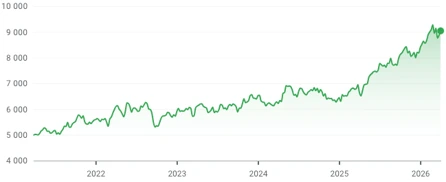
Source: Google Finance. Data accessed in May 2026.
9. Nikkei 225
This is the main benchmark index of the Japanese market, comprising 225 companies selected from the Tokyo Stock Exchange.
• Analytical advantage: it offers exposure to the technology and automotive ecosystems of developed Asia, which often benefits from the Bank of Japan’s highly specific monetary and exchange rate policies.
• Note: as with the Dow Jones, it is price-weighted, so extra care is required when interpreting the internal volatility of its components.
Performance of the Nikkei 225 over the last 5 years
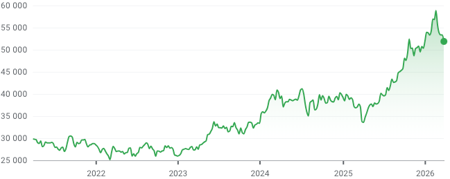
Source: Google Finance. Data accessed in May 2026.
10. CSI 300
It measures the performance of the 300 largest companies listed on the Shanghai and Shenzhen stock exchanges, which represent the core of mainland China’s economy.
• Analytical advantage: it provides direct access to the world’s second-largest economy and its leading industrial and consumer companies.
• Note: there is a high risk of regulatory intervention and dependence on global trade tensions. This requires an investor profile that can tolerate sharp fluctuations.
Performance of the CSI 300 over the last 5 years
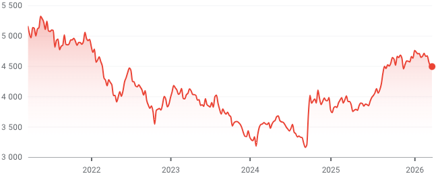
Source: Google Finance. Data accessed in May 2026.
11. MSCI World
This is a broad global index that tracks over 1,400 large- and mid-cap companies across 23 developed markets.
• Analytical advantage: it provides an ideal foundation for any long-term strategy by effectively offsetting the specific risk associated with a single country or company.
• Note: Although it is a global index, around 60-70% of its composition is allocated to the US. This means that the index remains highly sensitive to Wall Street.
Performance of the MSCI World over the last 5 years
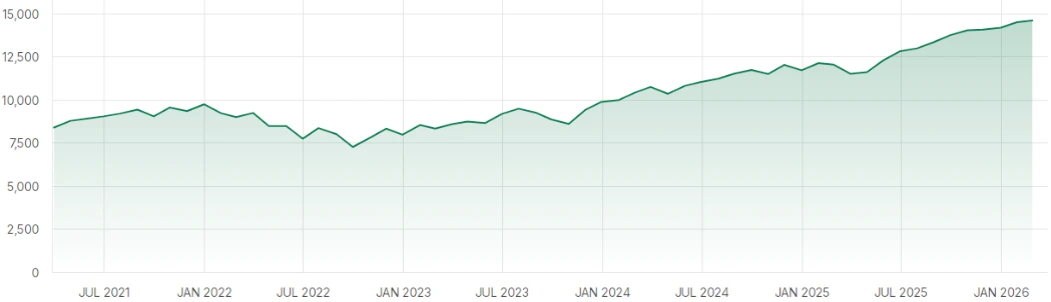
Source: MSCI World Index. Data accessed in May 2026.
12. MSCI Emerging Markets
It tracks the performance of large and medium-sized companies in 24 emerging economies, such as India, Brazil, China and South Korea.
• Analytical advantage: it opens the door to high potential for demographic, industrial and consumer growth in regions that are undergoing economic acceleration.
• Note: during periods of global risk aversion, it is exposed to significant geopolitical risks, severe currency volatility and lower structural liquidity.
Performance of the MSCI Emerging Markets over the last 5 years
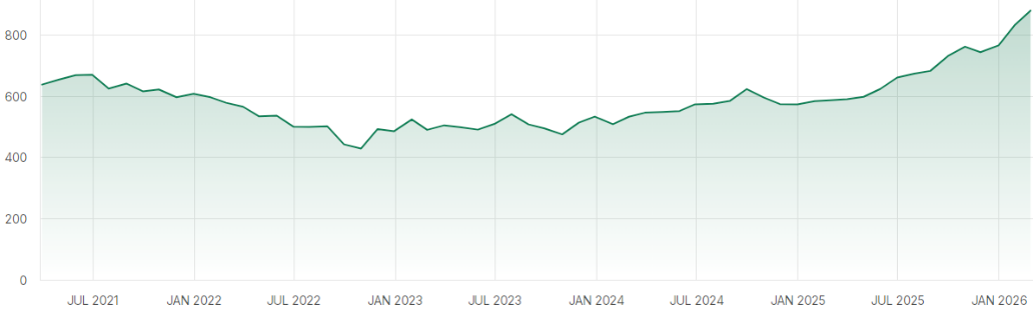
Source: MSCI Emerging Markets Index. Data accessed in May 2026.
Recommended reading
You can read our articles to learn more about some of the indices mentioned:
• S&P 500: What it is and how to invest in it
• Russell 2000: What it is and how to invest in it
• PSI Quotes: How to track the main Portuguese stock market index with confidence
• MSCI World: How to invest in the world’s largest companies
How can you track global indices?
Tracking global indices offers a quick way to gain an overview of developments in the main financial markets, regions and sectors. These 12 global indices are useful for understanding market trends and shifts in investor sentiment, as well as significant changes in major economies.
To track these indices effectively, it is important to consider the following aspects:
• Daily and historical changes in prices, to help you understand short-, medium-, and long-term trends;
• Composition of the index, identifying the sectors and companies with the greatest weighting;
• Exposure to geographical and currency factors, particularly when the index is denominated in a different currency;
• Macroeconomic context, including interest rates,inflation, economic growth, and decisions made by central banks;
• Volatility and liquidity, which can influence the behaviour of the financial instruments associated with each index.
Banco Carregosa’s GoBulling platforms
Investors can use the GoBulling platforms to monitor international markets, access market information and analysis tools, and trade across different asset classes.
In addition, the Markets Service enables you to trade in financial markets with the support of our experienced trading team. You will have access to a wide range of financial instruments and relevant, personalised information at all times via our trading room.
How can I invest in global indices?
Direct investment in a stock market index is not possible. An index merely measures the performance of a group of companies, markets or sectors. Investors typically use financial instruments that seek to replicate, track or reflect the behaviour of an index to gain exposure to its performance.
The most common ways to gain exposure to global indices are:
• ETFs, which aim to replicate the performance of a specific index and are traded on the stock exchange;
• Investment funds, which may follow index-tracking strategies or be actively managed in reference to specific indices;
• Index futures and options, which are usually used by seasoned or institutional investors;
• Index CFDs, which are derivative instruments that provide exposure to index changes. However, they involve high risk and may not be suitable for all investors;
• Structured products, which may be linked to the performance of one or more indices and have their own specific characteristics and risks.
Before investing in instruments linked to global indices, it is important to consider a number of factors:
• Investor profile and ability to sustain losses;
• Investment time horizon;
• Market risk, as the value of the instruments may rise or fall;
• Currency risk, where the index or instrument is denominated in a currency other than the euro;
• Costs and fees associated with the product;
• Liquidity, particularly with regard to less actively traded instruments;
• Complexity of the financial instrument, particularly in the case of derivatives or structured products.
Although exposure to global indices can contribute to greater geographical and sectoral diversification, it does not eliminate the risk of capital loss. Therefore, careful analysis and, where necessary, specialist guidance should inform the choice of instrument.
Discover your investor profile and strategy
Click on this article to find out what type of investor you are: conservative, moderate, or dynamic. Explore the various investor profiles with Banco Carregosa to find the one that best suits you.
Why should you monitor the markets with Banco Carregosa?
Founded in 1833, Banco Carregosa has its roots in one of Portugal's oldest financial institutions. Today, it is recognised as an independent leader in Wealth Management in Portugal. Drawing on nearly two centuries of experience, the Bank has developed a client-focused approach based on continuity, stability, independence, and personalised support.
For the second consecutive year, Banco Carregosa has been named Best Pure Play/Boutique Private Bank at the Euromoney Private Banking Awards 2026, an accolade that recognises the Bank’s dedication to providing an exclusive, personalised wealth management service. The award is entirely at the discretion of the awarding body.
Global indices provide various investment opportunities. From developed economies and emerging markets to technology sectors and traditional industries, each index has its own unique risk and opportunity profile.
With the support of the GoBulling platforms and the Private Banking team at Banco Carregosa, you can build a global and diversified investment portfolio that is perfectly aligned with your risk profile and wealth preservation objectives. Contact us!
Global Indices: FAQs
What are global indices?
They are indicators that track the performance of a group of shares, companies, sectors or markets. They are used as a benchmark to assess the performance of an economy, region or market segment.
What is the difference between the MSCI World and the S&P 500?
The S&P 500 tracks around 500 large companies listed in the US. In contrast, the MSCI World includes companies from developed markets such as the US, Europe, Japan, Canada and Australia, offering greater geographical diversification.
Is the Nasdaq-100 riskier than the S&P 500?
As it tends to be more heavily weighted towards technology and growth companies, it may experience greater volatility. However, the level of risk also depends on the investment vehicle used, the time horizon, and the composition of the portfolio.
What risks are involved in investing in financial instruments that track global indices?
The main risks include market risk, currency risk, the risk of sectoral or geographical concentration, liquidity risk, the cost of the instruments used, and the possibility of capital loss.
Which index best represents the global economy?
There is no single index that can do this. The MSCI World Index is a benchmark for developed markets, while the MSCI Emerging Markets Index covers emerging economies. Combining several indices can provide a more comprehensive view.
How should you decide which indices to track?
This decision should take into account investment objectives, risk profile, time horizon, currency, geographical exposure, the sectors represented, costs, and the tax framework. An informed decision should be accompanied by a personalised analysis.
Disclaimer: This content is provided for informational and educational purposes only. It does not constitute investment, financial, tax or legal advice, nor is it an invitation to buy or sell financial instruments. Investing in financial instruments carries risks, including the possibility of losing some or all of your invested capital. Past performance does not guarantee future results. Before making any investment decisions, we recommend that you consider your investor profile, objectives, time horizon, knowledge and experience, and your ability to withstand losses. Risks to consider include sectoral and geographical concentration risk, tracking error risk in index-tracking instruments, and complexity risk in derivatives and structured products.