



Learning to Invest: 15 practical tips for beginners

At a glance:
• The first step in learning to invest is setting goals, understanding your risk tolerance, and choosing instruments that suit your profile.
• The principles of diversification, starting with modest amounts, and avoiding impulsive decisions all help to reduce the risk of costly mistakes.
• Investing involves the risk of capital loss, and there are no guaranteed returns. Ultimately, no advice can replace an analysis of your specific situation.
• At Banco Carregosa, you will find the tools, resources and specialist guidance you need to get started.
What do renowned investors such as Warren Buffett, Peter Lynch and Ray Dalio have in common? They all started out as beginners and learned valuable lessons early on in their careers.
Famous fund manager Peter Lynch suffered losses when he focused on a single company that subsequently went bankrupt. Ray Dalio, the founder of Bridgewater Associates, predicted a fall in oil prices in the 1980s, but the market proved him wrong.
These cases emphasise the importance of learning from mistakes and setting aside sufficient time to master investments. Dalio, for instance, created his "principles” system, which is based on transparency and rigorous analysis, and which transforms setbacks into achievements.
Where should you start? With so much data available, how can you identify the most reliable sources of information? Perhaps the most important question of all is to identify the key pieces that can truly transform your portfolio and filter out the "noise”. This article will explore the best practices and learning resources for those who are new to investing.
Expert tips for those learning to invest
Banco Carregosa’s experts share 15 practical tips to help you get started with confidence:
1. Define a clear investment strategy
It’s essential to have a well-defined strategy in place before making any investment. Ask yourself what your short-, medium- and long-term financial goals are. Would you prefer to invest in new technologies or mature sectors that generate regular cash flows? A clear strategy will enable you to adjust your investments according to market conditions and your financial situation.
2. Adapt your investments to your risk tolerance
When it comes to investing, one of the most important things to learn is how to identify opportunities that align with your risk tolerance (and, of course, growth prospects).
• Low risk tolerance: these investors usually opt for bonds, dividend-paying shares or other conservative financial products, such as bond funds. While these investments are less risky, they also offer a more modest return.
• Moderate risk tolerance: investing in ETFs and index funds focused on technology, health, and sustainability could be a good option. This is a way of diversifying your portfolio and reducing the risk associated with investing in individual stocks.
• High risk tolerance: the higher your risk tolerance, the more likely you are to invest in shares of companies with great growth potential, or in sectors such as technology or the cryptoassets market. However, it is important to note the following regarding this last asset class: cryptoassets are far more volatile than shares; they have no intrinsic value linked to a company’s results; and their regulatory framework within the European Union is still in its infancy. This asset class is not suitable for beginners.
"Most mistakes made by beginners do not stem from choosing the wrong asset. Rather, they stem from failing to define, from the outset, how much they are prepared to lose.” — Ana Carvalho, Head of the Savings and Investment Department at Banco Carregosa.
In addition, using specialised services to delegate portfolio management to a team can also help you make informed decisions, manage risks, and optimise your investments.
3. Follow reliable sources of information
When it comes to investing, it is essential to have access to reliable sources of information. Read specialised publications such as financial reports, market analyses, and blogs by respected investors. Use this information to make informed decisions and keep up to date with market trends and risks. To learn more about this topic, take a look at our recommendations of essential investment books. Alternatively, you could listen to financial podcasts or watch specialist YouTube channels.
4. Be cautious of any online "tips”
Information about investments is widely available on social media and in online publications. However, this information may conceal risks. Firstly, it may be incomplete, which can result in hasty and ill-founded decisions. In addition, the information may not be based on thorough analysis or study of company fundamentals. This information may be simplified or distorted to grab your attention and make you act impulsively, without fully understanding the risks or opportunities involved in the investment. Make sure you understand the fundamentals of any shares or financial products you are considering before taking any advice on them.
This is an important issue: many of the recommendations circulating on social media are made by content creators who are neither qualified nor supervised. Our article on finfluencers explains how to assess them.
5. Start with small investments
When you’re just starting out, it’s important to make modest investments, so you can gain experience without taking significant risks. As your confidence grows, you can gradually increase your investments. You can also use simulation platforms, such as those offered by Banco Carregosa, to test different investment strategies.
6. Diversify your portfolio
This is perhaps the most frequently given piece of advice to beginners, and for good reason. By spreading your investments across different assets (such as shares, bonds, and investment funds) and sectors, you reduce your exposure to the risks associated with a single asset or market.
7. Avoid making market predictions
Many people who are new to investing are tempted to try to predict market behaviour based on short-term trends. However, it is better to develop a long-term strategy and avoid making hasty decisions in response to short-term market fluctuations.
8. Seek professional advice
If you’re new to investing and need assistance, don’t hesitate to ask a reputable financial advisor. Our investment experts can offer valuable insights and help you build a portfolio that matches your objectives.
9. Evaluate and prioritise the investment opportunities available to you
As not all investment opportunities are equal, it is important to analyse your options carefully before deciding where to allocate your resources. Consider factors such as expected returns, risk levels, liquidity, and time horizon.
10. Focus on sectors you know well
When learning to invest, it’s a good idea to focus on sectors with which you are familiar or in which you are interested. For example, if you have experience in the technology sector, you will find it easier to analyse companies and trends in that field, which will enable you to make more informed investment decisions.
11. Be prepared for volatility
Investment markets are volatile, and returns are not guaranteed. Be prepared for fluctuations and remember that patience and discipline are key. Don’t let temporary feelings of panic or euphoria overwhelm you. Successful investments often take time, so be patient. However, it is important not only to consider volatility, but also to analyse it critically. It is important to understand the reasons behind fluctuations in your investments, and to evaluate them in light of your objectives, fears, and convictions.
12. Learn from your mistakes
It’s inevitable that you’ll make some mistakes on your investment journey. The most important thing is to learn from these mistakes and view them as opportunities for growth. Think about what went wrong, review your decisions, and use this experience to inform your future choices.
13. Review your portfolio regularly
Although investing is a long-term endeavour, it is important to regularly review your portfolio to ensure it still aligns with your objectives and risk tolerance. You may need to adjust your portfolio in response to new information or changes in market conditions.
14. Avoid making investments on the spur of the moment
Rumours, panic, and social pressure can lead to impulsive decisions. It is important to take a step back and assess the situation before making any decisions. If an investment opportunity seems too good to be true, it is important to investigate it thoroughly and ensure that you fully understand the risks involved.
15. Stay informed without becoming overwhelmed
While it’s important to stay informed about the markets and economic trends, it’s also important not to overload yourself with information. With so many sources and opinions available, it’s easy to become overwhelmed. Choose a few reliable sources to follow, but don’t allow them to influence your ability to make rational decisions.
What are the best investment options for beginners?
There is no definitive answer to this question. The truth is that some investment instruments, such as options, require greater knowledge and expertise. However, when you first start investing, there is no need to begin with complex or large-scale investments. If you’re just starting out on your investment journey, we can provide you with some examples to analyse and see if they match your level of knowledge, investment objectives, and risk profile:
| Instrument | What it is | Diversification | Aspects to consider |
|---|---|---|---|
| Investment funds | A professionally managed portfolio in which investors can invest | Automatic, in line with the fund’s policy | Management fees; investment policies vary widely |
| ETFs | Exchange-traded funds that track indices, sectors or asset classes | Variable: high for a broad index, low for a thematic ETF | Costs (TER) and method of replication |
| Blue-chip shares | Shares in large companies that have a long track record and stable results | None: it depends on how many you hold | Company-specific risk: lower volatility does not mean an absence of risk |
| PPRs | A long-term savings product that offers tax relief on subscriptions | It depends on the PPR | Redemption conditions and penalties that are not provided for by law |
None of these investment instruments is suitable for all investors. Which one you choose depends on your individual objectives, time horizon and risk tolerance.
A platform designed for beginners
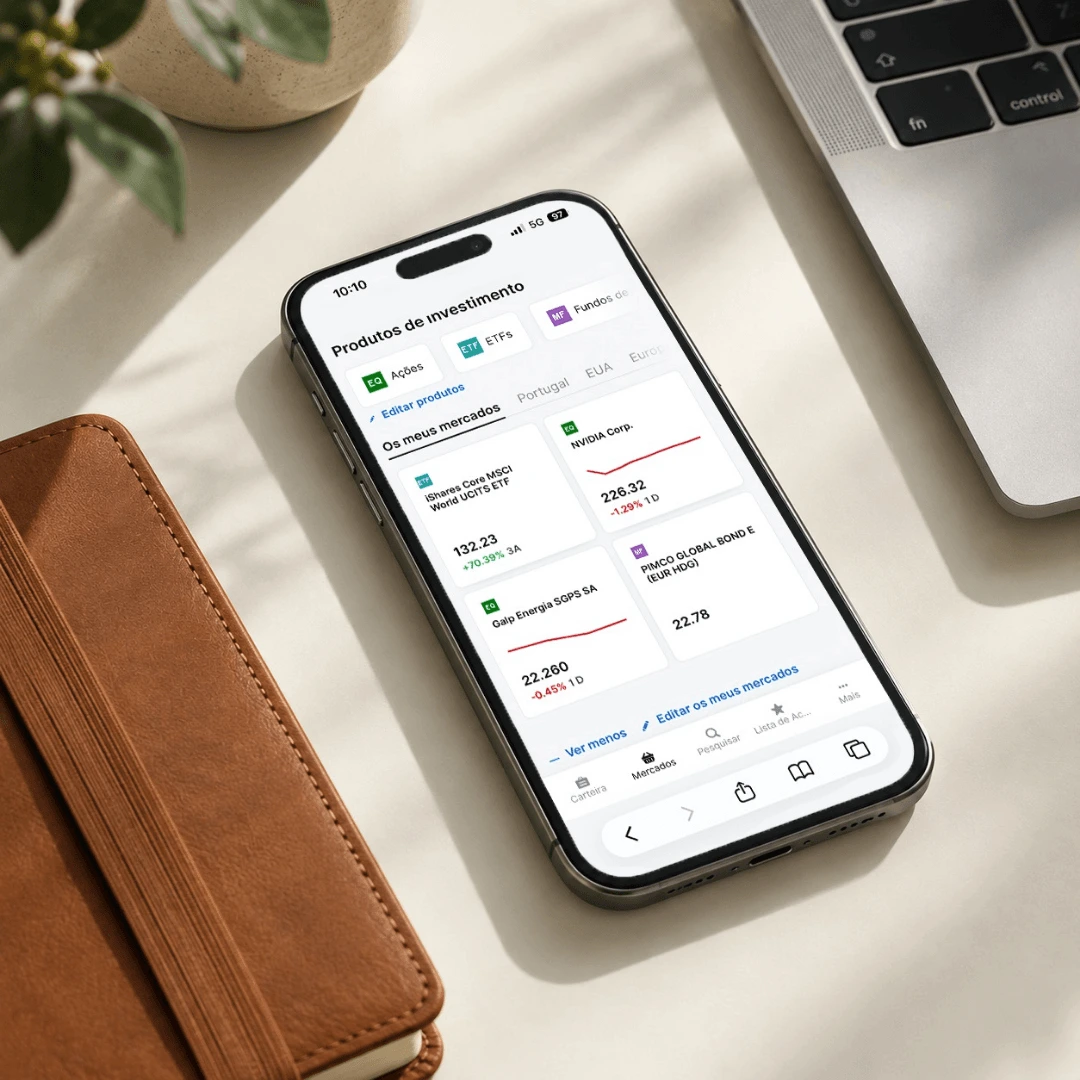
For those just starting out, the choice of platform can significantly impact the learning experience. Our GoBulling Investor Trading Platform is the ideal solution for those new to the financial markets who are looking for an intuitive investment experience.
• Simplicity: it offers a modern, user-friendly interface designed to make investing accessible to everyone, from beginners to seasoned investors;
• Practical tools: it provides effective features for tracking markets, analysing opportunities, and making informed decisions, even for those with limited experience. The platform integrates top performers and popularity, making it easy to spot trends;
• Essential financial instruments: explore shares and ETFs (PRIIPs) from Euronext and the US market, as well as investment funds. This enables you to diversify your portfolio with safe, affordable options;
• Day-to-day accessibility: it can be accessed via an app on iOS and Android devices or through a browser. No complex installation is required.
Start without any risk
The GoBulling Investor demo version enables you to trial investment strategies using virtual capital before committing real funds. It is free of charge and there is no obligation. Try the DEMO version.
Banco Carregosa: providing the support you need to invest with confidence
Although learning to invest can be challenging, it doesn’t have to be a solo journey. At Banco Carregosa, you’ll find the advice and tools you need to understand the risks and make decisions that are right for you. Our team is here to support you every step of the way, ensuring you make informed, conscious decisions that align with your goals.
About Banco Carregosa
Banco Carregosa can trace its origins back to Casa Carregosa, a currency exchange house founded in 1833 in Porto, making it the oldest financial institution still in operation on the Iberian Peninsula. It operates as a bank specialising in private banking and wealth management. It is authorised and registered with both Banco de Portugal (registration no. 0235) and the CMVM (registration no. 0169).
Recent accolades: in March 2026, Banco Carregosa was named the Best Pure-Play / Boutique Private Bank in Portugal by Euromoney for the second consecutive year. This is one of the most prestigious awards in the global Private Banking sector. In 2024, Global Banking & Finance Review named it the Best Bank for Private Wealth Management Iberia.
Learning to invest: FAQs
How should beginners start investing?
First, set financial goals and assess your risk tolerance. Then, choose investment instruments that suit your profile. Typically, these are investment funds, ETFs or shares in large, stable companies. You should start with modest investments and increase them as you gain experience. Remember that investing involves the risk of capital loss. At Banco Carregosa, however, you can practice risk-free with the DEMO version of the GoBulling Investor platform.
Where is the best place to learn how to invest?
Reliable sources for learning how to invest include financial reports from regulated institutions, reference books on investment, and specialist podcasts. Exercise caution when considering recommendations on social media, as these often fail to reveal the full context or the interests of the people posting them. Banco Carregosa offers market analysis and a selection of financial books and financial podcasts.
Why is it important to diversify your portfolio?
Diversifying your portfolio means spreading your investment across different assets, sectors, and geographical regions, in order to reduce exposure to the risk associated with any single investment. The impact on the portfolio of an asset losing value is less than if the asset represented the entirety of your capital. Although diversification reduces the specific risk of each investment, it does not eliminate market risk. In the event of a general market downturn, the value of the portfolio will fall too.
Which platform is best for those who are just starting to invest?
An authorised and regulated organisation should provide a platform suitable for beginners that has a simple interface and transparent fee structure. Ideally, it should also offer educational content and a demo version. The GoBulling Investor platform from Banco Carregosa meets these criteria and is available via a web browser.
How much money do you need to start investing?
There is no set minimum amount required to start investing. However, it is possible to start with small sums, particularly through ETFs or investment funds. It is more important to ensure that the investment is suited to your risk profile and that further contributions are made regularly than to consider the initial amount. Bear in mind that minimum fees can render very low-value transactions inefficient.
What steps can you take to avoid making mistakes when you first start investing?
The most common mistakes made by those starting to invest are making impulsive decisions driven by news or social pressure, concentrating capital in a single asset, trying to predict short-term market movements, and ignoring costs and taxes. To avoid this, you should define a strategy before investing, review your portfolio periodically, and seek professional advice when necessary.
Disclaimer: This article has been prepared by Banco Carregosa for information and educational purposes only. Under no circumstances does it constitute an investment proposal, recommendation to purchase, or personalised financial advice. The asset classes and examples provided are intended for illustrative purposes only and do not constitute a recommendation. Investing in financial instruments carries risks, including the possibility of losing all or part of the invested capital. Past performance is no guarantee of future returns. Before making any decisions, assess whether the solutions are suitable for your investor profile, objectives, and time horizon. To do this, consult the relevant pre-contractual documentation, and if necessary, speak to an account manager or financial adviser.

More solutions

Unit-Linked Insurance
Tax-efficient financial investment solutions tailored to the type of asset.
Explore
Pension Savings Scheme
Although nobody can predict the future, it is possible to plan for it.
Learn more